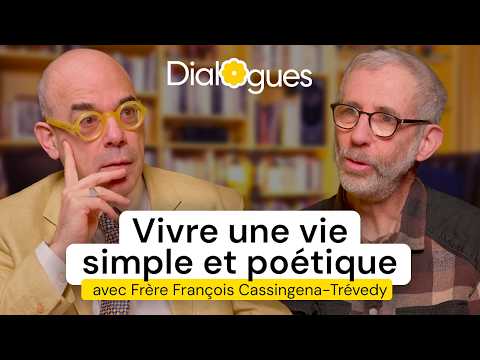
Paysan de Dieu - Dialogue avec Frère François Cassingena-Trévedy
AI Summary
In this dialogue, Frère François, a 66-year-old monk, shares his unique journey from a prestigious academic background in Paris to a life of austerity and manual labor in the Cantal region of France. Living without a car or television, he spends his days as a "peasant monk," milking cows and participating in the elementary tasks of farm life alongside local breeders. For him, the essence of human freedom is the ability to be the "poet of one's own existence," escaping the traps of consumption and career to embrace a life of internal gravity.
**Redefining Spirituality**
Frère François argues that spirituality is frequently misunderstood as religious rigidity or a flight from reality. In truth, it is a way of celebrating human existence within the most ordinary circumstances. It is not a "superior" level of life reserved for an elite, but a dimension internal to every act, from cooking and cleaning to social interactions. He illustrates this with the simple act of closing a door: the way a person handles a door reveals their inner state—whether they are inhabited by peace or violence. Learning to "close the door" is both a physical responsibility and a spiritual necessity for opening oneself to silence.
He also draws a sharp line between mercy and mediocrity. Spirituality is not about a vague, "nice" indulgence for everything. While a person always deserves mercy, the systems that damage life—such as hyper-consumption, violence, and ugliness—must be resisted with firmness. True spirituality is a form of resistance that protects what is vital and beautiful.
**The Three Traps of Modern Life**
The conversation identifies three major pitfalls that distract from a deep spiritual life:
1. **The Spectacular:** Modern society is obsessed with being seen and creating sensations. Frère François advocates for the "secret," referencing the biblical instruction to pray in one's room with the door closed. Spirituality is found in the humble, the small, and the invisible, rather than the sensational.
2. **Comfort:** He describes modern comfort as an "isolation booth" (isoloir) that prevents us from making contact with reality. By wrapping ourselves in comfort, we avoid the deep, necessary questions of existence. He suggests that seeking constant well-being is often the surest path to unhappiness because it de-vitalizes the human spirit.
3. **Escapism:** Many seek to flee the world, their bodies, or the present moment. However, the spiritual path requires being fully present "here and now," accepting the tragic and difficult aspects of life rather than trying to transcend them through fantasy.
**Finitude, Anguish, and Courage**
A central theme of the discussion is the role of finitude. Frère François notes that many people use religion as a "retirement insurance policy" for the afterlife to avoid the fear of death. He counters this by stating that spirituality must assume a degree of anguish. To exist is to have the courage to face one's own mortality and the insoluble questions of life.
He emphasizes that humans need three fundamentals to navigate this finitude: Rhythm, Rite, and Narrative. Without these, society falls into a state of "dispersion," where people confuse the urgent with the important. By establishing a regular rhythm of life and manual work, one can resist the "universal isolation" created by digital distractions and reclaim a sense of presence.
**The Art of Looking and Discovery**
To enter a spiritual experience, one must learn to truly "look." Frère François distinguishes between "exploring"—which he associates with conquest and possession—and "discovering," which is an opening to revelation. Looking is an active encounter where the light of the eye meets the light of the object. This quality of attention allows a person to find the marvelous within the ordinary, such as the bloom of a cherry tree or a shared gesture of work.
**Love and Vulnerability**
The monk offers a refined view of love, stripped of sentimentalism. To love is to respect the "otherness" of another person without trying to possess them. He notes that love involves preferences; it is not a vague, mandatory obligation but a sovereign right to choose what we cherish.
More importantly, he argues that the most difficult part of love is allowing oneself to be loved. This requires accepting one's own vulnerability. He points to the biblical encounter between Jesus and Peter after Peter’s betrayal: Jesus’s gaze does not judge but causes Peter to "melt," revealing his fragility. For Frère François, we are loved not for our power or "macho" qualities, but for our vulnerability.
**The Practice of Oraison (Silent Prayer)**
The dialogue concludes with the practice of *oraison*, or silent contemplation. Unlike utility-based meditation, *oraison* is about being "present for nothing." It is an "interstice"—a gap in the noise of modern life where one stops internal chatter to let a deeper presence emerge. He describes this as a "vital void," warning that the modern fear of silence is a profound infirmity. By "secreting" silence within oneself, a person can find "living water" even in a crowded, distracted world.
Ultimately, Frère François presents a spiritual path based on poverty, simplicity, and the rejection of "idols"—the things we domesticate and worship to feel secure. By embracing the "difficult happiness" of a frugal and attentive life, one can find a sense of fecundity and light even in the midst of the world’s challenges.