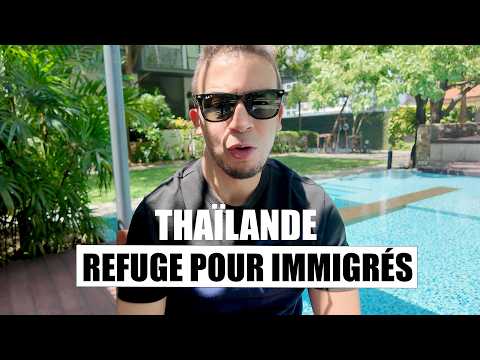
Pourquoi les riches fuient Dubaï et l'Europe pour la Thaïlande ( Iran, Ukraine...)
AI Summary
In this video, the speaker provides an insightful look into what he calls the "Thai Bubble," speaking directly from the heart of Bangkok. He describes a world where, while the rest of the planet seems to be teetering on the edge of major conflict and geopolitical instability, Thailand remains a unique sanctuary of calm. This "bubble" is not just a physical space but a psychological state of being that offers a total disconnection from the anxieties plaguing the Western world.
The speaker emphasizes that Thailand’s geographic position—roughly 11,000 kilometers away from the tensions in Europe and the Middle East—plays a massive role in this feeling of safety. This physical distance translates into a psychological buffer. He observes that the average Thai person is largely unconcerned with global geopolitics. Whether it is American military operations or the latest strikes in Iran, these events do not seem to penetrate the daily consciousness of the local population. Instead, people focus on their immediate lives, a mindset often associated with the "Sabai" lifestyle—a way of living that prioritizes comfort and avoids over-analyzing the future or "building castles in the air."
This stands in stark contrast to the atmosphere in Europe, which the speaker describes as being saturated with anxiety. In the West, turning on the television often leads to immediate stress. He points to Dubai as a recent counter-example; for years, it was marketed as an impenetrable, safe haven for investors. However, recent instabilities have caused a wave of panic, leading many to reconsider their investments and even flee the city. Thailand, by comparison, remains the "land of smiles," continuing to trade and live normally. For the speaker, Thailand has become the ultimate refuge from "Western psychosis"—a state of collective madness where no country seems to be working toward de-escalation.
The speaker shares a personal perspective as a father, expressing concern about the state of the planet and why some people today hesitate to bring children into a world ravaged by war and injustice. In this context, Thailand’s "bamboo diplomacy" is a key factor in its stability. The Thai government famously refuses to pick sides in global conflicts. They manage a delicate balance, conducting military exercises with the United States while simultaneously pushing for membership in the BRICS nations. Their primary goal is the protection of their own economy and national sovereignty, fueled by the historical pride of never having been colonized.
Information also moves differently in the Thai bubble. The speaker notes that news of global events often reaches the local population with a two-to-three-day delay. His own wife, for instance, might listen to news about international attacks with polite detachment, only fully processing the information days later. He argues that this "media silence" is actually a blessing for mental health. Constant exposure to 24-hour news cycles on channels like CNN or the BBC is designed to create a sense of resignation and fear. By living in Thailand, many expats and tourists undergo an involuntary "information detox," replacing screen time with real human encounters and a more present way of living.
The speaker’s father is a psychiatrist, and they often joke that a trip to Thailand should be prescribed as a medical treatment. In France, the speaker sees a rise in burnouts and psychiatric issues, and he believes the "curative" nature of the Thai environment—its smiles and its pace—could save many people. He advises those looking to emigrate to "widen the gap." Rather than moving to a nearby country like Portugal or Turkey, he suggests a total reset in a place like Southeast Asia or Mauritius. A significant geographic and cultural distance allows for a true "blank page" experience.
Culturally, Thailand offers constant stimulation. The speaker explains that even after nearly a decade in the country, he is still learning every day. To live well there, one must navigate various social layers, from the "Isan" farmers to the "Hi-So" (high society) bourgeoisie of Bangkok and the "Sino-Thai" communities. This requires an effort to learn the language and understand the subtle ways the society functions. While some retirees prefer to stay in "expat bubbles" with French restaurants and familiar friends, the speaker encourages a deeper immersion into the local culture.
Safety is another pillar of the Thai experience. The speaker compares Thailand to other popular destinations like Colombia or Brazil, noting that if safety is the primary concern, Southeast Asia is the clear winner. He shares an anecdote about working in coffee shops where he can leave thousands of euros worth of camera equipment unattended while he steps away, without any fear of theft. This level of security provides a mental clarity that is hard to find in Europe, where people often worry about being robbed or burglarized.
However, the speaker acknowledges that Thailand’s status as a "safe haven" is attracting "geopolitical refugees" from all over. He mentions a significant influx of Russians in Phuket and Koh Samui, and Israelis in Koh Phangan. This has led to a 20% to 30% explosion in real estate prices in certain areas. He also notes the presence of oligarchs who bring in millions, sometimes opening businesses that seem to serve more as fronts for money laundering than as genuine commercial enterprises.
Finally, the speaker highlights Thailand’s food independence as a source of its "untouchable" nature. While Europe worries about gas and wheat supplies, Thailand is a global powerhouse in exporting rice, poultry, and sugar. This self-sufficiency helps keep the cost of living relatively stable, even as global inflation impacts fuel prices. He concludes by warning that the dream of living in Thailand for 500 or 600 euros a month is a thing of the past. Expatriation is a privilege that requires serious financial planning and saving. He encourages those currently working in the West to begin preparing their own "refuge" and offers his professional services to assist in the transition to a more peaceful life in the Thai bubble.