How This Miracle Drug Disappeared Over Night
AI Summary
In 1996, a drug called ritonavir was introduced to treat HIV, rapidly becoming a miracle for patients. By 1998, 75,000 patients were taking up to 20 pills daily, transforming a fatal condition into a manageable one. Each batch of ritonavir capsules underwent rigorous quality control, including dissolution tests to ensure they dissolved within 30 minutes for proper absorption. For two years and 240 consecutive lots, the drug never failed.
However, an analyst discovered a capsule that did not dissolve properly, triggering an emergency shutdown. The entire batch was destroyed, and the production line was deep-cleaned to eliminate contamination. The next day, the same issue recurred: clear capsules turned white and cloudy. Technicians found the paste filled with millions of tiny, needle-like crystals, previously unseen. Attempts to recreate ritonavir in the lab also yielded cloudy, white paste, baffling researchers. Despite checking all ingredients, settings, temperatures, and procedures, everything appeared correct. Within a week, all ritonavir produced by both the lab and factory became cloudy.
Abbott had to halt production but couldn't cut off supply due to patient dependence. They leveraged extensive resources, conducting countless experiments, rebuilding facilities, and exploring alternative sites. An Italian factory was chosen, and initially, production there yielded pills that passed dissolution tests, suggesting the problem was localized to Chicago. A team of scientists traveled to Italy, meticulously comparing processes, but found no differences in pressure, temperature, humidity, or chemical weights.
Upon the Chicago team's return, they received a call from Italy: days after their visit, a tablet failed the dissolution test. The problem was spreading rapidly, contaminating every production site within weeks. They faced a rare disaster, a phenomenon where a drug or chemical compound "gets infected" and can become impossible to manufacture. This specific type of disaster, which spreads like a disease, meant that a drug that could be made one day might be gone forever the next. The terrifying aspect was its unpredictability—no one could forecast if, when, or to which compound it might happen.
The crystals found in the ritonavir capsules appeared to be a new compound, yet tests confirmed they were ritonavir. This seemed impossible, but a similar mystery had been debated 170 years prior by chemists Justus von Liebig and Friedrich Wöhler. Liebig, a respected but arrogant chemist, disputed Wöhler’s discovery of a compound made of one silver, one nitrogen, one oxygen, and one carbon, because his own compound with the exact same elemental composition behaved completely differently. Wöhler’s compound was a stable beige powder, while Liebig's was highly explosive. Their public scientific dispute lasted two years until they agreed to meet in Frankfurt to replicate each other's work.
To their astonishment, both were correct. They had discovered that a compound's properties are not solely determined by its elemental composition but also by the arrangement of those atoms. This led to the understanding of isomers. Today, techniques like infrared spectroscopy can identify these arrangements. Wöhler’s silver cyanate had two strong double bonds (carbon-nitrogen, nitrogen-oxygen), making it stable. Liebig’s silver fulminate, however, had a triple bond between carbon and nitrogen, and a very weak single bond between nitrogen and oxygen. This weak bond was easily broken, causing atoms to rearrange into stable gases, explaining its explosive nature.
Abbott’s scientists suspected a similar issue with ritonavir. Spectrometer analysis of the white paste showed the same peaks as ritonavir, indicating the same bonds. However, subtle deviations suggested a change in the arrangement of atoms or how the bonds moved. This phenomenon is called polymorphism, where a compound can exist in different crystal forms with varying properties, even with the same chemical composition.
A relatable example is chocolate. Shiny, snappy chocolate (Form V) melts around 34 degrees Celsius, while dull, soft chocolate (Form IV) melts around 27 degrees Celsius. Both are chocolate, but the cocoa butter molecules stack differently. Chocolate tempering is the art of controlling temperature and time to achieve the desired Form V crystals. Melting chocolate uncontrollably creates a mixture of forms. To temper chocolate, it's heated to 45-50 degrees Celsius to melt all crystals, then cooled to around 34 degrees Celsius to encourage Form V crystal formation, and further cooled to 27 degrees Celsius to promote rapid nucleation of various forms. By then raising the temperature slightly and holding it at 32 degrees Celsius, unwanted Form III and IV crystals melt, leaving abundant Form V. Finally, rapid cooling to 12 degrees Celsius locks in the desired crystal pattern.
For ritonavir, the needles under the microscope were a new, more stable polymorph: Form II. While still ritonavir, Form II was significantly less soluble than the original Form I, meaning it wouldn't dissolve properly in the body, rendering the drug ineffective. Unlike chocolate, where polymorphs can be switched, no amount of heating or cooling could convert ritonavir Form II back to Form I. This is explained by energy landscapes: Form II had a much deeper energy valley and a taller energy barrier to overcome to revert to Form I, essentially trapping it.
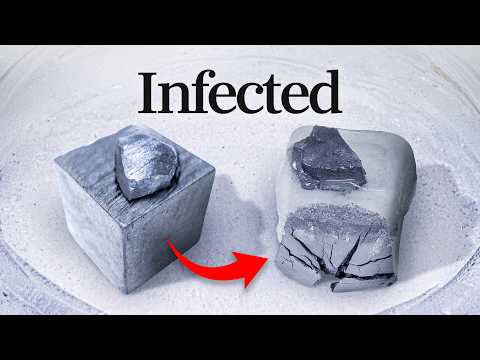
The critical question remained: why did Form II suddenly appear everywhere? Nothing in their procedures had changed. The answer lay in historical precedent, specifically the phenomenon of "tin pest." In bitter winters, organ pipes made of silver-colored tin would develop lesions and cracks, transforming into crumbly gray tin. This was not Satan's work but a polymorphic transformation. Below 13 degrees Celsius, silver tin can transform into gray tin. Crucially, once a tiny bit of gray tin forms, it acts as a nucleation site, drastically lowering the energy barrier for other silver tin to transform. This "infection" spreads, causing the tin to expand and tear itself apart.
The same mechanism explained ritonavir. Once a tiny bit of Form II appeared, it acted as a nucleation site, lowering the massive activation energy barrier and causing all Form I to crystallize into Form II. These tiny seed crystals could become airborne, contaminating production lines, equipment, and even people's clothes. When the Chicago team visited Italy, they unknowingly carried these seed crystals, infecting that factory too. Soon, no facility could produce Form I ritonavir.
Derek, from the YouTube channel Reactions, called ritonavir "arguably the most dramatic case of what we now call a disappearing polymorph." Abbott's thorough investigation couldn't conclusively pinpoint the initial cause. It might have been a production line mistake, creating a new crystal that acted as a seed, or simply bad luck. Experts note that dust particles or scratches in recipients can also induce different crystal structures. Once a more stable form appears, it can spread globally, making it impossible to retrieve the original polymorph.
Five months later, Abbott held a press conference, admitting they faced a "scientific and chemical impossibility." They emphasized that company size or scientific IQ had no bearing on the problem, describing it as an unpredictable phenomenon, a "mystery of nature" akin to hurricanes. They acknowledged that science couldn't solve all problems.
It turns out over half of all compounds are known to be polymorphic, and the number of discovered polymorphs often correlates with research investment. There are now at least five known forms of ritonavir. While rare, disappearing polymorphs remain a concern. The ritonavir incident spurred significant regulatory and scientific activity around polymorphs, highlighting the need for extensive screening.
Ultimately, Form I ritonavir could not be recovered successfully. Attempts were costly and risked re-infection. Abbott reverted to an older, liquid formulation of the drug, abandoning Form I entirely. While not ideal due to worse side effects, it served as a crucial safety net. The incident underscored the frightening possibility of any essential drug suddenly disappearing without an alternative.