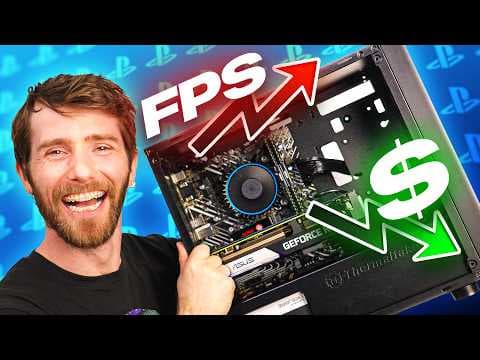
I Built a PS5-Killer PC... and Sony HELPED!
Audio Summary
AI Summary
Sony has recently implemented the largest price increase ever seen for a console, affecting the PS5 family. This move makes affordable gaming more challenging, but there are alternative solutions. One option is exploring the robust market for secondhand PS5s, as millions of these consoles are available, leading to potential deals. This trend is expected to continue throughout the current console generation.
Another viable alternative is building a PC, which can outperform a PS5 at its new price point, even with current market conditions. However, there are obstacles to consider, primarily RAM pricing, which remains high due to the demands of AI data centers. Not all RAM has been equally affected; DDR4 is still a relevant option, especially less desirable kits, and CPUs from just one platform ago can support it.
The build starts with an Intel Core i5 12400F, priced at $83. This CPU is readily available in secondary markets due to Intel's decreased appeal to gamers and their quiet dominance in CPU market volume, resulting in suppressed demand. While it has two fewer cores than an equivalent AMD chip or the PS5, its modern architecture and 4.4 GHz turbo speed compensate for this.
Intel motherboards typically come at a higher price, but opting for a used budget chipset motherboard, like the ASUS Prime H610M MATX, can be found for under $50. These budget motherboards have significantly improved in recent generations, supporting 12th-gen CPUs and even 14th-gen upgrades. Intel's low-end chipsets now also support XMPP, allowing users to maximize non-ECC memory kits. For example, a 16GB kit of Corsair Vengeance LPX at 3200 MT/s was acquired for about $60, a decision made due to the substantial price jump for 3600 MT/s memory.
Global shipping costs are a concern, but a "Shiptorm" promotion offers free shipping on ltdstore.com for orders over $150 in the US and Canada or $225 worldwide from April 24th to May 7th. A lower free shipping threshold is available for supporter plus tier members at flowplane.com.
Beyond RAM, SSD prices are also challenging, and their recovery might take longer. A 1TB DRAM-less SSD was purchased for $100, though it's considered worth closer to $50. However, patience can uncover better deals, and storage is easily upgradable or expandable thanks to improved entry-level motherboards with multiple M.2 slots. Savings could also be achieved by opting for a SATA SSD or a smaller SSD combined with a larger hard drive, though this would be an unfair comparison to the PS5.
A used case, like a battle-worn ThermalTake Versus 17 with missing parts, was acquired for under $10, proving sufficient when compared to the PS5. For cooling, while the 12400F includes a stock cooler, secondhand units often lack it. Replacements can be found for around $5. A 500W Thermaltake Smart 500 power supply, costing not much more, is adequate for the build.
A potential pitfall of buying secondhand hardware was encountered with a damaged USB3 header on the motherboard, highlighting the risks.
The most critical component, the GPU, was initially considered to be an Intel B580. However, after reviewing availability and performance, a better option was sought. While an AMD 6600 XT-level performance would match the PS5, GPU pricing has been improving. Nvidia's 3000 series, specifically the RTX 3070, offers excellent gaming performance for $215. This series is new enough for appealing features but old enough to be less attractive to AI professionals, benefiting gamers.
The total cost for this PC build came to $544, leaving enough budget for a new Gamester Cyclone 2 controller or a used DualSense controller.
In performance testing with games like "God of War Ragnarok," the PC build demonstrated comparable or superior visual quality, especially with DLSS enabled. HDR configuration was a point of difference, with the PC requiring manual setup for optimal display. Some flickering and texture issues were observed on the PC, potentially due to VRAM limitations at a distance, suggesting the need for in-game setting adjustments.
In "Returnal," the PS5 initially showed significantly better visuals and smoother performance, with the PC experiencing substantial FPS dips. Adjusting PC settings to medium improved performance and maintained sharpness, though not reaching a consistent 60 FPS in complex environments.
In "Death Stranding," the PC loaded slightly slower but, after adjustments to medium settings and turning off motion blur, achieved over 60 FPS and noticeably sharper visuals than the PS5. The PS5, however, seemed to handle the level of detail better in the distance. Close-up, the PC's character detail, particularly hair, was superior.
The conclusion is that the PC build offers equal or greater performance for less money than the new PS5 price. However, the advantage of secondhand hardware is acknowledged, and it's noted that secondhand and even new PS5s often sell below the new retail price.
The new PS5 price increase might be a strategic move by Sony to allow for significant discounts later, encouraging purchases, or to test the market for future console pricing, such as the PS6. Sony's challenges with RAM and SSD costs for their SoC production are also a factor.
Regarding DDR5, upgrading the system to DDR5 would add about $150, making it too expensive for the budget. DDR4 remains the better option for now, though DDR5 prices may decrease in the future.
The discussion also touched on game pricing. While PC gaming is often praised for Steam sales, PlayStation also offers similar sales for older games. Concerns were raised about Sony's strategy to extract more from its current audience, potentially through higher game prices or new hardware, and their renewed focus on exclusives to drive PS5 sales, moving away from PC ports.
Despite the price increase, the PS5 remains competitive, especially if willing to buy used or open-box. A special edition PS5 was acquired for $380 US, demonstrating that good deals are still available.
Ultimately, building a budget PC rig is still possible, even without the latest features, providing access to tens of thousands of games. This approach reminds gamers that enjoyable experiences don't always require the newest hardware or hype. Upcoming games like "Alabaster John" and a new "Castlevania" can be enjoyed on this PC or a secondhand PS5.
The video also includes a recurring segment about ODO, a sponsor offering an all-in-one business solution with apps for invoicing, inventory, CRM, and more, available with a free 15-day trial. The hosts then discuss other budget PC builds they've created, including a recent