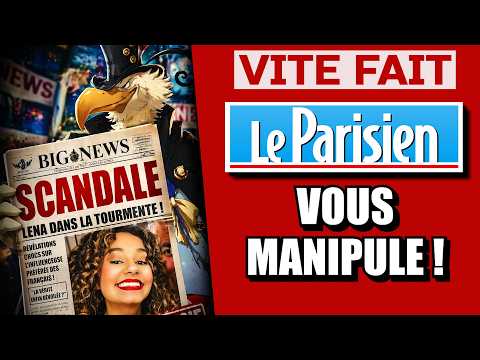
L’étrange point commun entre Léna Situation et les drones Russes !
AI Summary
This video discusses the questionable methods employed by the French newspaper *Le Parisien* to generate clicks, sell advertising, and promote narratives, particularly in an era where mainstream media outlets are struggling financially. The speaker highlights how these outlets, despite receiving substantial public and private subsidies, resort to manipulative tactics to maintain influence and justify continued funding from their billionaire owners, who often use media ownership to indirectly sway politicians.
The core argument is that *Le Parisien* uses "allusion" to spread misinformation and incite strong emotional reactions without being directly accountable for false claims. This technique involves crafting headlines and articles that strongly imply a certain narrative, allowing readers to draw incorrect conclusions, which the newspaper can then disavow by claiming the public "misunderstood." This approach is presented as a way to produce "conspiracy theories" and "fake news" without direct culpability.
Two specific examples are provided to illustrate this method.
The first example concerns influencer Lena Situation and her father. A headline from *Le Parisien* announced, "Debts have accumulated. Lena Situation’s father calls for donations to save a puppet company." This was accompanied by a photo of Lena and her father, leading many to believe that Lena, a wealthy influencer, was asking for public donations for her father’s company. The article itself, while detailing the financial struggles of a puppet theater company that Lena’s father is part of, carefully avoids stating that Lena herself made an appeal for donations. It mentions her father's long-standing collaboration with the company and an appeal video featuring all the troupe members, including her father.
However, the article uses suggestive language and selective information. For instance, it notes that Lena "made it known" that the company was in financial difficulty, and that the donation video was "liked more than 41,000 times, including by Lena." Crucially, it includes a quote from Lena about her father's involvement with the troupe, but this quote is revealed to be from 2021, completely unrelated to the current fundraising effort. The speaker emphasizes that Lena merely "liked" a video featuring her father on social media and did not create any content or message promoting the fundraiser.
This subtle manipulation led to a significant backlash online, with users criticizing Lena for seemingly asking for donations despite her wealth. Comments expressed outrage, calling it "scandalous" and questioning why a "millionaire's daughter" would need public donations for her father's "company." The speaker points out that the public inferred Lena's direct involvement based on the suggestive presentation, not on explicit statements by *Le Parisien*.
The day after the initial article, *Le Parisien* published a follow-up titled, "Lena Situation justifies herself after her father's call for donations." This article acknowledged Lena's reaction to the criticism and more clearly distinguished between her father’s role (as an employee of an association) and Lena herself. Lena clarified on social media (in a now-deleted post) that her father lent his image like other actors for a video to help a struggling theater troupe, which is an association, not his private business. She also stated that she had personally donated money to the association.
The speaker concludes that *Le Parisien* deliberately created this "shitstorm" through allusion, generating clicks and online engagement by inciting hatred against Lena based on a misleading narrative. The newspaper profited from the controversy, effectively selling advertising space on its website, while ostensibly appearing to report on actual events. The speaker also highlights the financial distinction between Lena’s personal wealth and her business, and the ethical implications of suggesting she should bankroll her father’s activities.
The second example concerns alleged Russian drone attacks in NATO countries. A headline read, "A Russian drone hits a chimney. A drone from Russia or an amalgamation. A drone from Russia hits the chimney of a power plant in Estonia. Another crashes in Latvia." The speaker notes that similar claims about Russian drones invading NATO airspace have been debunked in the past, often turning out to be civilian drones or misinterpretations.
Upon examining the article, the speaker reveals the same pattern of allusion. While the headline strongly implies a Russian military attack, the body of the article contains contradictory information. It states, "The Russian drone that fell in Latvia was likely Ukrainian," and mentions that "Kyiv had carried out numerous strikes on Russia overnight." The article becomes deliberately confusing, alternating between "drone from Russian territory" and "Ukrainian drone," leaving the reader uncertain about the origin and nature of the incidents.
For example, it mentions that Estonian and Latvian authorities indicated the drones "came from Russian territory," but then quotes the Prime Minister stating the drone in Latvia was "likely Ukrainian." It further introduces a third event involving a Ukrainian drone crashing in Lithuania, framing it all within the context of Ukrainian strikes on Russian targets. Despite the evidence pointing to Ukrainian drones, the article concludes by attributing these incidents to "the effects of Russia's large-scale war of aggression," suggesting Russian culpability even when Ukrainian drones are involved.
The speaker argues that *Le Parisien* uses allusion to suggest Russia attacked a NATO country, a claim that is "totally false" and based on Ukrainian drones crashing, sometimes after being shot down by Russia. This again serves to generate clicks and promote a specific "war propaganda" narrative by playing on public fears and emotions, while skirting legal responsibility for outright falsehoods.
In conclusion, the speaker asserts that *Le Parisien*, and by extension other mainstream media, exploit the limits of the law by using "allusion" to spread misleading information, incite hatred, and serve propaganda purposes, all under the guise of combating "conspiracy theories" and providing quality information. The speaker advises readers to be cautious, avoid reacting too quickly to emotionally charged information, read beyond headlines, and support independent journalism as a counter to such manipulative practices.