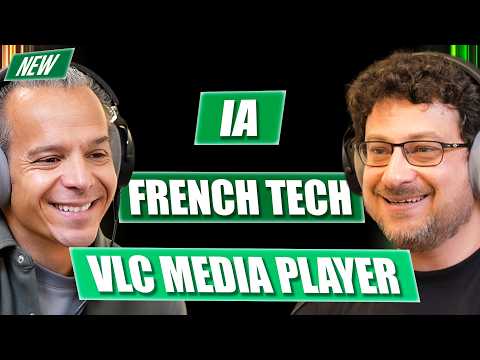
VLC, le logiciel français le plus utilisé au MONDE
AI Summary
Jean-Baptiste Kempf, the president of the French non-profit VideoLAN and founder of several tech companies, including Kyber, discusses the journey of VLC, the world's most used yet least profitable open-source video player, and his vision for the future of remote machine control with Kyber.
VLC's origins trace back to the 1960s at the École Centrale des Arts et Manufactures, evolving from a student project focused on video streaming over local networks. Initially part of the "Via Central Réseau" association, the VideoLAN client (VLC) project gained traction in the early 2000s. Its key differentiator was its ability to play virtually any media format out-of-the-box, a stark contrast to the cumbersome codec pack installations required by other players at the time. This, combined with its open-source nature and cross-platform compatibility, propelled its global adoption. Despite its massive user base, VLC operates on donations, generating a modest €40,000-€60,000 annually, a testament to its non-profit, association loi 1901 structure. Kempf highlights that the iconic orange traffic cone logo, a student prank, has become inseparable from VLC's identity.
Kempf's entrepreneurial journey extends beyond VLC. He founded Videolabs in 2012 to support VLC development and offer external R&D services, primarily to large tech companies like Google, Amazon, and Netflix, leveraging VLC's powerful multimedia framework. He also established FFLABS, specializing in FFmpeg processing for major clients, and Codeclabs for niche legal and technical contracts. His experience includes a stint as CTO of Shadow, a cloud gaming startup, where he gained invaluable insights into business turnaround strategies, even collaborating with prominent figures like Xavier Niel. This experience, along with his time as VP of Engineering at Vente Privée and CTO at Scaleway, has shaped his understanding of building and scaling tech companies.
A central theme in Kempf's philosophy is the importance of understanding foundational principles. He advocates for returning to the basics of how computers work, from transistors to logic gates, emphasizing that a deep understanding of the underlying technology is crucial for innovation, especially in the age of AI. This belief stems from his early exposure to computing and his experiences at École Centrale, where he pursued a master's in computer architecture.
Kempf's latest venture, Kyber, aims to revolutionize remote machine control by minimizing latency. Kyber is designed to facilitate seamless interaction with a wide range of autonomous and semi-autonomous machines, including drones, robots, and even surgical robots. The platform handles not just video but also audio, sensor data, and control commands, enabling real-time monitoring and remote operation. Kempf envisions Kyber as a tool to bridge the physical distance between humans and machines, making complex remote operations feel as intuitive as local control. He sees significant applications in various sectors, from industrial automation and advanced manufacturing to healthcare and defense, and even in everyday scenarios like remote elderly care monitoring.
Kempf also touches upon the challenges faced by open-source projects, including legal battles with entities like Dolby and navigating complex patent landscapes. He recounts instances of malicious actors attempting to distribute fake VLC versions for cyberattacks, highlighting the constant vigilance required to protect the software and its users. He emphasizes a strong moral compass in his business dealings, including rejecting lucrative acquisition offers for VLC if they compromised its open-source ethos and accessibility.
Throughout the discussion, Kempf underscores the value of learning, adaptability, and a proactive approach. He advocates for embracing AI as a tool for augmentation rather than fearing it, stressing the importance of mastering new technologies to remain competitive. His personal approach to problem-solving involves deep dives into understanding every aspect of a system, a trait he attributes to his early experiences and a continuous desire for knowledge. This has led him to develop a highly automated lifestyle and a rigorous recruitment process focused on identifying individuals who complement his strengths and are aligned with his vision. He also shares his personal philosophies on leadership, delegation, and the importance of self-awareness, recognizing that while he excels at initiating projects and understanding complex systems, effective management and delegation are crucial for scaling.
The conversation also delves into the evolving landscape of tech entrepreneurship, the role of venture capital, and the rise of "deep tech" companies focused on foundational technological advancements. Kempf expresses a preference for complex, software-driven solutions that address fundamental infrastructure needs, contrasting them with simpler SaaS models that might be more vulnerable to disruption by AI. He highlights the growing importance of French and European tech initiatives in areas like sovereign cloud and AI, seeing significant potential for innovation and growth in these sectors. Finally, Kempf shares his personal mantras for success: continuous learning, embracing challenges, and maintaining a strong moral compass.