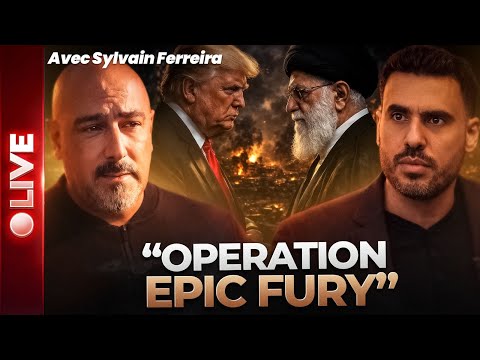
Opération Fureur Epique: Vraie Guerre ou Guerre-Spectacle?
AI Summary
This summary provides an analysis of the discussion between host Idris and strategic analyst Sylvain Ferreira regarding the sudden escalation of military operations against Iran, referred to in the transcript as "Operation Epic Fury" or "Lion’s Roar."
**The Outbreak of Official Conflict**
The discussion begins by noting that the conflict between the United States, Israel, and Iran has moved from unofficial tension to an official armed confrontation. A tragic opening note is the confirmation of an Israeli strike on a girls' school in Iran, which resulted in the deaths of 85 children. This event sets a grim tone for what Ferreira describes as a transition from "spectacle war" to "real war." The operation is steeped in symbolism; it was launched on the 11th day of the 9th month (9/11 in the American calendar), which corresponds to the 11th day of Ramadan. Furthermore, the Israeli name for the mission, "Lion’s Roar," invokes the historical symbol of the Iranian monarchy, hinting at a long-term goal of regime change.
**Military Retaliation and Intelligence**
Contrary to some expectations of a one-sided campaign, Iran has demonstrated a sophisticated and rapid retaliatory capability. Ferreira highlights that Iran successfully targeted high-value US and Israeli assets, including command-and-control centers (C4ISR), radar installations, and the headquarters of the elite Unit 8200. These strikes occurred in Iraq, Qatar, and even the United Arab Emirates, where targets like the Palm Jumeirah and Abu Dhabi terminals were hit.
A significant insight provided is the role of China, which appears to have shared millimetric-precision intelligence with Tehran to facilitate these strikes. On the American side, the USS Gerald Ford reportedly suffered internal sabotage—clogged toilets and passive protests by sailors—reflecting a deep exhaustion and a lack of desire for a new Middle Eastern war among US service members.
**The Trump Dilemma and the Epstein Factor**
A central theme of the analysis is the surprising shift in Donald Trump’s behavior. Having previously campaigned on a platform of avoiding foreign wars, Trump’s decision to launch "Epic Fury" is seen as a potential "political suicide." Ferreira and Idris explore the theory that Trump may be under extreme duress. They note that unsealed documents related to the Jeffrey Epstein case have resurfaced, potentially containing compromising material (compromat) used by Israeli intelligence to blackmail Trump into supporting Prime Minister Netanyahu’s agenda. Trump’s recent public appearance—wearing a USA hat in a somber, poorly lit setting—is described as "lugubrious" and uncharacteristic, suggesting he is acting against his own political instincts.
**Internal Iranian Dynamics and Potential Betrayal**
The analysts argue that air strikes alone cannot win an existential war or force regime change. However, they suggest that the "endgame" may rely on internal Iranian fractures. The Iranian elite is divided between those who have profited from Western sanctions and those who have been economically ruined. Ferreira suggests that "Operation Epic Fury" might be designed to empower disgruntled members of the Iranian oligarchy to stage a coup.
The most explosive claim discussed is the reported death of the Supreme Leader, Ayatollah Khamenei, and the Iranian President. While Israel claims these leaders have been eliminated, Iran has remained largely silent, though some officials have appeared on US networks like NBC to downplay the losses. If Khamenei is indeed dead, the power vacuum could lead to a rapid transition of power to a more "moderate" or Western-aligned faction, potentially led by figures like Pezeshkian, provided they survived the initial strikes.
**Geopolitical and Economic Consequences**
The conflict has immediate global repercussions. Iran has announced the closure of the Strait of Hormuz. While this is currently a "reversible" diplomatic threat, Ferreira warns that if Iran physically blocks the strait by sinking ships or laying mines, the war will become long and irreversible. This would drive oil prices to $120 per barrel or higher, providing a massive financial windfall for Russia and crippling Western economies.
Furthermore, the "MAGA" base in the US is showing signs of deep fracture. Influential voices like Tucker Carlson and Glenn Greenwald are openly criticizing Trump for betraying his anti-war promises. The analysts suggest that unless the conflict ends with a "miraculous" and immediate regime change by Monday, Trump’s political legacy and the future of the MAGA movement are in jeopardy.
**Conclusion: A "Spectacle" or a Catastrophe?**
The discussion concludes with two possible scenarios. The first is a "spectacle war" outcome, where the elimination of Khamenei allows for a quick diplomatic "Happy Ending" that secures the US midterms and stabilizes markets. The second is a "real war" scenario, characterized by a bloody Iranian civil war and a prolonged regional conflict that draws in the "nations by their hair." The analysts remain cautious, noting that while the signs of a "spectacle" are present—such as the Friday night timing intended to minimize market impact—the high civilian death toll and the intensity of Iranian retaliation suggest the situation could easily spiral into a global catastrophe. The next 48 hours will determine if Trump has performed a masterstroke of "boxe de l'ivrogne" (drunkard’s boxing) or if he has led the world into a third world war.