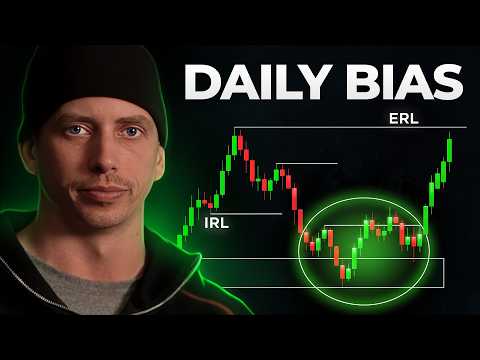
How Smart Money Traders Find Market Direction Every Single Day
AI Summary
Most bad trades occur because traders ignore or fail to check the high timeframe bias, even if the setup looks good on their trading timeframe. High timeframe bias is the most crucial filter in trading, distinguishing profitable traders from unprofitable ones. This video provides a repeatable process to determine market direction before looking for an entry.
High timeframe bias is essentially a directional filter. Before checking a 5-minute or 1-minute chart for entries, you must establish whether the asset is bullish or bearish based on higher timeframes. This dictates all subsequent trading decisions.
Think of timeframes as a hierarchy, like Russian dolls. The weekly chart provides the macro direction, indicating price movement over weeks or months. The daily chart shows major swings and trend information over several weeks. The 4-hour chart reveals the local trend over days or weeks. Timeframes below this, such as the 1-hour or 15-minute, are considered entry timeframes.
The key is to work from top to bottom. Before considering an entry on a 15-minute chart, you need to understand what the weekly, daily, and 4-hour charts are doing. If your 1-hour setup is a long position, but the weekly, daily, and 4-hour charts are all bearish, it's a bad trade. Trades should align the high timeframe bias with the low timeframe bias. The highest timeframe acts as the "boss"; its direction dictates your bias. If the weekly and daily are bearish, you look for shorts on your entry timeframes, regardless of any uptrend on a 15-minute chart.
For this series, the hierarchy will be weekly, daily, 4-hour, 1-hour, and 15-minute for entries. The principle applies as long as you use multiple timeframes in a top-down manner. The highest timeframes dictate your bias, which then influences your entry timeframe. This top-down analysis is paramount.
To determine high timeframe bias, start with the weekly chart. For example, if the weekly shows higher lows and higher highs, breaking market structure to the upside, it's safe to say the weekly is bullish. This takes only a moment, applying concepts like higher highs and higher lows. If price pulls back, it's assumed to be a higher low, not a full reversal, due to the bullish weekly bias.
Next, move to the daily chart. This chart might appear bearish, showing lower highs and lower lows, indicating a downtrend. However, within the context of a bullish weekly, this daily downtrend is likely just a pullback. The question then becomes: is this a significant reversal, or just a pullback within the larger weekly uptrend? Knowing the weekly is bullish gives confidence that the daily's bearish movement is temporary.
Now, consider the weekly dealing range. If price is below the equilibrium (EQ) of the weekly range, it's in a discount. This is the highest probability area for the daily chart to flip bullish and align with the weekly uptrend. So, instead of getting bearish with the daily pullback, you anticipate a higher low and continuation of the uptrend. You'd look for clues like a market structure shift on the daily, moving from lower highs and lows to higher highs and lows, indicating a turn.
Liquidity also plays a role. If internal range liquidity has been taken out during the pullback, the next target is likely external range liquidity. If the daily is in a discount, and internal range liquidity has been taken, the next target is probably external. This alignment of dealing range, liquidity, and high timeframe bias provides confidence for high-probability setups.
This top-down framework involves:
1. Identifying the high timeframe structure or trend.
2. Determining where price is within the dealing range (premium or discount).
3. Using liquidity to inform the narrative (what liquidity was just taken, and what's next).
This process helps avoid guessing and provides a clear direction.
The most important question in trading is: where is price going? This question is answered by liquidity. Price constantly oscillates between internal and external liquidity, and between buy-side and sell-side liquidity. If you can identify the most likely liquidity pool to be hit next, you have a trade idea. If you can't, you don't have a valid setup.
Risk-reward ratio is also critical. Even if the high timeframe bias aligns, the trade must offer asymmetric risk-reward in your favor (e.g., 2:1 or 3:1). If the potential loss is significantly greater than the potential gain, it's not a positive risk-reward trade, and you should not take it.
Here's a checklist for every trade:
1. **High Timeframe Market Structure:** Is it bullish or bearish? (e.g., higher highs/lows for bullish).
2. **Dealing Range:** Are we in a premium, discount, or at equilibrium? For longs, you want to be in a discount.
3. **Liquidity:** What liquidity just got taken out (internal/external, buy-side/sell-side), and what's the next target? For longs, after taking internal, you target external (buy-side).
4. **Entry Model:** (To be covered in future videos).
All four points must be checked before taking a trade. If even one is missing, the trade should be filtered out. This rigorous filtering process eliminates bad trades and increases the probability of successful ones.
Let's apply this to a real chart example with Bitcoin on the weekly.
1. **Weekly Market Structure:** Clear higher highs and higher lows, indicating a bullish trend. During pullbacks, you understand this is within a bullish context, not a reversal.
2. **Daily Dealing Range:** Within the weekly uptrend, the daily chart might show a pullback, appearing bearish. Identify the daily dealing range's swing low and high. If price is below the EQ, it's in a discount.
3. **Liquidity:** On the daily, if internal range liquidity (e.g., lows, fair value gaps) has been taken out within the discount, the next target is likely external range liquidity (e.g., buy-side liquidity at the top of the range). This aligns with the weekly's target.
When all these factors align—bullish weekly, daily in discount, internal liquidity taken, external liquidity as target—it creates a high-probability setup. Even if the daily temporarily looks bearish, the higher timeframe bias frames it as a pullback, not a full reversal. This allows you to identify the strong, long-term moves that align with the overall market direction.
**Three Key Takeaways:**
1. **Dial in your High Timeframe Bias:** This is your best filter. If your low timeframe trade doesn't match, it won't work consistently. Use a top-down, hierarchical approach.
2. **Use the Checklist:** High timeframe bias, dealing range, liquidity, and entry model. All four must be checked. This will lead to fewer, but higher-probability, trades.
3. **Repeat Regularly:** Re-evaluate your high timeframe bias frequently (daily, weekly, or after any significant market structure shift). This ensures your bias remains current.
This foundational knowledge of market structure, liquidity, dealing ranges, and high timeframe bias is essential before moving into more advanced concepts like fair value gaps and order blocks. Consistent application of this checklist and disciplined filtering will significantly improve trading performance.