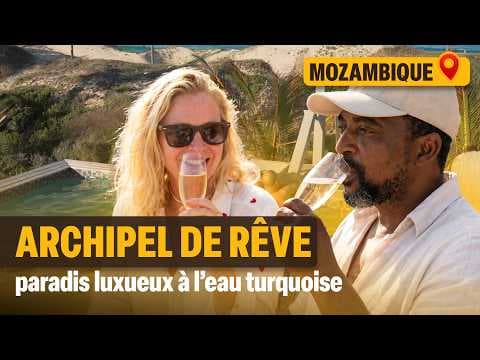
Mozambique : l’archipel secret à 10 000€ LA NUIT
Audio Summary
AI Summary
The Bazaruto archipelago, off the coast of Mozambique, offers breathtaking turquoise waters, pristine white sandy beaches, and largely preserved nature. European tourists travel over 8,000 km to visit this small paradise. Upon arrival, they are greeted by dugongs, emblematic mammals of the archipelago, measuring up to 4 meters long. Around 250 dugongs live in these waters, a rare sight on African coasts. This abundance is no accident; the archipelago has been a protected marine area since 1971, making it a unique diving spot where fishing is restricted. Visitors can immerse themselves in one of the world's best-preserved ecosystems, encountering turtles and even sharks.
From the highest point of Bazaruto, the splendid blue ocean, white sand, and incredibly green island create a stunning panorama. However, this Eden comes at a price, with luxury hotels costing up to $10,000 per night for a suite with a view, private beachside pool, and designer furnishings. These establishments represent just one aspect of Mozambique's largely underexploited tourism potential. With over 2,500 km of white sand beaches along the Indian Ocean, a pleasant climate almost year-round, and both land and water safaris, Mozambique has all the ingredients of a postcard destination. Yet, it attracts barely a million tourists annually.
The country aims to increase tourism's contribution to its GDP from 4% to 6% by the end of the decade, projecting 8,000 new jobs by 2029, bringing the total to 22,000. This includes creating lodges, restaurants, and natural preservation efforts.
Less than two hours from the capital, the Maputo National Park is a flagship attraction, offering rare sightings of large marine and terrestrial mammals. Today, over 400 elephants roam the region alongside giraffes and zebras. Just a few years ago, this was unimaginable due to a 16-year civil war that decimated animal populations. Species like buffalo, antelope, elk, impala, and waterbuck had to be reintroduced, a process that required significant resources, including rangers. Fifteen years after reintroduction began, the 1,700-hectare park now hosts over 13,000 animals. The park director views this as an ecological and tourism success, attracting many visitors. While the primary goal was ecological balance, the park now offers a desirable product for tourists.
A safari day costs at least 150,000 francs, and the park welcomes between 800 and 2,000 visitors monthly. While this is far less than neighboring countries' major parks, visits are growing by an average of 20% annually, pushing the park towards financial equilibrium. Rangers monitor animals using GPS collars to ensure their well-being and maintain the electric fence enclosing most of the park, repairing damage caused by elephants.
The lush environment is a key asset for Mozambican tourism. Eco-lodges, built in harmony with nature using local materials like mapira (palm leaves) for roofs, exemplify this approach. A night in such a tranquil setting costs around 110,000 francs. Visitors, particularly during winter holidays, appreciate the calm. Operating in remote areas, several kilometers from paved roads, requires autonomous systems like solar panels (28 at one lodge) and batteries for electricity and water pumps. A lodge investment can exceed 300 million CFA francs.
Angela Nauman, co-founder of a lodge, emphasizes the importance of local support for such projects in pristine nature. She and her partners trained and hired about fifteen people from nearby villages. She believes Mozambique will become a top destination, stressing that local inclusion is crucial for success and that concrete pylons, for example, would not integrate with the landscape or be accepted by the community.
Further south, in Bara, Inhambane province, a French couple opened a restaurant over a decade ago. They prioritize local ingredients, with fresh seafood delivered directly to the beach by local fishermen using the restaurant's boat and motor. Signature dishes, averaging 15,000 to 20,000 francs, use fresh produce from their gardener, reducing reliance on imports. Tourists and regulars are delighted, praising the fresh seafood and beachfront location.
While customers believe more could be done to promote Mozambique, noting travel difficulties and expensive domestic flights, they are optimistic about tourism growth. One regular states, "When I see the development of the coast and all the money being invested, it will become a paradise."
Mozambican authorities are also facilitating entry by lifting visa requirements for citizens of 20 countries, including the US, Canada, France, and Japan, to attract more non-African tourists and position the country as a leading destination.
Off the Tanzanian coast, the Zanzibar archipelago, with its 75 idyllic islands, is world-renowned. Nearly 400,000 tourists annually visit its white sand beaches and crystal-clear waters, home to rich biodiversity, including a protected coral reef where fishing is restricted. Dolphins are a major attraction.
Beyond its picturesque landscapes, Zanzibar's other treasure lies inland: spices, particularly cloves. Cloves were Zanzibar's "black gold" and primary resource until tourism developed 30 years ago. Today, it still supports over 6,000 farmers and their families, with cloves exported globally, fetching up to €80 per kilo in Europe.
The journey to discover Zanzibar's cloves begins on Pemba Island, an hour's flight from Stone Town, Zanzibar's capital. Pemba hosts most of the archipelago's clove plantations, small plots cultivated by some 6,000 farmers. Isa, a 67-year-old farmer, maintains about 300 clove trees, inherited from his grandfather. These trees can grow up to 20 meters tall and yield up to 6 kg of cloves annually. The perilous harvest, requiring climbing high to pick the spice, is four months away. Isa spends long hours tending his trees, which provide his family's modest income. While he also grows coconuts, pineapples, cassava, jackfruit, and mangoes, cloves are his most lucrative crop. He hopes to plant more but needs more money. A good harvest can earn him 3 to 4 million CFA francs annually.
After harvest, cloves are transported to the village, sorted by families, and dried for 2-3 days before being sold to the government, which handles global export. The cloves then move to Unguja, the largest island, and Stone Town, its capital.
Stone Town prospered from the 19th century spice trade between Africa, Europe, and Asia, with its buildings reflecting this glorious past. Oman's Sultan introduced the first clove trees, making Zanzibar the world's top