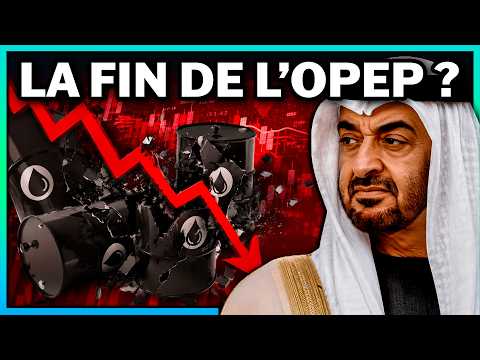
🛢️ L'OPEP vient tout juste de s'effondrer ! (c'est pire que vous l'imaginez)
AI Summary
The UAE has formally left OPEC after 60 years of cooperation, an announcement that went largely unnoticed due to global focus on the US-Iran standoff. This departure, however, is not a snap decision but the culmination of years of simmering resentment. The UAE felt OPEC’s rules no longer served its interests and were costing it tens of billions of dollars annually. Furthermore, Abu Dhabi was angered by the lack of support from other Gulf countries against Iranian strikes. Just before the announcement, Anwar Gargash, an Emirati presidential advisor, publicly expressed disappointment with the Gulf Cooperation Council.
The UAE’s exit means OPEC loses a significant member capable of influencing global oil supply, as the Emirates accounted for 5% of global production before the crisis. This could mark the beginning of the end for the powerful energy cartel, leaving Saudi Crown Prince Mohammed bin Salman to bear the burden of sacrifice alone.
The UAE, a member of OPEC since 1967, has dramatically increased its production capacity, investing $127 billion between 2022-2026 and projecting another $150 billion for 2026-2030. Their production capacity now nears 5 million barrels per day, with plans for even more by 2027. However, OPEC quotas capped Emirati production at 3.4 million barrels per day, resulting in a daily loss of 1.3 million barrels, or over $100 million, amounting to nearly $40 billion annually. Abu Dhabi recognizes the ongoing energy transition and the eventual plateauing of oil demand, making every un-sold barrel a potential future loss. Adhering to cartel discipline that hindered returns on investment became untenable. The Emirati energy minister stated their future efforts would focus on national interest.
Beyond quotas, the UAE has been under repeated Iranian missile and drone attacks since late February. While Abu Dhabi intercepts and retaliates, Dubai, a global economic hub, has seen slowed activity. The lack of support from neighboring Gulf countries, including Saudi Arabia, Qatar, and Kuwait, has fueled Emirati frustration. The GCC, meant to embody solidarity among oil monarchies, has only condemned the attacks. Gargash's public disappointment with the GCC's weakness underscored the sentiment: if support isn't offered during attacks, then oil solidarity cannot be expected.
The UAE's departure is particularly impactful because, alongside Saudi Arabia, it formed the duo with significant reserve capacities, a mechanism OPEC used to influence prices. Now, Riyadh is left to shoulder this role alone. While other members like Qatar, Ecuador, and Angola have left before, the UAE's scale is different. Qatar produced 600,000 barrels per day, Angola 1 million, but the UAE boasts nearly 5 million barrels of capacity, low extraction costs, and a minimal carbon footprint per barrel.
Without Abu Dhabi, OPEC will shrink to 8 active members, controlling only 40% of global production, down from over 50% fifty years ago. The real danger isn’t just losing a large member, but the signal it sends. Several countries, like Iraq, Kazakhstan, and Nigeria, already flout their quotas. The UAE has demonstrated that leaving the cartel for free production and profit, without reprisal, is viable. The question will soon shift from who leaves to who stays and why. Saudi Arabia cannot sustain the role of sole regulator indefinitely, cutting its own production to support prices while others profit, especially with its ambitious Vision 2030 and Neom projects.
In the short term, the market, already volatile from the Strait of Hormuz crisis, will likely absorb the UAE’s exit without immediate price shocks. However, in the medium term (12-24 months), analysts expect the UAE to gradually increase production to 4.5 million, then 5 million barrels per day. This increased supply, arriving as the Iranian crisis potentially resolves, will benefit major importers like China, India, Japan, and Europe through lower prices, boosting economic competitiveness.
However, a less regulated oil market will be more volatile. The current OPEC is a shadow of its 1970s self, when it controlled over half of global supply. Today, the US is the top producer, followed by Russia, Brazil, and Canada. Without OPEC’s coordinating role, price