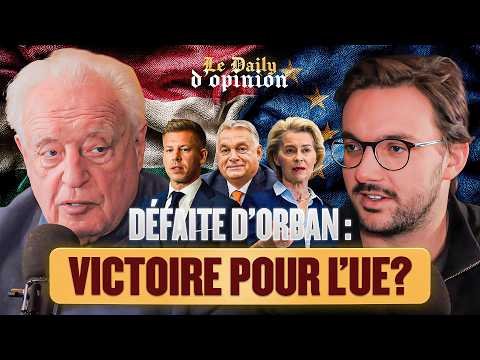
La défaite d'Orban est-elle vraiment une défaite?
AI Summary
The video discusses the recent Hungarian legislative elections where Péter Magyar's party secured a significant victory with 54% of the vote, resulting in 138 out of 199 parliamentary seats. This marks the end of Viktor Orbán's 16-year tenure, a period often characterized by illiberal policies. The new Prime Minister, Péter Magyar, is presented as a figure who was previously involved in Orbán's administration for over two decades before breaking away in February 2024 following a presidential pardon scandal.
Magyar's political platform advocates for a conservative, pro-European, and liberal reorientation for Hungary. Key promises include restoring the rule of law, judicial and media independence, limiting parliamentary and prime ministerial terms to two, and joining the European Public Prosecutor's Office to combat corruption. He aims to unblock an estimated 20 billion euros in frozen EU funds to revitalize the stagnant economy. Socially, his proposals include doubling family allowances, increasing small pensions, lowering income tax for low earners from 15% to 9%, and implementing a 1% annual tax on wealth exceeding 1 billion forints (approximately 2.6 million euros). He also plans a 25% salary increase for those in education, child protection, and social services, and relaxed retirement conditions for men with 40 years of contributions.
On immigration, Magyar maintains a firm stance, proposing to halt the organized recruitment of foreign workers introduced by Orbán since 2022 and to maintain the border fence. He criticizes Orbán for being too lenient on immigration, arguing that the country's low birth rate (around 1.4) necessitates careful management of labor needs.
In terms of energy, Magyar aims to end dependence on Russian gas by 2035 and double the share of renewables by 2040. He supports joining the Eurozone once Maastricht criteria are met and strengthening NATO ties while maintaining a pragmatic foreign policy towards Russia. Regarding Ukraine, he opposes sending arms and an accelerated EU accession, preferring a national consultation. He frames his project as a "New Hungarian Deal," aiming to break with clientelism while preserving conservative values.
The discussion raises questions about the potential conflict between Hungarian sovereignty and European integration, noting that Orbán's strategy was to resist what he perceived as the EU's efforts to dismantle national identities. The speaker suggests that it's impossible to fully align with official Europe while asserting complete national sovereignty. The prolonged time in power for Orbán is also highlighted as a potential reason for his defeat, with the speaker suggesting that 10 years is a reasonable limit for a leader. Orbán's initial mandate after the fall of communism was liberal-conservative, a stark contrast to his later policies.
The video touches upon Orbán's alleged control over media and justice through foundations and wealthy associates. While acknowledging potential parallels with media control in France, the speaker emphasizes the need for intellectual honesty in criticizing such practices in Hungary. The lack of a public broadcast opposition in Hungary is noted, contrasting with the situation in France.
Economic policies are also examined, with criticism of Orbán's price freezes and budget deficit increases, particularly in response to the COVID-19 pandemic and the war in Ukraine. These measures are seen as contributing to inflation, which disproportionately affects the poor. The speaker also contrasts Hungary's situation with Poland's economic success despite not being in the Eurozone.
The discussion then shifts to immigration more broadly, with a critique of the idea that importing workers prevents wage increases. The speaker references Jacques Lul's views on immigration, distinguishing between assimilation and non-assimilation, and expressing a preference for immigrants who can integrate, citing Filipinos and Vietnamese as examples. The complexity of immigration is emphasized, with distinctions made between labor immigration and family reunification, and the potential impact on national identity.
The recent adoption of a restrictive text on the return of irregular migrants by the European Parliament is discussed, highlighting the creation of "return hubs" outside the EU. However, skepticism is expressed about the actual implementation of such measures, citing past instances where adopted texts have not been effectively enforced, particularly due to national interests and differing interpretations of law. The opacity of European institutions, including the Commission and the Council, is also noted.
The speaker points out the shift in German policy, with the current Chancellor, Friedrich Merz, seeking agreements with the Syrian government for the return of Syrian refugees, a stark contrast to Angela Merkel's earlier open-door policy. This shift is seen as a response to the rise of right-wing parties like the AfD. The discussion concludes by questioning whether words and pronouncements from European leaders are sufficient to address real problems, suggesting that a more concrete approach is needed. The disconnect between elected officials and their constituents is also highlighted, with a loss of connection to local issues and a tendency for politicians to be dictated by party leadership. The speaker views the removal of Orbán as potentially enabling a continuation of the "destruction of nations" and the push for a federal Europe, suggesting it might be a negative development. The speaker also expresses doubts about Ukraine's potential EU accession due to its ongoing war, linking it to opportunities for corruption. The speaker concludes by likening the current situation to trying to treat a serious illness with mild remedies, suggesting that the fundamental issues are not being addressed.