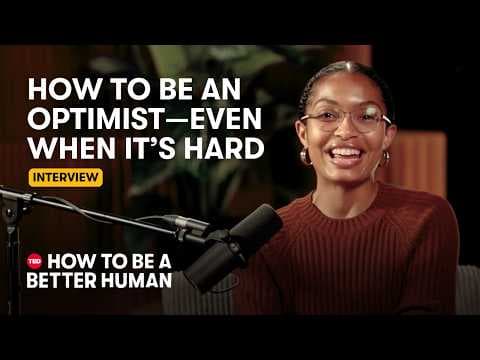
How to Find Your Purpose (W/ Yara Shahidi) | How to Be a Better Human | TED
Audio Summary
AI Summary
The speaker, Yara Shahidi, reflects on her journey of balancing her passions for acting and education, and her evolving perspective on optimism and purpose. From an early age, she was encouraged to explore her interests, from reenacting the Odyssey with Polly Pocket dolls to reading religious books. At 13, James Baldwin's short stories profoundly impacted her. This supportive environment fostered her diverse interests.
However, as she grew older, she faced the recurring question, "Are you sure about that?" This challenge intensified in August 2018, when she began her freshman year at Harvard while filming season two of her television show, "Groanish." Acting allowed her to explore fantasies and develop empathy, while education fulfilled her desire for knowledge about the world and herself. Despite advice that these two paths were incompatible, she sought an "and" rather than an "either/or." Having now graduated from Harvard and with her show concluding, she embraces the unknown, confident that her next adventure lies "somewhere between the two."
Shahidi identifies as an optimist, noting that "being a pessimist is easy." Her own experience as a teenager and young adult led her to this conclusion. At 18, she felt hopeful due to her generation's energy and her newfound civic duty to vote. However, realizing the complexity of civic processes and global issues led to a period of pessimism, exacerbated by her social science studies at college, which emphasized critique. She realized that while pessimism led to inaction, even slight hopefulness resulted in more accomplishment. Optimism, for her, isn't naivety but a commitment to doing something, rather than nothing.
To combat feelings of pessimism and doubt about what's realistic, Shahidi emphasizes the importance of conversation and continuous learning. She finds rejuvenation in discussions with people who introduce her to new fields and topics, much like her love for school stemmed from the excitement of realizing how much she didn't know, signifying endless possibilities. She likens her current knowledge to "0.98" of the world's knowledge, an "overestimation," suggesting that there's always more to learn and discover.
When faced with feelings of a "shut" door of possibility, Shahidi turns to history for hope, noting that society has overcome numerous difficult moments requiring significant effort. Her tattoo, "63" for 1963, serves as a reminder of those who fought for a better future they weren't guaranteed, creating a world she inherited. This perspective frames her work as both self-serving for the present and a contribution to a future that may not be immediately visible but is necessary.
On a practical level, she and her business partner (who is also her mother), developed a "hard yes list." This list comprises things that bring joy, ranging from colors and foods to conversations. The idea is to build an "arsenal of things to fall back on" for moments when a material reset is needed. This practice, born from a "year of no" that evolved into a discerning "year of yes," helps to actively sprinkle undeniable joys into life.
Shahidi believes that optimism is not about denying reality but about taking it seriously and actively working towards a path forward. She references Dr. Laurie Santos, who suggests that skepticism and pessimism are often mistakenly seen as more intellectual, but can be as naive as extreme bliss. The Optimist Project, which Shahidi co-created, recognizes that optimism is a daily practice that requires cultivation, especially on one's worst days. It's about fighting for joy amidst challenges, not ignoring them. As she puts it, "if joy is the feeling, optimism is the practice."
She connects this to historical struggles, noting that her generation might experience "shock" at setbacks because they grew up in a world where certain rights, like marriage equality, were already established, unlike previous generations who fought for them. This generation now realizes that these advancements are not "givens" and must be maintained.
When facing shifts in public opinion where it becomes risky to hold certain stances, Shahidi emphasizes the concept of "highest order." This refers to the core priorities or purpose that drive one's actions. It can be applied to macro goals, like a life of impact, or micro goals, like a project's objective of sharing information. Recognizing one's highest order helps navigate difficult conversations and maintain conviction when popular support wanes. She acknowledges that it's okay not to have all the answers, especially in challenging times, and that individuals deserve the space to think through their purpose and how to navigate new obstacles.
Shahidi admires Professor Cornell West, who embodies optimism by being intimately aware of global catastrophes yet remaining joyous and hopeful. West's phrase, "some of being a part of life is being on intimate terms with catastrophe," resonates deeply with her, especially in current times where many communities are collectively understanding this reality.
She addresses the societal expectation for public figures, and increasingly everyone on social media, to have immediate opinions on everything. Shahidi learned to be comfortable saying "I don't have thoughts on that" or deferring to others who are more "well-studied." Her academic journey provided her with the space to deeply understand issues she cared about, allowing her voice to have greater impact by being more granular and informed. She believes that for her voice to have impact, it's important to be selective about what she speaks on and to acknowledge when she lacks information.
Shahidi ties the belief in a better world to the belief that people can change and become more informed. Optimism, for her, is rooted in the conviction that things are not fixed, and individuals can grow.
She reflects on navigating her dual identities as a student and an actor. As a "nerd" from birth, her love for education was a constant. "Blackish," starting when she was 14, necessitated making choices about how to configure her life to make space for all her interests. Initially, she found herself with unexpected free time on set, leading her mother to ask, "What else do you want to be doing?" This prompted her to pursue other interests, like civic engagement, which not only enriched her personal life but also enhanced her acting by providing more life experience. She highlights that "side projects" can significantly develop one's main career.
Even after achieving the significant milestones of graduating from Harvard and her show ending, Shahidi experienced an "overwhelming" period of redefining herself. These two anchoring aspects of her life for over a decade concluded simultaneously, leaving her with the question of "who is Yara day by day." This brought her back to the concept of "highest order" beyond school and work. She finds comfort in conversations with people of all ages, including her grandfather, who are also grappling with questions of purpose.
Shahidi shares her love for the "Glockenspiel" (xylophone), despite being "bad at it." This hobby, along with DJ equipment and a talk box, reflects her passion for music and creation, where she's at the beginning of the artistic process, unlike acting where she often steps into an already created world. She embraces being an amateur, using the Glockenspiel as a reminder not to take herself too seriously.
She discusses the importance of embracing being "bad" at things, a relatively new concept for her. Despite her high achievements, she's intentionally sought out situations where she's an amateur, like horseback riding or gymnastics, which she's "infamously bad at." A moment of shedding a tear in a bathroom because she couldn't cartwheel, despite having no aspirations to do so, was a crucial realization. This led her to intentionally pursue activities where the point is to be an amateur, opening doors she previously closed due to fear of not being good enough or embarrassment. These hobbies, like watercoloring or crocheting, bring her immense joy, even if she never completes a scarf. She concludes that being imperfect can be more relatable and connect people, contrasting with the pressure to be exceptional.