L’avenir de l’humanité à l’ère de l’IA | Sadhguru
AI Summary
The discussion begins with an explanation of a chant, emphasizing that while birth is a joy, the goal should be to live in such a way that one's death is met with compassion, not laughter. The only issue with death is its prematurity; people only negotiate for more time, not to avoid death itself. Time is described as a mill that grinds without permission, passing at the same rate for everyone, regardless of their actions or emotional state. The key is whether one can "surf" the cycles of time or be crushed by them. Surfing these cycles leads to pleasure and compassion, while failing to do so results in being overwhelmed, as seen in the physical aging process. True vitality comes from mastering the cycles of time, which is achieved by managing one's energy, as time itself cannot be controlled. This allows individuals to accomplish in a year what others do in ten, not because they are superhuman, but because they realize the potential of being human.
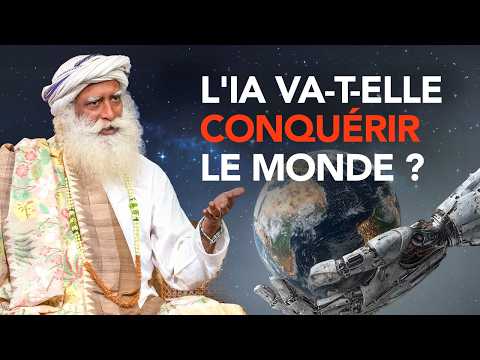
The conversation then shifts to Artificial Intelligence (AI) and the future of humanity. The speaker acknowledges two prevailing visions: a positive one, where AI, much like industrialization, frees humanity from physical labor and allows focus on higher pursuits like creativity and compassion; and a negative one, where AI creates an exploited underclass or leaves people with idle time that could lead to mental distress, as seen with social media. The speaker’s vision of AI is overwhelmingly positive, dismissing fears as unfounded. He draws a parallel to historical shifts, such as the introduction of cranes in Mumbai's docks, which initially caused strikes among manual laborers but ultimately led to a better quality of life as machines took over strenuous physical tasks. He argues that human beings are "bad data centers" and that it is "stupid to convert human beings into data centers," implying that AI taking over data processing is a beneficial development.
The speaker shares his early experience with a desktop calculator, which, at 12 or 13, made him question the purpose of rote memorization in school. He believes AI will free humans from mundane intellectual tasks, much as machines freed them from physical labor. He criticizes the European philosophical tradition, particularly René Descartes' "I think, therefore I am," arguing that existence precedes thought and that compulsive thinking is a form of mental illness. He suggests that AI, by handling all data processing, will force humans to confront what they are beyond their thoughts, leading to an ultimate freedom.
The speaker also touches upon the political implications of AI. While technology is advancing rapidly, policymakers are not keeping pace, leading to potential exploitation. However, he believes that within 10-25 years, new policymakers will emerge, influenced by AI, which will likely determine election outcomes by tailoring campaigns to individual voters. He hopes this will lead to the election of "better caliber people" who focus on policies rather than emotional manipulation.
Regarding the question of whether AI can become conscious, the speaker firmly states it will never happen. He defines consciousness (chitta) as a deep intelligence untainted by memory, an unbiased intelligence that all humans possess but rarely access. He believes AI will perform all knowledge-based tasks, including science, technology development, teaching, and interpreting religion, but consciousness is beyond the mechanical sphere of life. This, he says, is why he is excited about AI, as it will push humans to explore this deeper intelligence.
The speaker emphasizes that the focus should not be on slowing down technology but on "accelerating human beings" by restructuring education. He advocates for a shift from an education system that prioritizes competition and external validation to one that fosters individual growth and self-mastery. He argues that humans are not endangered and do not need policies dictating family size. Instead, the focus should be on raising children as a 20-year project of investment.
He further explains that human life's purpose is not work or labor, which became central due to the difficulty of survival in the past. Today, survival is better organized than ever, allowing humans to pursue something beyond mere existence. He contrasts human life with that of animals, whose lives are complete once survival is assured. Humans, however, lack a "top line" definition, leaving them constantly questioning their purpose. This freedom to self-create is both a gift and a source of suffering for many. AI, he believes, will exacerbate this problem, pushing people to confront their freedom.
The concept of identity (ahamkara) is introduced as the second aspect of the mind, influencing how the intellect operates. Limited identities (national, religious, racial) lead to divisive thinking. The speaker advocates for a "cosmic" or "global" identity, which would allow the intellect to work for a broader well-being. The third aspect, manas, is a vast memory silo containing elemental, evolutionary, genetic, karmic, conscious, and unconscious memories. This memory, combined with a prejudiced identity, shapes how information is processed.
The speaker addresses a question about random cosmic events and human existence, stating that the most fundamental fact humans miss is their mortality. Being constantly aware of limited time would lead to living very differently. He illustrates this with an anecdote about a woman with 800 pairs of shoes, symbolizing the human tendency to accumulate unnecessarily, driven by a perception of endless time or a lack of self-awareness. He argues that the universe is not random; everything is perfectly coordinated. The notion of "my" and "yours" will become blurred with AI, which he finds exciting.
He concludes by reiterating that AI presents a formidable possibility, but whether it becomes a fantastic opportunity or a disaster depends on human choices. He highlights the dangers of technology being used for destructive purposes, citing a video game that promotes sexual violence. To prevent such outcomes, he stresses the importance of people with technological capabilities developing a broader, more inclusive identity, possibly through practices like meditation. He expresses concern that if a large percentage of the population becomes idle or addicted, the negative consequences of AI could outweigh its benefits. However, he remains optimistic that if even 40-50% of people use their newfound freedom to do "fantastic things," humanity can achieve a phenomenal future. He emphasizes that "your life is your making" and that true understanding comes from acknowledging "I do not know," which fuels the quest for knowledge and self-discovery.