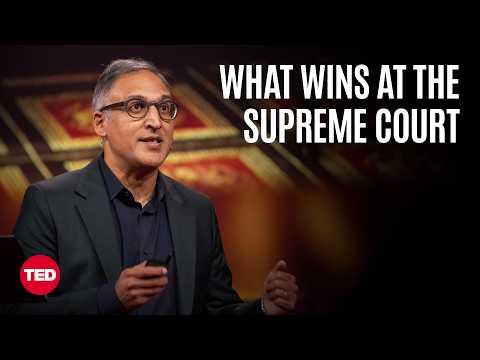
What Really Won the Trillion-Dollar Supreme Court Case | Neal Kumar Katyal | TED
AI Summary
The speaker describes the intense environment of practicing law at the Supreme Court, where quick thinking and precise language are crucial. He recounts a pivotal case where he was tasked with challenging a president's four-trillion-dollar initiative, a move unprecedented in the Court's history. The president had imposed tariffs on virtually all countries, bypassing Congress and invoking emergency powers. The speaker's colleagues and legal scholars deemed the task impossible, citing the president's appointments to the Court.
Despite the daunting odds, the speaker felt a surge of determination, followed by a wave of self-doubt, acknowledging the risks and the historical precedent of people dying at that very podium. He prepared intensely for months, facing internal sabotage from a teammate and a critical editorial in The Washington Post just weeks before the argument. Nevertheless, he walked up to the podium and won, with the president's tariffs declared unconstitutional.
He then reveals that his victory wasn't solely his own but a result of four key "teachers" who helped him connect with himself, information, and others. The first was Ben, a sports psychologist, who helped him confront his imposter syndrome by reframing his fear. Ben taught him to shift from "I have to" to "I get to," transforming his terror into joy and a sense of purpose in defending the Constitution.
The second connection was with information, facilitated by a relentless legal team and an AI named Harvey. Harvey, a bespoke AI system trained on 25 years of Supreme Court justice inquiries and writings, acted as a "sparring partner." It predicted specific questions from justices like Gorsuch, Kavanaugh, and Barrett, and even offered potential escape routes for the Chief Justice, demonstrating an uncanny ability to anticipate the argument's contours.
The third teacher was Liz, an improv coach, who taught him the power of active listening and the "yes, and" principle. This allowed him to transform the justices' attacks into a dialogue, validating their concerns and building bridges, ultimately flipping the room's energy.
Finally, the most important teacher was Bob, a meditation coach, who instilled stillness and calm. Bob helped him clear the mental static, making him feel calm and "dangerous" as he entered the courtroom.
The speaker emphasizes that while AI like Harvey provides invaluable foresight and pattern recognition, it cannot replicate the irreducibly human skill of connection. He recounts a moment with Justice Barrett where he looked at her, truly listened, and responded to her underlying worry, an action beyond algorithmic capability. This ability to connect, to persuade by appealing to something beneath the surface, is the ultimate advantage. He concludes that the question isn't about being replaced by AI, but about deepening our uniquely human abilities to connect and persuade, to come home to ourselves, where our true edge lies. His final preparation involved not just legal notes but an email from Liz and the names of his family, reminding him of who he was fighting for.