The Evolution of Speed in Formula 1
AI Summary
In 1968, Colin Chapman of Lotus pioneered the use of airfoils or wings on cars to increase downforce, improving traction during turns. These early wings were small, marking a transitional period in Formula 1 car design. While downforce helps cars stick to the road, large spoilers also create significant drag, slowing the car on straightaways. The goal became to maximize downforce while minimizing drag.
Nine years later, in the late 1970s, Lotus sought a revolutionary approach to downforce. Their breakthrough was to design the entire car as a wing, rather than simply attaching a wing to a traditional car body. The Lotus 78, for instance, resembled one large wing. This concept drew inspiration from fluid dynamics, specifically the principle of lift generation in airplanes. Instead of creating lift, Lotus inverted the airplane wing design. The car's underside was shaped to create low air pressure, effectively sucking the car onto the ground. This was achieved by a special skirt on the bottom of the car that channeled airflow, squeezing air into a small space between the car and the road. This accelerated airflow created a low-pressure zone beneath the car, a phenomenon known as the Venturi effect, with the areas under the car being called Venturi tunnels.
This "ground effect" technology proved incredibly effective. Mario Andretti, driving the Lotus 78, described it as cornering "as if it was painted to the road," leading him to win the drivers' championship and Lotus to win the constructors' championship in 1978. However, by the 1980s, the immense downforce generated by these ground effects became a safety concern. Cars could take corners at dangerously high speeds, and any disruption to the ground effect, such as hitting a curb, could lead to a loss of traction at speeds far exceeding what the car could handle without the effect. Consequently, ground effects were outlawed in 1983, and regulations mandated flat-bottomed cars.
Beyond aerodynamics, significant advancements occurred in engine technology. F1 engines became remarkably fuel-efficient, losing only 50% of energy to heat compared to 70-80% in road cars. This efficiency allowed for lighter cars due to reduced fuel loads. Horsepower also saw a massive increase, tripling from around 300 in the 1950s to approximately 1000 today, in cars that are a fraction of the weight of an average sports car. Turbochargers also played a crucial role, harnessing exhaust gases to spin a turbine, which then compresses air entering the engine. This increases oxygen in each engine cycle, leading to more powerful combustion and greater overall car power. While these innovations were not initially developed for consumer road cars, much of this technology eventually made its way into the consumer automotive landscape.
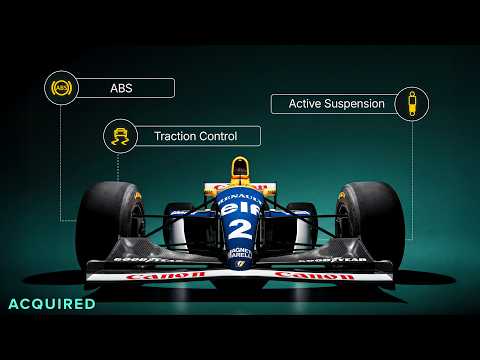
The early 1990s marked a breakthrough in electronics with the Williams team. They integrated real-time automated systems, including traction control, anti-lock brakes, active suspension, and semi-automatic transmissions. The car could even automatically adjust its ride height for each corner of a racetrack. This dominance led to Williams winning both drivers' and constructors' championships in 1992 and 1993. The car's superiority was so pronounced that Ayrton Senna, a three-time world champion, sought to join Williams. However, the FIA subsequently outlawed these electronic driving aids, deeming them to diminish the driver's role too significantly. Senna joined Williams in 1994, only to find himself with a car that was no longer dominant due to the removal of these electronic innovations, tragically leading to his fatal crash early that season.