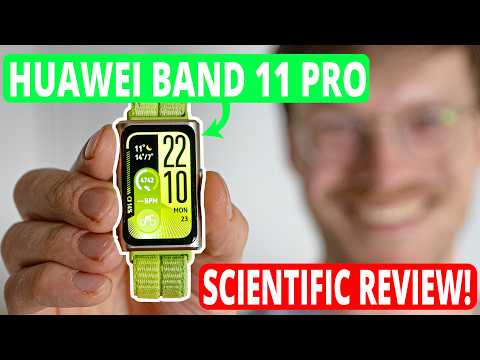
Huawei Band 11 Pro - Scientific Review
AI Summary
In this detailed evaluation, scientist and biological data analyst Rob provides a systematic review of the newly released Huawei Band 11 Pro. While Huawei launched both the standard Band 11 and the Pro version, this analysis focuses on the Pro model. The primary distinctions between the two devices lie in screen brightness, construction materials, and, most significantly, the inclusion of integrated GPS in the Pro model—a feature absent in the base version.
The review is structured around three core performance pillars: heart rate tracking, sleep stage accuracy, and GPS reliability. As a budget-oriented device, the expectation is not for top-of-the-line precision but for "decent" performance consistent with Huawei’s previous entry-level wearables.
### Heart Rate Tracking Performance
The heart rate testing utilizes a Polar H10 chest strap as the gold-standard reference. Testing begins with indoor cycling, which is generally the easiest activity for wrist-based sensors to track. The Band 11 Pro performed admirably here, showing a strong correlation of 0.98. While there were moments of "noise" and minor deviations where the device recorded a slightly lower heart rate than the reference, the results were deemed sufficient for the price point. Interestingly, the performance mirrored the previous Huawei Band 10, suggesting that the sensor and algorithmic hardware remain largely unchanged.
When moving to more strenuous activities like running, the limitations of the budget sensor became more apparent. The correlation dropped to 0.94. The reviewer noted instances of "cadence lock," a common issue where the watch mistakenly tracks the rhythmic movement of the runner's steps rather than the actual heart rate. While one test run showed significant deviations toward the end, a second run was much more stable. Compared to higher-end models like the Huawei Watch GT6 or the Watch Fit 4, the Band 11 Pro falls into the "middle class" of performance—better than many Garmin devices on this specific tester’s body, but not as precise as premium Huawei or Apple models.
Outdoor cycling and weightlifting proved even more challenging. During outdoor cycling, the correlation dropped further to 0.84, with the device frequently missing heart rate peaks or displaying a delayed response to intensity changes. In weightlifting, despite a high mathematical correlation of 0.98, the device struggled to capture the rapid heart rate spikes associated with high-tension sets. This is a typical struggle for wrist wearables, as arm tension can interfere with optical sensors.
### Sleep Stage Tracking
To test sleep accuracy, the reviewer compared the Band 11 Pro against a ZMAX EEG headband, which measures brain waves and eye movements. The results indicate that sleep stage tracking remains a weak point for Huawei. The Band 11 Pro correctly identified deep sleep about 60% of the time, light sleep at 54%, and REM sleep at only 46%.
The data places the Band 11 Pro in the "lowest tier" of sleep stage trackers. It performs similarly to other Huawei wearables like the GT6 and Watch Fit 4, which generally struggle with stage differentiation compared to industry leaders. For users prioritizing sleep data, the reviewer suggests looking toward brands like Fitbit, Google (Pixel Watch), or specialized devices like the Oura Ring or Whoop strap. However, he notes that while stage tracking is poor, other metrics like resting heart rate and heart rate variability may still be useful.
### GPS and Outdoor Tracking
The defining feature of the "Pro" model is its integrated GPS. To ensure an independent test, the reviewer performed runs without a connected phone to prevent the watch from "piggybacking" on the phone's location data. The testing involved running repeated circles to see how well the GPS paths overlapped.
The results were described as "okay at best." In open areas, the signal was somewhat consistent, but in more complex environments—such as running near walls or under tree cover—the signal tended to "flare out" and lose precision. While the GPS is functional and likely "good enough" for casual joggers who want a rough estimate of their distance and pace, it lacks the pinpoint accuracy found in more expensive dedicated sports watches.
### Design, Battery, and Final Verdict
The Huawei Band 11 Pro offers a variety of strap options, including a green fabric velcro version and standard rubber polymer straps in black or blue-white. The reviewer strongly recommends the fabric strap, as it allows for a more secure and comfortable fit, which is essential for optimizing the performance of the optical heart rate sensor.
One of the device's strongest selling points is its battery life, which can last up to 14 days depending on usage. While a definitive price was not available at the time of the review, it is expected to retail between €70 and €80.
In summary, the Huawei Band 11 Pro is a solid, budget-friendly wearable that performs exactly as expected for its category. It offers respectable heart rate tracking for general fitness and a functional (if not perfect) GPS for outdoor activities. While it falls short in high-intensity weightlifting and detailed sleep stage analysis, it remains a competitive option for casual users who want a versatile, long-lasting device without the high price tag of a premium smartwatch. For those seeking higher precision, the reviewer suggests stepping up to the Huawei Watch Fit series or the GT series.