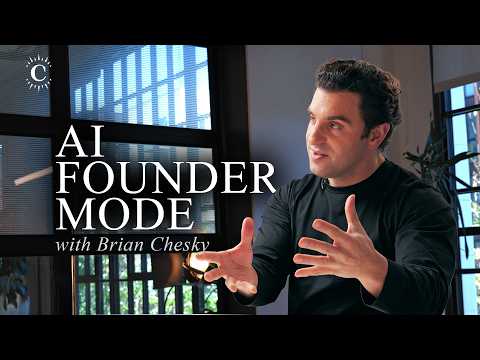
How Brian Chesky Is Redesigning Airbnb for the AI Era
AI Summary
Brian Chesky, CEO of Airbnb, emphasizes that while founders are often born with innate qualities, becoming a good CEO is a learned skill, often counterintuitive and learned the hard way. His background in industrial design from RISD profoundly influenced his approach, instilling a deep understanding of user empathy, problem-solving, and the critical link between design and commercial success. He learned that industrial design, unlike architecture, is inextricably tied to market viability; a product that doesn't sell is a failure. This perspective, coupled with his early exposure to iconic designers like Raymond Loewy and his fascination with products that captured imagination, shaped his view on creating user-centric experiences. The project of designing a child’s ventilator, which required him to consider the emotional impact on both the child and parents, as well as the pragmatic needs of medical staff, was a pivotal learning experience in navigating complex stakeholder dynamics.
Chesky introduces the concept of "founder mode" as distinct from being a CEO. Founder mode, characterized by deep engagement in details and an unwillingness to delegate core responsibilities without understanding them, was effective for early-stage companies. However, as companies grow, founders often transition into CEO roles, which can be challenging. He recounts his own experience during the 2010s, where his company grew so large that he felt disconnected and lost control, akin to being in a car without a steering wheel. This realization, amplified by the pandemic’s crisis, led him to adopt a more intense "founder mode," reviewing every detail of the company, working intensely, and regaining control. He learned that true leadership involves not just hiring great people but actively auditing their work and being hands-on, especially in the initial stages.
The conversation then pivots to the emergence of AI and its potential impact on leadership, introducing "AI founder mode." Chesky anticipates this will be even more detail-oriented than traditional founder mode, leveraging AI for on-demand information. He contrasts the meeting-heavy approach of founder mode with the potential for more asynchronous and efficient communication in the AI era, suggesting a reduction in management layers. He foresees a shift where pure people managers will become obsolete, replaced by hybrid roles that combine management with technical expertise and a deep understanding of the core work. This means lawyers must understand case law, and engineers, even managers, must code. The emphasis is on managing through work, not just people, and avoiding the pitfalls of becoming a mere therapist or mentor.
Chesky highlights two types of individuals who will struggle to adapt to the AI age: pure people managers and those resistant to change. He emphasizes the importance of a growth mindset and believes AI tools will become increasingly intuitive due to economic incentives. He observes that AI is currently an enterprise-focused phenomenon, with few consumer-facing applications, but predicts a future "consumer AI renaissance" as the next significant prize.
The discussion delves into "Project Hawaii," an internal initiative at Airbnb that embodies a lean, startup-like approach to innovation within a large company. This project focused on improving the guest experience and conversion rates, achieving remarkable financial results. The success of this model led to its application to other areas like pricing, demonstrating how a small, focused team can drive significant impact. Chesky’s management philosophy, rooted in starting hands-on and gradually letting go, is likened to a golf instructor guiding a student. He contrasts this with the common entrepreneurial tendency to delegate too early, leading to the development of incorrect "muscle memory."
A core theme is the principle of starting small and scaling, exemplified by Airbnb’s launch in a single city to achieve product-market fit before expanding. This "one to 10 to many" approach is contrasted with the past practice of trying to scale globally from the outset. Chesky advocates for making problems as small as possible to achieve deep understanding and customer connection. He cites Paul Graham’s advice: "It's better to have 100 people love you than a million people sort of like you." This emphasizes the importance of building a devoted user base rather than a broad, shallow one. The exercise of thinking about "11-star experiences" is presented as a method to push boundaries and uncover what truly delights customers, moving beyond the standard five-star rating to identify opportunities for genuine differentiation.
Chesky discusses the transformative power of AI in reigniting creativity, comparing it to a paintbrush and canvas for everyone. He believes AI will shift focus from consumption to creation, enabling individuals to express latent artistic and creative potential. He draws parallels to musicians and artists who communicate profound ideas through their craft, suggesting that AI will unlock this capacity in many more people. The act of creation, whether through writing, designing, or using AI tools, is seen as a way to discover and refine ideas.
A significant portion of the conversation addresses the shift from seeking external validation and status ("agilation") to pursuing intrinsic motivation and the pure joy of creation. Chesky admits that early success at Airbnb led him to chase accolades, which ultimately felt like a "leaky bucket." The pandemic served as a catalyst for re-evaluation, prompting him to detach from external approval and focus on doing what he loves, inspired by artists like Leonardo da Vinci and Walt Disney who worked until their final days because they loved their craft. This shift from seeking to "be" something to focusing on "doing" what one loves is presented as the path to genuine fulfillment and impact.
Chesky identifies two key types of people who will not survive the AI age: pure people managers and those resistant to change. He stresses the importance of content and expertise, arguing that leaders must have a deep understanding of the work they oversee. He advocates for managing through work, not just people, and for building relationships organically rather than through daily one-on-one meetings.
The conversation explores the paradox of building enduring companies. While some businesses can become so perfected that almost anyone can run them (the "ham sandwich" analogy), Chesky argues that the most impactful companies are those that remain founder-led, constantly reinventing themselves. He uses Disney as an example, where Walt Disney’s vision created such a strong foundation that the company has endured for decades, even with different leaders. He believes that while technology companies are more susceptible to disruption and require continuous founder involvement, the ultimate goal is to build something so robust and imbued with principles that it can outlast its founders.
Looking forward, Chesky outlines his vision for Airbnb's future, aiming to shift the "atomic unit" from homes to people. This involves developing authenticated identity profiles, robust preference libraries, and a real-world social graph, moving beyond just offering accommodations to providing a comprehensive suite of travel-related services. He also discusses the challenge of disrupting oneself with AI without jeopardizing existing investors and hosts, exploring new ventures in "sandboxes" to explore radical new ideas.
Chesky reflects on his own journey, acknowledging that while founders may be born with certain traits, CEO skills are learned. He emphasizes the importance of continuous learning and reinvention, drawing parallels to the need to stay "light on your feet" in a rapidly changing world. He also touches upon the concept of "progressive overload" from bodybuilding, applying it to leadership by breaking down problems into observable and measurable components, such as the quality of talent within the company. He stresses the critical role of hiring, advocating for spending significant time on it and building talent pipelines proactively.
Finally, Chesky discusses the power of belief, both in oneself and in others. He highlights instances where people believed in him when he doubted himself, setting him on a path to success. He sees giving belief to others as a profound gift and advocates for recognizing and nurturing the unknown potential within individuals. He concludes that the most important person to believe in is oneself, and that true happiness and success stem from this self-belief, especially for entrepreneurs often driven by deep-seated insecurities.