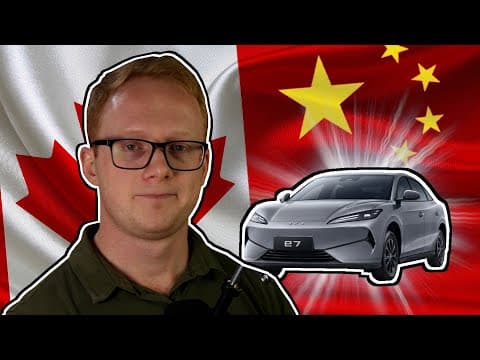
The Canada-China Trade Deal
AI Summary
In this update from early 2026, Richard of *The Plain Bagel* explores the rapidly shifting landscape of international trade, specifically focusing on a landmark deal between Canada and China. The global context is one of significant volatility; the United States, under President Trump, has recently imposed new tariffs on semiconductors and threatened European nations over access to Greenland. Amidst this "unhinged" environment, Canadian Prime Minister Mark Carney’s recent visit to Beijing marks a pivotal moment in Canada’s economic strategy, signaling a move toward trade diversification and a thawing of long-standing tensions.
The centerpiece of the new agreement is Canada’s decision to waive its 100% tariff on Chinese-produced electric vehicles (EVs) for up to 49,000 units. This makes Canada the only member of the KUSMA (USMCA) agreement to allow Chinese EVs into its market without exorbitant levies. While critics view this as a direct rebuff to the United States—which views China as a primary global adversary—President Trump’s initial reaction has been surprisingly "chill," suggesting that Canada is right to seek deals where it can. However, the move remains controversial among other U.S. officials and within Canada, where some fear a loss of U.S. favor or an increase in Chinese influence.
To understand the significance of this deal, one must look at the "trade war" that preceded it. In August 2024, Canada followed the U.S. and EU in slapping a 100% tariff on Chinese EVs, citing concerns over state-subsidized production, poor labor standards, and data privacy risks. Simultaneously, Canada imposed 25% tariffs on Chinese steel and aluminum. China retaliated in 2025 with massive tariffs on Canadian agricultural products, including a 100% tariff on rapeseed (canola) oil and peas, and a nearly 76% tariff on canola seed. These retaliatory measures hit Canada’s prairie provinces hard, as China typically buys about a third of Canada’s total canola exports.
The 2026 deal effectively reverses much of this damage. In exchange for Canada allowing 49,000 EVs at a reduced 6.1% tariff rate, China will slash its canola oil tariffs from 84% to 15%. China is also removing tariffs on canola meal, lobsters, crab, and peas. While pork tariffs remain for now, they are expected to be lifted soon. This exchange is projected to add nearly $3 billion in export orders for Canada. Richard notes that while the deal is being framed as a massive shift, it mostly restores trade to 2023 levels. However, it serves as a "first step" toward a much deeper integration.
Beyond the immediate numbers, the deal revives the Joint Economic and Trade Commission, which had been dormant for eight years. Prime Minister Carney has set an ambitious target to bolster exports to China by 50% by 2030, reaching roughly $30 billion annually. The agreement also includes "softer" wins, such as the restart of Canadian beef exports to China and visa-free access for Canadians traveling to the country—a significant move given that 9% of Canada’s recent immigrants come from China.
The strategic motivation behind this pivot is Canada’s desperate need to diversify. Currently, Canada sends over 75% of its exports to the United States. However, recent U.S. protectionism, including threats to annex Greenland or treat Canada as a "51st state" through economic coercion, has undermined Canadian trust. Carney’s goal is to double non-U.S. exports over the next decade. China is the only individual market with the purchasing power to rival the U.S., particularly for crude oil. While 96% of Canadian crude currently goes south, China is the world’s largest oil importer. With new pipeline infrastructure reaching Canada’s west coast, the country is now positioned to sell directly to Chinese buyers, reducing its total reliance on American demand.
Furthermore, Canada is looking to China to help solve its "productivity issue." The Canadian economy has struggled with plateauing labor productivity and high unit costs. By fostering Chinese joint ventures, Carney hopes to revitalize the country’s infrastructure and EV battery sectors, which have seen projects delayed or scrapped in recent years.
Despite the economic logic, the deal faces significant domestic opposition. While agricultural leaders in Manitoba and Saskatchewan approve, Ontario’s Premier Doug Ford has warned against "Chinese subsidized spy cars" entering the market. There are legitimate national security concerns regarding cyber espionage and data collection, risks that even Carney has acknowledged in the past. Additionally, the KUSMA agreement is up for review in 2026, and U.S. officials have warned that cozying up to China could jeopardize Canada’s tariff-free access to the American market.
Ultimately, the transcript suggests that Canada is navigating a "new world order" where it must balance the security risks of China against the volatility of a protectionist United States. While the deal itself is a return to previous trade norms, the intent behind it signals a major shift in Canada’s long-term economic alignment.