The God Who Broke All The Rules
AI Summary
Krishna is a significant figure in Hindu tradition, often counted among the principal avatars of Vishnu. However, in many devotional traditions, Krishna is worshipped more than Vishnu himself. This is largely due to his relatable and multifaceted portrayal in stories, which depict him as a god who spent his childhood stealing butter, getting scolded by villagers, dancing, and later, driving chariots into wars and delivering profound teachings. People don't just worship Krishna; they fall in love with him because of his familiar and intimate nature.
The concept of an "avatar" in Hindu theology comes from the Sanskrit word "avatara," meaning "descent." It refers to a being who descends into the material world. Vishnu, as the preserver within the Hindu trinity (alongside Shiva and Brahma), is said to incarnate repeatedly throughout the ages to restore cosmic order, known as dharma. An avatar of Vishnu means that the supreme sustaining principle of the universe takes an embodied form, not merely as a prophet or inspired teacher, but as God entering history. While Krishna is seen as one of these incarnations in many traditions, some devotional schools consider him not just an avatar, but the original source from whom even Vishnu emanates.
Krishna's story begins with a prophecy surrounding his birth. King Kamsa, a paranoid and brutal ruler, receives a divine voice prophesying that his sister Devaki's eighth child will kill him. In fear, Kamsa imprisons Devaki and her husband Vasudeva, murdering their first six children. The seventh child, Balarama (Krishna's older brother), is miraculously saved. When the eighth child, Krishna, is born, chains fall, doors open, and guards fall asleep. Vasudeva carries the newborn in a basket, crossing the raging Yamuna River which mysteriously lowers, shielded by a multi-headed serpent. He swaps Krishna with a cow herder's newborn daughter in the village of Gokul before returning to the dungeon. The next morning, Kamsa tries to kill the baby girl, but she transforms into an eight-armed goddess, Yoga Maya, mocking him and declaring that his killer is already alive elsewhere. This birth narrative shares parallels with stories in other traditions, such as Jesus and King Herod, or Moses and the parting of the Red Sea, highlighting universal themes of prophecy, miraculous escapes, and divine intervention.
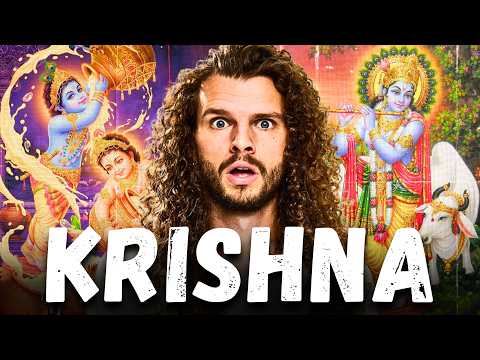
Krishna grows up as the adopted son of simple cow farmers, Yashoda and Nanda, in the village of Vrindavan, initially unaware of his divine or royal lineage. He becomes a mischievous child, constantly stealing butter, climbing to impossible heights, and sneaking into homes. Though the villagers complain, they secretly adore him. This "butter stealing" is symbolic: butter, being refined and valuable, represents the purest offering of a devotee's heart. By stealing it, Krishna is seen as stealing their affection, valuing this playful, noisy bond over formal prayer.
One day, when Yashoda tries to tie Krishna to a grinding stone as punishment, no matter how much rope she uses, it's always "two fingers too short." Only when she surrenders to the absurdity of the situation and her overwhelming love for him does the rope hold. This symbolizes that God cannot be bound by force, only by love and acceptance. Another remarkable incident occurs when Krishna's brother Balarama accuses him of eating dirt. When Yashoda tells Krishna to open his mouth, she sees the entire universe—stars, galaxies, creation, and destruction unfolding simultaneously. Krishna, however, casts a divine illusion (maya) over her so she only sees him as her child, not the creator, because he desires a mother, not worship, in that moment. This illustrates the infinite choosing to be finite, the cosmic choosing to be intimate.
Despite these endearing moments, King Kamsa continuously sends assassins to kill Krishna. One such demoness, Putana, disguised as a beautiful woman, attempts to nurse Krishna with poisoned milk. Krishna drinks the milk but also drains her life force, causing her true demonic form to collapse. Remarkably, because Putana approached him as a mother and offered him milk, even with murderous intent, she still receives liberation, signifying that the form of the action can be more significant than the intent in Krishna's world. Other demons like Trinavarta (a whirlwind) and Kaliya (a multi-headed serpent poisoning the Yamuna River) are also subdued by Krishna. Notably, Krishna doesn't kill Kaliya but banishes him, stripping away his arrogance and removing toxicity from where it can harm, rather than erasing it from existence.
Krishna also challenges the gods. When the villagers of Vrindavan worship Indra, the lord of rain and storms, out of fear, teenage Krishna convinces them to redirect their offerings to Govardhan Hill, the land that sustains them. Enraged, Indra unleashes a devastating storm, but Krishna lifts the entire mountain with his finger, holding it like an umbrella for seven days and nights, sheltering the village. This act demonstrates that devotion built on fear is hollow, and honoring what truly sustains life is more important than bowing to power. Indra eventually humbles himself and apologizes.
A significant part of Krishna's story involves the gopis, the cowherder women of Vrindavan, and his flute. When Krishna plays his flute at night, the gopis drop everything—homes, duties, even food—and run towards the sound, compelled by the call of the divine. Radha, often considered Krishna's lover, represents the highest, most selfless form of devotion. Her story is defined by longing and separation, as Krishna eventually leaves Vrindavan to fulfill his destiny, never returning. In Hindu theology, love experienced through separation (viraha) can be more intense and deepen the love, keeping it alive.
Later, as a king in Dwarka, Krishna remains human and accessible. His childhood friend Sudama, now destitute, visits him with only a small bundle of rice as a gift. Krishna joyfully accepts and eats the rice, valuing Sudama's sincerity and humility more than wealth. Sudama, without asking for help, returns home to find his hut transformed into a palace, his family well-provided for. This emphasizes Krishna's valuation of authentic relationships and sincerity over worldly status.
The most famous part of Krishna's story is arguably the Bhagavad Gita, which takes place on the battlefield of the Mahabharata. Krishna serves as charioteer and advisor to Arjuna, the greatest warrior of the Pandavas, who faces his own cousins, teachers, and family in a devastating civil war. Paralysed by moral despair, Arjuna drops his bow, unwilling to kill his own kin. Krishna, without shaming him, delivers profound teachings over 18 chapters on how to act when choices feel impossible. Key lessons include: controlling your actions, not their outcomes; living your own imperfect life rather than perfectly imitating another's; and recognizing unchecked desire as an enemy. The Gita also highlights multiple paths to the divine: selfless action, wisdom, and love. At Arjuna's request, Krishna reveals his cosmic form, Vishvarupa, overwhelming Arjuna with its vastness and power, before returning to his familiar form. Krishna concludes by telling Arjuna to think clearly and choose for himself, emphasizing freedom and guidance over commands.
The prophecy of Kamsa's death is fulfilled years later when Krishna, as a young man, returns to Mathura. Kamsa sets a trap in a wrestling tournament, but Krishna and Balarama effortlessly defeat his champions. Krishna then leaps onto the royal platform, grabs Kamsa, and kills him with his bare hands in front of the kingdom.
The reason for Krishna's profound devotion, even over Vishnu, is that in many traditions, particularly Gaudiya Vaishnavism, he is seen not as a partial manifestation (amsha) but as the complete, original source (adi purusha) from which all other divine energies, including Vishnu, emerge. He chooses to live a human life, fully divine and fully human, engaging with humanity as a friend, teacher, and even a butter thief, making him tangible and relatable. Unlike Rama, who is revered as an ideal man enduring loss and duty, Krishna knows exactly who he is from birth, and his actions—the mischief, demon slaying, teaching, and even leaving—are intentional, part of his "leela" or divine play.
Krishna's story concludes in an almost ordinary way. After the great war and the death of Kamsa, Krishna grows old. His own clan, the Yadavas, destroy themselves in a drunken brawl. Krishna watches, then walks into a forest to rest. A hunter named Jara, mistaking Krishna's foot for a deer, shoots him with an arrow. Krishna, without anger, forgives Jara, explaining that it was destined to happen, a cosmic debt repaid from a previous life. He then closes his eyes and departs. This ending, where God wrestles with loss and says goodbye, underscores Krishna's profound intimacy and relatability, showing that even the divine experiences human struggles. His enduring influence stems from this portrayal of a god who "gets it," having walked in the same world as humans, offering a contradictory, frustrating, yet beautiful and deeply loving example of existence.