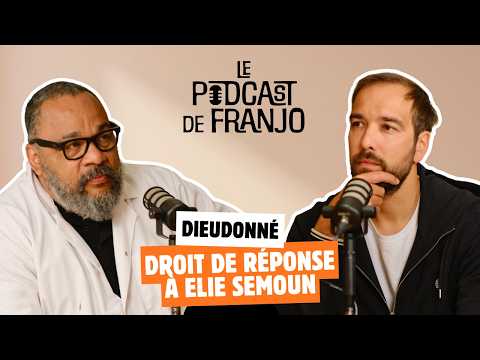
Dieudonné - Les limites de la liberté d'expression - Le podcast de Franjo
AI Summary
The podcast features a special guest, Dieudonné M'bala M'bala, who was invited to provide a right of reply following a previous podcast with Elie Semoun. The host, Frano, clarified that while legally obligated to offer a response, he found Dieudonné's presence "interesting" but wasn't sure if he was "happy" to have him.
Ilias, the co-host, used ChatGPT to introduce Dieudonné. ChatGPT described Dieudonné as a "highly controversial figure with numerous judicial convictions for anti-Semitism and incitement to racial hatred." It outlined his biography, noting his birth in 1966, his early career as part of the anti-racist duo "Elie et Dieudonné" from 1991 to 1997, and his subsequent solo career and political ventures. The AI then highlighted a "radical ideological shift" in the 2000s, leading to controversial performances with anti-Zionist and later anti-Semitic stances. ChatGPT also mentioned the "quenelle" gesture, which it described as triggering a global controversy, and noted Dieudonné's multiple convictions and the banning of his shows in France, Switzerland, Belgium, and Canada. It concluded by stating that his performances continue to be prohibited by prefectural orders.
Dieudonné reacted to ChatGPT's summary with humor, stating that being called racist by "American white people" was amusing, especially given his background with a white mother and black father. He addressed the anti-Zionism accusation, linking it to anti-colonialism and the situation in Gaza, acknowledging it as a complex issue. He shared his idea for a comedic show with an Iranian and an Israeli comedian, playing caricatured roles of each other, to find "a path of appeasement" through humor in difficult subjects.
Regarding his controversial career, Dieudonné expressed pride, stating he is now a painter and invites people to view his work on artministratif.com, where he reinterprets prefectural orders. He claimed to be earning more from painting than from filling large venues with his shows. He views his art as unique, with each canvas representing a numbered and stamped page of history, signed by the Minister of Interior, making it a direct result of his personal journey and legal battles.
Dieudonné then discussed the Epstein files, revealing a significant personal connection. He explained that a December 2013 email from Arianne de Rothschild, a French banker, expressed outrage to Epstein after seeing a video of Dieudonné making comments about Jews and money, calling his remarks "outrageous" and expressing concern over the video's views. This email, he noted, coincided with a wave of show bans in January 2014, culminating in a Council of State order (the "Dieudonné order" of January 9th) that validated his interdictions, which is now studied in law universities. Dieudonné asserted that this sequence of events strongly suggests a political and potentially "mafioso" dynamic behind the efforts to silence him, especially given Epstein's alleged ties to Mossad. He highlighted the "deep state" aspect, suggesting that powers beyond official institutions influence such decisions.
He further elaborated on a past sketch where he mentioned a pedocriminal network, which he learned about from the children of a high-ranking magistrate who confessed to being part of such networks before his death. Dieudonné believes this sketch contributed to Arianne de Rothschild's perception of him as "dangerous." He noted recent perquisitions at Arianne de Rothschild's home, suggesting a potential link between her, Epstein, and these networks. He also criticized the double standards in the French justice system, pointing out that public figures like Jacques Lang, who have faced accusations, remain unmolested, while he faces house arrest for jokes. He humorously contrasted his electronic bracelet with Pierre Palmade's situation, highlighting the disparity in treatment.
Dieudonné argued that the French justice system is a "two-speed" system, especially for Black individuals, drawing parallels with the US justice system and the historical context of colonization and slavery. He stressed the importance of humor for Black people to cope with systemic injustices, stating, "you have to know how to laugh or else you're screwed."
Responding to Elie Semoun's previous comment that he is "politically incorrect, minus the racism," Dieudonné found it absurd for Semoun to accuse him of racism. He challenged Semoun's claim of political incorrectness, stating that true political incorrectness in France leads to legal repercussions, which Semoun has not faced. He suggested Semoun's writing was "poor" and that he struggles to "renew himself."
He also touched upon the possibility of reuniting with Semoun for a show, expressing his willingness if his electronic bracelet allows him to attend Semoun's performance. He stated that Semoun is "afraid" to reunite, attributing it to the powerful forces Dieudonné has faced, including the Rothschild network and Epstein. He clarified that he views Semoun as a friend, distinct from these "mafia" figures, and noted Epstein's documented "negrophobia," which he found ironically positive in a grim context.
Dieudonné criticized the current state of French politics and media, suggesting that figures like Manuel Valls were "puppets" pushed by powerful financial groups like Rothschild, which he claims have historically profited from African resources and the slave trade. He argued that the "deep state" concept is no longer a conspiracy theory but a tangible reality, with powerful entities dictating political and judicial outcomes.
He explained that his prefectural bans are based on an "ubuesque" interpretation of the "Benjamin law," which traditionally guarantees total freedom of expression. His "Dieudonné order" allows for a priori prohibition of his shows based on reputation or anticipated content, effectively making him a symbol of the curtailment of free speech in France. He contrasted this with Charlie Hebdo's "total freedom of expression," suggesting that his race plays a role in the differential treatment.
He reiterated that his art, particularly his administrative art, is a means of expressing himself freely, with each piece being a unique historical document reflecting censorship. He noted the financial success of his paintings, which are now highly sought after, partly due to their unique nature and tax-exempt status in France. He also described the "quenelle" gesture as an act of emancipation, particularly for Black people in France, symbolizing their disillusionment with promises of liberty and equality.
Dieudonné concluded by advising young artists to be self-reliant and not to expect help from a system designed to exploit and destroy them. He criticized the entertainment industry for fostering depression and compromise, urging artists to prioritize authenticity and natural creativity, much like Molière, who also performed from a "roulotte" (caravan). He announced his current show, "Le Fil d'Arianne," inspired by the Rothschild email, which he performs in his bus or at private venues, inviting people to find dates on his website.