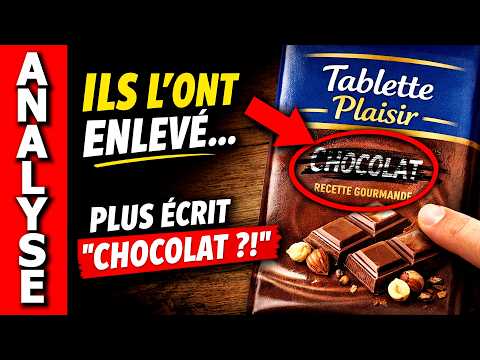
Pourquoi le mot “chocolat” disparaît des tablettes 🍫? (et c’est inquiétant)
AI Summary
The discussion focuses on the changing landscape of chocolate products in supermarkets, specifically the disappearance of the word "chocolate" from packaging and the implications for consumers and the industry. The speaker notes that this trend was first brought to their attention by Fabrice, a cacao farmer, and decided to investigate further by visiting a local Carrefour supermarket, which boasts an exceptionally large chocolate aisle.
Upon observation, it's clear that the word "chocolate" is increasingly absent from the front of chocolate bar packaging. Instead, brands emphasize their name and descriptors like "hazelnut," "milk," or "dark," with "chocolate" often relegated to small print, a corner, or even the side of the packaging. This trend extends to products that mix chocolate with other ingredients, such as Ovomaltine, where the product is a blend and not solely chocolate, and the word "chocolate" is entirely missing from the front.
The speaker reminds listeners that "chocolate" is a legally defined term. For instance, dark chocolate must contain at least 43% cocoa solids (26% cocoa butter), milk chocolate at least 25% cocoa, and white chocolate at least 20% cocoa butter (as it contains no cocoa mass). Products meeting these definitions are considered "standard chocolate." However, even for these standard products, like Côte d'Or dark chocolate, the word "chocolate" is often replaced by the brand name and descriptors like "dark" or a percentage, with "cocoa bean" mentioned in tiny letters. Similarly, Carrefour's own brand emphasizes added flavors like mint or apricot over the chocolate itself.
A significant portion, estimated at 90%, of the chocolate aisle is now dedicated to "recipes" – products that combine chocolate with other ingredients. While classic combinations like nuts and almonds are present, there's a growing trend of more unusual mixtures, such as orange, citrus, grilled sesame, or pistachios. The speaker notes that this isn't inherently bad but has consequences for the ingredient list. The range also includes "creations" that blend chocolate with fillings, resembling chocolate bars in tablet form.
The trend of omitting "chocolate" from packaging is evident with brands like Milka, where "Milka" and "milk from an imaginary land" are highlighted, while "milk chocolate" is discreetly placed in tiny letters. Even for products that still include the word "chocolate," such as Nestlé desserts, the primary emphasis is on "dark" or "milk," terms that are commercially descriptive but lack precise legal meaning.
Examining the ingredient list of a Lindt "Authentic Milk" product reveals that while it is legally an "extra fine milk chocolate" (requiring at least 30% cocoa solids, 5% more than standard milk chocolate), the front packaging only says "Lindt Extra Fine Milk." The speaker suggests that this shift away from promoting "chocolate" as a category helps brands distinguish their products and encourages consumers to buy a specific brand rather than chocolate in general.
The proliferation of "chocolate bar derivatives" in tablet form is another key observation. Products like "crème brûlée" or "rocher coco" are essentially fillings made of fats, sugar, and other ingredients, presented as chocolate tablets. While they might taste good, they represent a dilution of the chocolate concept. Collaborations between chocolate brands and biscuit brands, such as Côte d'Or with Biscoff or Milka with Oreo or Lu, further blur the lines. The speaker questions whether these are biscuits or chocolate, noting that products like Kit Kat, a well-known chocolate bar, are now presented as chocolate tablets in the chocolate aisle, despite being far from traditional chocolate. Ironically, Kit Kat and Kinder Chocolate are among the few products that prominently display the word "chocolate" on their packaging, even though they are highly processed and contain less actual chocolate.
The consequences of these trends are evident in the ingredient lists. For a white chocolate tablet with coconut and almond filling, "white chocolate" constitutes only 60% of the product. Within that 60%, the cocoa content is 20%, meaning the overall cocoa content in the entire product is just 12%, compared to 20% in pure white chocolate. This allows manufacturers to reduce costly cocoa butter, replacing it with cheaper fillings like sugar and palm oil.
An even starker example is Milka Oreo, where white chocolate makes up only 40% of the product, and the filling contains "cocoa-flavored biscuit pieces." The primary ingredients are sugar and palm oil, with cocoa butter appearing later. The overall cocoa content drops to a mere 8%. These products are highly processed, containing glucose syrup, emulsifiers, starches, and acidity regulators, moving them further away from the definition of chocolate. In contrast, a Carrefour 80% dark chocolate tablet lists cocoa mass, sugar, and cocoa butter as its main ingredients, with 80% cocoa, indicating a much higher quality product.
The speaker also highlights Côte d'Or products like "Dark Pistachio Caramelized" or "Truffled Dark Chocolate," which are marketed as premium but contain significantly less actual chocolate. For instance, the "Truffled Dark Chocolate" is described as "extra dark chocolate" with "fantasy truffle filling" and "liquid confectioner's cream." The "extra dark chocolate" only makes up 34% of the product. Furthermore, for a "filled chocolate" product, the chocolate component must be at least 25% of the total weight. This means the "extra dark chocolate" in this product, which itself contains over 43% cocoa, ultimately contributes a very small percentage of actual cocoa to the overall product, possibly as low as 4%. The speaker suggests that the added low-fat cocoa powder in the cream might even contribute more cocoa than the "extra dark chocolate" itself.
This strategy allows companies to sell products with less noble, cheaper ingredients (sugar, palm oil, milk powder) while marketing them as high-end. A 190g bar sold for €4.25 (or €22/kg) might contain very little actual cocoa.
A final point of contention is the "sustainable" claims made by these brands. The speaker criticizes the vague nature of these claims, citing Côte d'Or's "Cocoa Life" program, which emphasizes "gender awareness" for community members. The speaker sarcastically questions the relevance of "gender theory" to cacao farmers struggling with poverty and deforestation, suggesting it's a superficial solution that distracts from genuine sustainability issues.
In conclusion, the speaker identifies three main objectives behind these industry trends:
1. **Habituate consumers to buying a brand rather than chocolate:** By replacing "chocolate" with brand names, consumers associate the product with the brand, not the legal definition of chocolate.
2. **Introduce recipes with less chocolate:** The proliferation of filled tablets and mixed products dilutes the cocoa content, substituting noble, expensive ingredients with cheaper alternatives like sugar and palm oil, yet these are often sold at high prices.
3. **Prepare for "ersatz" products:** The ultimate goal, according to the speaker, is to introduce new product lines that look like chocolate (brown, rectangular, with squares) but contain very little or no actual chocolate. These "cocoa confectionery" products would be made primarily from sugar, hydrogenated vegetable fats, and low-fat cocoa powder (a cheap byproduct), flavored with chocolate aroma (which is permissible since they wouldn't legally be "chocolate"). These products could be marketed as "sustainable" or "alternative," allowing for higher profit margins while deceiving consumers who wouldn't notice the difference due to the prior disappearance of the word "chocolate" from packaging.
The speaker warns that consumers, unless they are experts in reading ingredient lists, will be easily misled into buying these imitations at inflated prices.