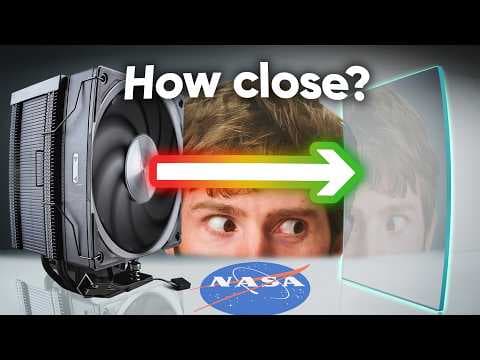
We Went to NASA To Solve a Computer Mystery
Audio Summary
AI Summary
This video investigates how much space a fan needs to operate effectively before it experiences airflow starvation, a common problem in PC case design. The research was conducted at NASA's Langley Research Center in Virginia, collaborating with scientists to determine optimal distances for PC cooling.
The initial method used was "tufting," a low-tech but crucial aerodynamic testing technique involving small pieces of string (tufts) attached to the back of a Noctua NFA12X25 fan. Acrylic panels were used as airflow restrictors, and their distance from the fan was varied from 3.5 cm down to 0.5 cm to observe the effect on airflow. As expected, at ample distances, the fan performed well, drawing air in and blowing it out. However, when the panel got very close, specifically 1.5 to 2 cm from the fan face, the tufts near the center became slightly floppy. Getting even closer caused the fan to not only blow ineffectively but also start sucking the tufts back into the blades, indicating reversed airflow. To better visualize this, a NASA-grade ultraviolet lamp and a high-speed camera (Kronos 4K12) recording at 1,000 frames per second were used to capture the glowing tufts in slow motion, revealing increased turbulent flow and tufts dragging into the fan's low-pressure areas.
The research then progressed to a more advanced technique: Particle Image Velocimetry (PIV). This involved shining a bright, thin vertical sheet of light, filling the air with particles, and rapidly taking pairs of pictures microseconds apart. Sophisticated mathematical algorithms were then used to determine the velocity (speed and direction) of these particles. While not tracking air directly, this method provides valuable insights into air behavior. The equipment used included a Levision Flowmaster, a high-precision machine capable of taking photos nanoseconds apart.
The first PIV test involved the fan with no obstruction, serving as a control. The analysis of the air flowing out of the fan revealed smooth and fast-moving flow, with a small section of no flow directly behind the fan hub where there are no blades. It was noted that Noctua fans' design, which throws momentum inward, contributes to reduced noise.
When a plate was moved closer to the fan, significant changes were observed once the distance reached approximately 15 mm. The "dead zone" (area of no flow) behind the fan hub became larger, and the airflow started to curl outward instead of coming straight out. This outward curling indicates lower streamwise momentum, which is less effective for cooling components or passing through restrictive heat sinks or radiators. This phenomenon is attributed to the difference in radial pressure, where lower-pressure air from the blade tips interacts with higher-pressure stagnant air near the fan hub. While not optimal, this level of restriction might still be acceptable for a case fan.
The worst-case scenario in open air, simulating a PC case against a wall or a power supply intake on a carpet, showed severe airflow starvation. The fan barely pulled any air in at the edges, and a reverse flow created a vortex that would not effectively move heat.
To test a scenario with higher back pressure, a water cooling radiator was introduced. Adding the radiator to an already restricted fan (at a very close distance) resulted in "zero flow." Backing off to a 15 mm gap yielded better results, but performance was still significantly reduced compared to the free-air test, with only about the outer 50% of the fan blades providing effective flow. Interestingly, the radiator straightened out the flow, eliminating the outward curling, but the air speed was cut by about half.
The overall conclusion for performance is that fans should be kept more than 15 mm (a little over half an inch) away from any surfaces for reasonable performance. For scenarios involving other obstructions like a heat sink or radiator, a clearance of 20 mm or more is recommended.
The research also delved into the acoustic properties of fans using NASA's anechoic chamber, known as "the shack," which can reach an extremely quiet 18 dB. Two microphone arrays were used: a linear array for broad sound directivity and a spiral (phase) array of 40 beam-forming MEMS microphones for detailed sound source localization. An industrial fan, significantly louder and faster than the Noctua fan, was used for sound testing due to the original fan being too quiet. This industrial fan had pressure-sensitive paint on it, which might slightly affect its performance but was deemed acceptable since only intake clearance was being compared.
Intuitively, one might expect covering a fan to decrease noise, but often the opposite is true until the fan is completely starved of air. The tests confirmed this, showing a broad-spectrum increase in noise when the front panel was present at 15 mm. This increase in noise is linked to the stalled flow in the middle of the fan, which causes overall air flow to be more unsteady and thus louder. This also appeared in the phase array results, further emphasizing the importance of adequate clearance to avoid increased noise and annoying resonances, as experienced by some PC case owners.
In summary, for optimal performance, fans require more than 15 mm of clearance from surfaces, extending to 20 mm or more when dealing with additional obstructions like radiators. For noise reduction, greater intake clearance is always better, as insufficient clearance can lead to increased noise due to unsteady airflow. The video highlights that scientific understanding is built upon many small discoveries, and this research provides crucial insights into the complex behavior of air and sound in PC cooling systems.