Congress Does NOTHING...Then This Happens
AI Summary
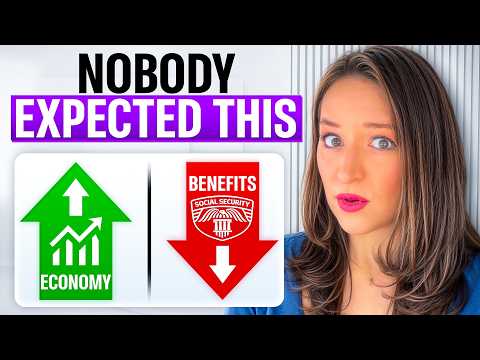
The Congressional Budget Office (CBO) has presented a counterintuitive scenario regarding Social Security: if Congress takes no action and benefits are automatically cut in 2032, the economy could end up larger in a few years than if benefits had remained unchanged. It's crucial to understand that this is a modeled scenario and not a prediction or an endorsement of benefit cuts.
The context for this discussion is that Social Security's Old Age and Survivors Insurance Trust Fund is projected to run out of money in 2032. This does not mean the Social Security program itself ends, but rather that by law, it can only pay out what it collects in payroll taxes. Historically, payroll tax revenue has been stable at 4-4.5% of GDP, while payouts have risen due to more retirees living longer. If the trust fund hits zero without reforms, current benefits would be cut. The Social Security Trustees project a 22% cut, meaning a $2,000 monthly benefit would become $1,560. The CBO's modeling, which this discussion is based on, projects a shortfall starting smaller in 2032 and climbing to an average of 28% by 2036.
The CBO's "payable benefits scenario" assumes that benefits automatically shrink to match incoming revenue starting in 2032. In this specific model, people do not anticipate the cut, so they don't alter their saving or work habits beforehand; it's a sudden, unannounced reduction.
Initially, the CBO estimates align with common sense: less money for people means less spending. Real GDP would be 0.7% lower in 2033 (the year after the cut) compared to if benefits had continued as scheduled. Unemployment would slightly increase, and inflation would slightly decrease. The Federal Reserve is assumed to lower interest rates to mitigate the impact.
However, the surprising part of the CBO's projection is the long-term outlook. While the CBO report through 2036 shows an initial dip, another CBO report extending to 2053 projects the economy could be 5% bigger over that longer period. This suggests the long-term gain could be substantially larger than the 2036 figures imply.
The CBO identifies three main reasons for this long-term economic expansion:
1. **People work more:** If future benefits shrink, some individuals may respond by working more hours, staying in the workforce longer, or even re-entering the workforce after retiring. More workers contribute to higher productivity. For instance, a 58-year-old planning to retire at 62 might work until 64 if their benefits are cut by 25%.
2. **People save more:** Workers who haven't retired yet, anticipating reduced benefits, may increase their savings to bridge the gap. This additional savings doesn't remain idle; it gets invested, which enhances economic productivity.
3. **The government borrows less:** Social Security has been in a shortfall since 2010, covering it by cashing in Treasury bonds from its trust fund. Once the trust fund is depleted in 2032, any remaining gap would be covered by new government borrowing. If benefits are cut to match revenue, this gap shrinks, leading to less new government borrowing. Reduced government borrowing frees up credit markets for private investment and slightly lowers interest rates. The CBO estimates the 10-year Treasury rate could be 0.4% lower in 2033 (e.g., from 4.2% to 3.8%). Even a small drop in these benchmark rates can significantly impact other borrowing costs like mortgages, auto, and business loans.
Combined, these factors also positively impact the federal budget. The CBO projects federal debt held by the public would be $52.8 trillion in 2036 under this scenario, compared to $56.2 trillion if benefits remained unchanged. As a share of the economy, this translates to 112% of GDP instead of 120%.
In essence, the CBO projects that an immediate benefit cut would initially harm the economy but, in the long term, would leave it larger and stronger than if no cuts occurred. This direction aligns with established economic principles: if people expect lower benefits, they may work longer, save more, and delay retirement. The primary debate centers on the *magnitude* of these behavioral changes. If people's behavior changes minimally, the long-term economic benefit would be much smaller. However, if millions significantly alter their work and saving habits, the CBO's projection becomes more plausible. The extent of these behavioral changes is a major uncertainty in the model.
The CBO acknowledges that the impact of these changes would vary significantly by age and financial situation. Retired individuals or those nearing retirement would have little time to adjust, experiencing a straightforward loss. Younger individuals, especially those with higher earnings, would likely change their behavior the most (adjusting work hours, duration, and savings) and stand to benefit from a growing economy and higher wages. The CBO specifically notes that the boost in income and wealth is largest, in percentage terms, for younger people with higher earnings. Therefore, the pain would largely concentrate in older generations, while the gains would primarily accrue to younger generations.
It's important to reiterate that this CBO model is an "illustrative scenario," not a prediction. It's based on specific economic assumptions, and the CBO admits to uncertainties regarding how people would react to a benefit cut, how those behavioral changes would ripple through the economy, and the future state of the broader economy.
The speaker personally believes Congress would not allow an automatic cut to benefits, considering Social Security beneficiaries' high voter turnout. Action is deemed more likely than inaction. However, understanding this scenario is valuable as a baseline for comparison.
If Congress were to act, several ideas are currently under consideration:
1. **Raising or eliminating the payroll tax cap:** Currently, earnings above $148,500 are not subject to Social Security payroll taxes. Eliminating this cap entirely, as proposed by Senators Bernie Moreno and Elizabeth Warren, could close 50-66% of the long-term funding gap. However, this would mean a 12% tax increase for those in the highest brackets, potentially pushing their marginal tax rate (federal and state combined) to 50%.
2. **Changing the cost-of-living increases (COLAs):** Using a "chain-weighted CPI" would not cut benefits outright but would slow their growth over time. Long-term projections suggest this could close 10-15% of the gap, making it a partial solution.
3. **Gradually raising the retirement age:** Congress has done this before (in 1983). Phasing it in over decades would primarily affect younger workers, not those currently retired or near retirement.
4. **Capping benefits on the high end:** Very high-income earners could see their benefits grow more slowly or be capped at a certain inflation-adjusted point.
Unlike the "payable benefits" scenario, these reform ideas have not been run through the same detailed CBO economic model with specific GDP numbers attached in published reports. While the directional reasoning holds, economists disagree on the precise magnitude of their impact on the overall economy.
A third path, considered likely by some retirement economists in the short run, is for Congress to simply borrow more to make scheduled payments. This avoids immediate benefit cuts or tax increases, especially around a presidential election year (2032-2033). Estimates suggest this could mean $600-$700 billion in additional Treasury borrowing annually, on top of existing debt and deficits.
However, increased government debt could lead people to question the government's ability to repay, potentially driving up interest rates. Rising Treasury yields ripple through the economy, affecting mortgage and auto loan rates. Large-scale government borrowing also means competition with private businesses for capital, which can push up private borrowing costs. These factors could lead to higher inflation and slower economic growth – the opposite of the CBO's optimistic long-run model, which depends on deficits coming down if benefits are cut. If Congress resorts to borrowing, the debt would continue climbing without the projected economic growth.
In conclusion, the 2032 Social Security shortfall is real. If Congress does nothing, the near term will be painful, especially for retirees. However, the medium-term economic effects, as modeled by the CBO, are more complex and counterintuitive than typically portrayed. Any reform will involve trade-offs, and a combination of borrowing, higher taxes, and reduced future benefits for younger workers is likely. The situation is unlikely to be solved by a single measure, and its unfolding remains to be seen. The speaker reiterates that Congress is unlikely to do nothing.