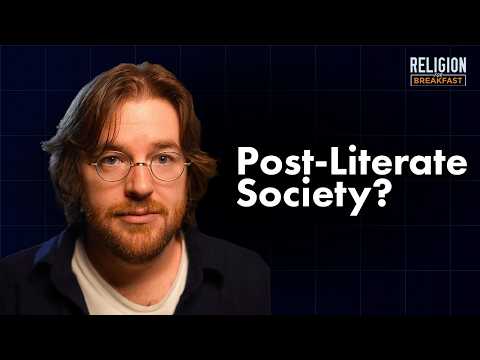
Why AI Feels Spiritually Dangerous | ft. Jared Henderson
AI Summary
Jared Henderson, a philosopher and author turned YouTuber, explores the impact of modern technology on human consciousness, ritual, community, and grief. His work on Substack and YouTube delves into topics like attention, reading, artificial intelligence, and synthetic relationships, offering a historical and philosophical perspective on contemporary anxieties.
Henderson's journey from academia to YouTube was driven by a desire to engage in intellectual discussions after leaving a PhD program and working in tech. He found the academic job market challenging and missed the intellectual community of university life. His channel initially covered various topics but has since narrowed its focus to philosophical questions about modern life, particularly our technological environment. He emphasizes that while current technological issues, such as the attention economy, have reached an unprecedented scale, they are not entirely new in kind. Similar concerns about information overload arose with the printing press, and historical solutions offer comfort that present challenges can also be overcome.
The conversation touches upon the concept of a "post-literate age," where video and audio increasingly replace reading. While mass literacy is a relatively recent phenomenon in human history, the introduction of writing profoundly transformed human consciousness, facilitating memory and new forms of reflection. Henderson argues that the shift to a "broadcast society" – where information is primarily consumed and recorded through platforms like TikTok and Instagram – will similarly transform human consciousness, not as a reversion to oral traditions, but as a new phase of technological evolution. This broadcast society, characterized by performativity and a lack of shared context, changes how information is transmitted, stored, and even how we think about problems. For instance, the evolution of recipes from oral traditions to precise written instructions and now to rapidly evolving video trends illustrates how the medium shapes the content and its cultural impact.
A significant concern for Henderson is the outsourcing of human cognition to AI, particularly large language models like ChatGPT. He worries about "deskilling," where individuals lose the ability to perform tasks like writing or coding by relying on AI. He notes that people often treat AI as authoritative, even despite its known flaws, leading to a decline in critical thinking and intellectual virtues. Henderson believes that writing, for example, is not just about extracting information but about structuring thoughts, developing rationality, and communicating effectively – skills essential for a well-lived human life. If AI performs these tasks, individuals may not cultivate these crucial intellectual virtues.
The impact of AI on education is also discussed, with concerns about students and even professors using AI for assignments and grading, potentially devaluing the educational process and threatening the existence of specialized academic fields and language departments. Universities, traditionally bastions of knowledge preservation and transmission, face an uncertain future if the core functions of education and research are undermined by AI.
Henderson and the host, both ex-academics turned YouTubers, grapple with the irony of criticizing the post-literate, broadcast society while contributing to it. Henderson views his YouTube work as a public service, making knowledge accessible to those who cannot attend traditional seminars. He aims to encourage viewers to engage with ideas and ancient texts directly, fostering a "life of the mind" beyond academic institutions. He notes that many viewers report reading more after watching his videos, indicating that platforms like YouTube can serve as an "on-ramp" to deeper intellectual engagement.
The conversation then turns to the unsettling nature of synthetic relationships, particularly AI chatbots designed to mimic deceased relatives. Henderson finds this practice deeply profane, arguing that it undermines established rituals for mourning and processing grief. He emphasizes that traditional rituals acknowledge the sacredness of the dead and the necessary transformation of our relationship with them. AI avatars, by creating a false sense of continued presence, bypass the essential human experience of grief and personal growth that often arises from loss. He likens it to replacing a deceased spouse with an identical-looking person, highlighting the philosophical concept that love is directed towards a particular individual, not a mere replica.
The discussion extends to AI companion chatbots, which some users report forming incredibly strong bonds with, sometimes surpassing their human relationships. While acknowledging potential psychological benefits for lonely individuals, Henderson expresses concern that this trend, consistent with the historical impact of technologies like television and the internet, will further increase alienation and diminish genuine social connection and community formation.
Both express a shift from techno-optimism in the 2010s to a more critical stance in the 2020s. They acknowledge that every technology offers benefits but also exacts a cost. The widespread adoption of technology without critical questioning has led to current downsides, prompting a re-evaluation of how much technology is truly needed in life. While not advocating for a complete rejection of technology (a "Luddite" stance), they emphasize the importance of nuanced thinking and critical assessment. Henderson argues that "Luddites," often misunderstood, play a crucial role in highlighting the potential downsides of technological progress. He concludes by offering practical advice for re-engaging with reading, suggesting starting with enjoyable books and carrying them to fill small pockets of free time, gradually rebuilding reading habits and attention spans.