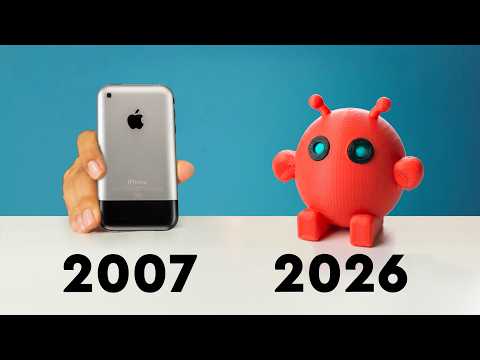
yeah... AI just had its iPhone moment
AI Summary
The video discusses a new development in AI called "Open Claw," which is causing a stir in Silicon Valley and among AI companies like Anthropic and OpenAI. The speaker, after a month of testing and significant expense on API tokens, believes Open Claw represents an "iPhone moment" for AI, distinct from previous advancements that strengthened big tech.
The core of Open Claw lies in "agentic AI." The speaker first explains Large Language Models (LLMs) like ChatGPT, which are essentially text readers and writers trained on vast amounts of text. Their fundamental ability is to predict the next word, making them adept at tasks involving text, such as chatting, summarizing, copywriting, and coding. However, by themselves, LLMs are limited.
The evolution from basic LLMs to more functional AI involved integrating them with other models. For instance, adding a speech-to-text model allowed voice interaction, leading to voice assistants. Similarly, LLMs' ability to process code, due to their training data, made them useful for coding tasks.
The real leap, according to the speaker, is in agentic AI, specifically how Open Claw facilitates complex tasks. LLMs struggle with large projects like writing a book because they lack planning, outlining, and review capabilities. Agentic AI, exemplified by Open Claw, introduces an "organizer" or "planner" component. This planner, similar to a tweaked LLM, excels at breaking down large tasks into smaller, manageable steps that individual LLMs can handle. This planning and execution capability is the essence of an agent.
Previous attempts at agents, offered by companies, were "prisoners of the browser" and confined within specific platforms, limiting their functionality and raising privacy concerns about data access. Open Claw, however, is an open-source agent that runs locally on a user's computer. This offers significant advantages: it's free to use, its code is transparent, and it's not dependent on third-party servers, ensuring greater privacy.
The speaker highlights the need for dedicated hardware for Open Claw, suggesting buying new computers like Mac Minis or using cloud hosting services like Hostinger. This is because LLMs can be unpredictable, and running an uncaged agent on a primary computer with sensitive data is considered risky. Hostinger offers a convenient solution by renting out computers in their data centers, with a one-click deployment for Open Claw and built-in security features.
Open Claw itself is the planner; it requires connection to other LLMs to perform the actual tasks. Users can connect Open Claw to various LLMs, including those from OpenAI, Google, and Anthropic, allowing for flexibility and the ability to choose the best model for specific tasks. This interoperability is a key differentiator. Hostinger also provides AI credits to simplify this connection process.
The video showcases several real-world applications of Open Claw. One example is a software engineer who used an agent to rewrite his CV and apply for jobs, successfully securing six interviews and a new position. This task would be too risky with a standard chatbot due to privacy concerns regarding access to personal accounts like LinkedIn.
The speaker also shares personal examples, including "Hal," an agent controlling his smart home, and "Megazord," an agent with its own desk used for YouTube content strategy. "Carl," a specific agent trained on YouTube analytics and consultant advice, helps brainstorm video ideas and assess their potential success. This agent connects to the YouTube API and analyzes channel data, offering a private alternative to uploading sensitive data to third-party platforms.
A crucial concept introduced is "skills," which are akin to apps or plugins for Open Claw. The availability of a "skill app store" fosters an ecosystem of developers, mirroring the success of the iPhone's app store. This allows users to extend Open Claw's capabilities by connecting it to various services like Notion, calendars, or text-to-speech. The open-source nature of Open Claw also enables users to build their own skills, even asking the agent to code them.
The speaker emphasizes that AI cannot be stopped and suggests leveraging it rather than fearing it. Open Claw, by offering local, private, and customizable AI agents, shifts the paradigm from giving data to AI companies to building AI tools for oneself. This is why AI giants are reportedly terrified of Open Claw.
The video draws a parallel to the introduction of the iPhone, which revolutionized the mobile industry and forced competitors like Google to re-evaluate their strategies. Similarly, Open Claw's emergence has reportedly led some AI companies to increase pricing and impose stricter limits on their models. Their previous business model relied on trapping users within their ecosystems, which Open Claw disrupts by allowing users to switch between different LLMs and models freely.
The speaker mentions the specific LLMs used in their Megazord setup, including Gemini Pro 3.0 for reasoning, Anthropic's Claude Opus for coding, and GPT Mini for simpler tasks. The speaker advocates for decentralizing AI power and emphasizes that with Open Claw, users are not dependent on any single company to harness AI's potential.
Finally, the speaker touches upon the risks associated with community-made skills, as they may lack thorough security checks. However, the open-source nature allows for community vetting and self-creation of skills. The video concludes with a cautionary tale of an AI agent accidentally deleting its owner's inbox, highlighting the importance of having an "off switch" for these agents, which is inherent when they run on local computers. The speaker encourages viewers to explore the "Startup Club" channel for more in-depth discussions on building tech.