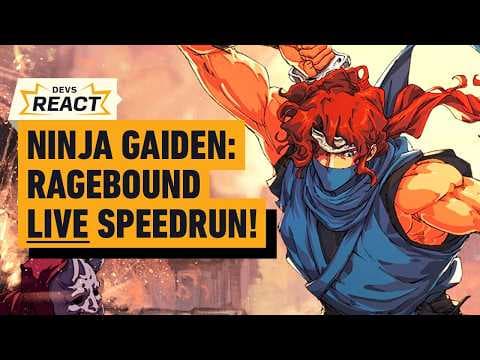
Ninja Gaiden: Ragebound Developers React to a Live Speedrun
Audio Summary
AI Summary
David Mandreo, game director and producer for Ninja Gaiden Ragebound, and Oruriel Tartarin, game designer, join Brian, also known as Cutie, a speedrunner and host for Gamesquick, for a live speedrun of Ragebound. This is the first time IGN has done a live dev react. Brian emphasizes that this won't be a world record run but promises to do his best.
The speedrun begins with the first tutorial level. Oruriel notes that the first two tutorials were the most iterated levels in the game, developed later to ensure all mechanics were taught to players. David expresses curiosity about potential skips, as the goal was for players to at least try basic moves like wall climbing and long jumps. Brian quickly demonstrates skips, bypassing enemies and using precise jumps to advance. The developers comment on a particular jump that was difficult to perform consistently, even for them. Brian frequently lands on spikes, explaining that it's often the faster way to traverse sections despite taking damage. He also utilizes a "crouch cancel" technique, which was a "hot topic" during development due to its exploitable nature, though it was eventually nerfed.
Brian collects most of the collectibles, surprising the developers who expected him to skip them entirely. He also demonstrates a "guillotine boost" on projectiles, a mechanic the developers are glad they implemented as it aids traversal. One of the talismans Brian equips increases damage as his HP decreases, which he uses strategically. The speedrun highlights how Brian often avoids fighting enemies, preferring to roll past them or use environmental elements to his advantage. The developers note that some bosses can be continuously stunned with a hypercharge, preventing them from attacking.
During a section with high trees, David recalls that a designer, Miguel, intended for players to be able to time jumps and maintain a rhythm to play it quickly, which Brian exemplifies. The run continues with Kumori's section, which plays differently due to her spammy attacks. Brian performs an "elevator skip" and throws knives before enemies even spawn, leading to a build-up of enemies behind him. The developers are impressed by his quick skips of cutscenes, acknowledging that artists would be sad to see them bypassed. They recall how Brian was often asked to choreograph cool moves for promotional footage during development.
The team discusses the "S tier" scoring system in the game, noting that achieving S+ on every level in a full run is considered "crazy" and likely hasn't been done, though individual level S+ runs are common. They then move on to a section featuring a demon chasing the player through a subway, a favorite moment among the development team. The level also features subtle audio details from a train station, added by the audio designer. David mentions the challenges of balancing speed and visibility during the bike sections, requiring significant iteration.
In the "steel mine" level, Brian uses a talisman that reduces damage on hypercharge, which combines well with his playstyle. He demonstrates freezing enemies downwards, a tutorial mechanic. The developers note that they placed many enemies in this section for players to charge up Ragebound orbs, but Brian doesn't need them. They also recall the fun they had developing the mid-level banters between Kenji and Kumori. The art for this level was heavily iterated upon, with final art coming very late in development due to changes in combined mechanics.
During a level with large pits and breaking platforms, Brian uses a "guillotine boost" to activate a cog, a move the developers hadn't considered. Kumori's sections were designed with speedrunning in mind, featuring timers that reset the challenge if they run out. Brian skips most of the orbs that extend the timer. A significant skip in a previous demo, which allowed players to jump over a falling platform into "blockout territory," was patched out.
The "pirate cave" level, one of the earliest levels developed with both Kenji and Kumori, underwent many iterations, particularly concerning vertical challenges and screen space management to avoid unfair enemy encounters. The developers aimed to make almost every projectile hitable with a boost, allowing players to use them as platforms for traversal. They also made adjustments to downward vertical sections to prevent players from falling into pits.
As the game progresses to the final section, military enemies are introduced after a plot twist. These enemies, armed with guns, were designed to increase the game's difficulty by forcing players to manage threats from a distance. Brian, however, often bypasses them without engaging. The developers are surprised by Brian's ability to use "guillotine jumping" to avoid electrical spikes that were intended to hit the player. They acknowledge that the game's difficulty curve was a major design challenge, aiming to be challenging like the Ninja Gaiden series while still being accessible. They encourage players who find the game easy to try for S tier on every level in hard mode.
Brian then explains some of his techniques: the grapple boost on electrical fields works if there's a ledge above, allowing for short hops. The guillotine boost has a one or two-frame window after boosting on spikes where a jump or roll can be performed without taking damage.
The "lava level" features platforming and heavy combat. The lava effect, credited to Leper and Lewis, was initially too damaging but was adjusted to allow players to stick to it and roll when it rises. Brian continues his rapid pace, bypassing ambushes and gatling gun enemies without stopping. The game introduces "bio things" and a second plot twist. The developers recall that one particular boss was considered very hard during development, requiring them to tone it down for the main game, with the original difficulty reserved for the hard mode.
An early "elevator section" was completely redone later in development to incorporate more interesting enemies. Brian navigates laser grids and crawling sections, narrowly avoiding traps. He also skips a "triple scarab" collectible. An infamous bug involving lasers that blocked the way was also patched out. The speedrun then showcases a boss that doesn't move but throws deflectable balls, requiring specific patterns.
The "train ride" level was one of the most challenging to create due to the coordination required between foreground, background, and enemies. Brian demonstrates precise "guillotine jumping" on traffic lights. The developers note that there are spots where infinite guillotine boosts are possible. They recall many deaths during playtests in this section. The "bike ninja" enemies were among the first concepts developed.
In the final level, featuring a helicopter chase and rooftop combat, Brian continues to showcase his mastery. The developers mention that each level was designed to tell a story through its environment and events, making them more memorable. They highlight unique animations, like a demon hijacking a helicopter, which are only seen once or zero times if players skip cutscenes.
The final boss, the Demon Lord, is encountered. The developers describe the extensive effort put into animating the boss, taking months to complete. Brian then reveals a "secret" glitch: if Kmori has "last stand" equipped and performs a supercharge that would reduce her health to zero, she becomes invincible. While technically banned in speedruns, Brian wanted to demonstrate it. The speedrun concludes, with David and Oruriel expressing their amazement at Brian's skill and how he made a difficult game look easy. Brian praises the game's music, pixel art, and movement, urging viewers to buy it.