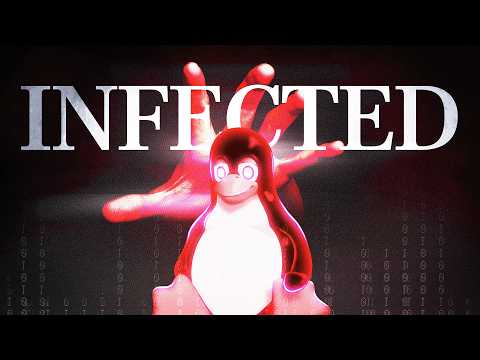
How One Hack Nearly Took Down The Internet
AI Summary
In 2024, the global tech community narrowly avoided a digital catastrophe when a lone developer discovered a sophisticated backdoor in XZ Utils, a critical data compression tool used in nearly every Linux distribution. This event exposed a fundamental vulnerability in the internet's infrastructure: the world’s most secure systems often rely on small, obscure libraries maintained by single, unpaid volunteers.
The story of how we became so vulnerable begins with the birth of the open-source movement. In the 1980s, researcher Richard Stallman founded the Free Software Foundation after being denied the source code to fix a jammed printer. He believed software should be free to run, study, change, and share. This philosophy led to the creation of the GNU Project and, eventually, the Linux kernel by Linus Torvalds. Today, Linux powers everything from supercomputers and nuclear submarines to the majority of the world’s internet servers. Because the code is open, it is governed by "Linus’s Law," which suggests that "with enough eyeballs, all bugs are shallow." However, the XZ incident proved that when a project is obscure enough, those eyeballs may not be looking.
The modern open-source ecosystem is a complex web of dependencies. Large programs like OpenSSH—the "maintenance backbone of the internet" used for secure remote logins—rely on thousands of smaller tools. One such tool is XZ Utils, created in 2005 by Lasse Collin, a developer in Finland. Over nearly two decades, XZ became the industry standard for lossless compression due to its efficiency. Despite its global importance, Collin maintained the project as an unpaid hobby. By 2021, he was suffering from burnout and mental health struggles while facing increasing pressure from the community to update the software.
This pressure was part of a calculated social engineering campaign. Using "sock puppet" accounts—fake identities created to manipulate public perception—an entity known as "Jia Tan" began pressuring Collin to hand over control of the project. Jia Tan appeared as a "helper elf," a highly competent and responsive contributor who eventually earned Collin’s trust. By 2023, Jia Tan had become a co-maintainer, gaining the authority to modify the XZ source code directly.
Jia Tan’s plan to compromise the internet was a meticulous three-step operation. The first step was the "Trojan Horse." Jia hid malicious code inside binary "test blobs"—files used to check if compression is working correctly. Because these files are not human-readable text, they are rarely scrutinized by other developers. Jia then modified the project’s build script to quietly unpack this hidden payload and inject it into the XZ library during installation.
The second step, known as the "Goldilocks Zone," involved hijacking the authentication process of OpenSSH. Jia realized that if he could compromise the RSA decryption function, he could create a "master key" to any server. To do this, he exploited a feature called an IFUNC resolver, which normally optimizes code for different hardware. Jia used the resolver to find a precise, millisecond-long window during the system’s startup—after the real RSA function was loaded but before security protections locked the memory—to swap in his malicious payload.
The final step was the "Cat Burglar." Jia’s backdoor was designed to be invisible. It didn’t just open a door for anyone; it listened for a specific, encrypted master key that only Jia Tan possessed. If the key was present, the backdoor granted root access; if not, the system behaved normally. Jia even included code to wipe logs and prevent crashes, ensuring the intrusion would remain undetected by standard security audits.
The backdoor was successfully integrated into pre-release versions of major Linux distributions like Fedora and Debian. It was weeks away from being included in stable releases that power hospitals, governments, and banks. However, the plan unraveled because of a 500-millisecond delay.
Andres Freund, a Microsoft engineer, was testing a version of Debian when he noticed that SSH logins were slightly slower than usual. While most would have ignored a half-second lag, Freund’s curiosity led him to investigate. He traced the slowdown to XZ Utils and discovered the hidden code within the binary test files. His public report sent shockwaves through the industry, leading to an immediate rollback of the compromised software.
The identity of Jia Tan remains a mystery. The sophistication of the hack, the multi-year social engineering campaign, and the high level of technical expertise suggest a state-sponsored actor. While timestamps initially pointed to China, further analysis suggested the work of APT29, a Russian-linked hacking group, though nothing is certain. Jia Tan vanished from the internet the moment the backdoor was discovered.
The XZ incident serves as a "canary in the coal mine." It highlights the danger of "single points of failure" in open-source software and the unfair burden placed on volunteer maintainers. While open source remains more transparent than proprietary software, the community now faces a difficult question: how many other "helper elves" are currently weaving backdoors into the foundations of the digital world? As attackers become more patient and sophisticated, the survival of the internet may depend on supporting the people behind the code as much as the code itself.