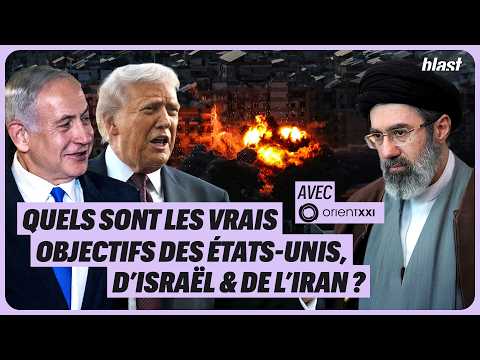
GUERRE AU MOYEN-ORIENT : QUELS SONT LES VRAIS OBJECTIFS DES ÉTATS-UNIS, D’ISRAËL ET DE L’IRAN ?
AI Summary
The following summary is based on the provided transcript regarding the geopolitical crisis involving the United States, Israel, and Iran as of February 2026.
### The Conflict and the Official Narrative
On February 28, 2026, the United States and Israel launched massive strikes against Iran. The official justification provided by Benjamin Netanyahu was the "liberation" of the Iranian people from a terrorist regime. However, the reality on the ground contradicts this humanitarian rhetoric. The strikes have resulted in over 1,200 civilian deaths, including 168 children killed in a school bombing. While Donald Trump claimed the intervention was necessary because Iran was on the verge of obtaining nuclear weapons, the International Atomic Energy Agency (IAEA) reported no evidence to support this claim.
### The Sabotage of Diplomacy
A central insight from the discussion is that these strikes occurred just as a historic diplomatic resolution was within reach. Negotiations between the U.S. and Iran, which had been progressing since June 2025, were reportedly 48 hours away from a positive conclusion. Experts Bernard Hourcade, Sarah Grira, and Sylvain Sipel argue that the war was a deliberate attempt to sabotage this rapprochement. Netanyahu has consistently opposed any U.S.-Iran agreement since the early 2000s, viewing a negotiated peace as a threat to Israel’s strategic goals. By initiating war, radical factions in Israel and the U.S. effectively neutralized the possibility of a diplomatic "grand bargain" that would have normalized Iran's status and potentially weakened its Islamic regime through political evolution rather than violence.
### Strategic Goals: Redrawing the Map
The true motivations for the war appear to be geopolitical rather than preventive. Israel’s objective is to ensure it remains the sole hegemonic power in the Middle East by "raying Iran off the map" as a regional competitor. This strategy involves dismantling not just the regime, but the Iranian state’s industrial and military infrastructure, specifically its missile capabilities.
Furthermore, the conflict serves broader U.S. interests regarding China. Iran acts as a primary energy supplier and a strategic trade hub for China. By destabilizing Iran and controlling its oil flow, the U.S. exerts pressure on its main global rival. The experts suggest that the "nuclear threat" is merely a rhetorical tool used to justify a war aimed at regional reconfiguration and global energy control.
### Regional Escalation and the "Gaza Precedent"
The war has rapidly expanded into Lebanon, where Israeli bombardments have displaced over 7,600 people. The transcript highlights a "new era" of international relations where the "law of the strongest" prevails. The speakers argue that the international community’s failure to stop the genocide in Gaza created a precedent of total impunity. Today, international law is applied selectively; Western leaders like Ursula von der Leyen and Olaf Scholz are criticized for exempting Israel from the rules of war while demonizing Iran.
This shift is accompanied by a "civilizational" discourse, exemplified by U.S. officials like Marco Rubio, which the experts interpret as a move toward the "recolonization" of the Global South. This logic suggests that certain lives are worth more than others, a sentiment echoed in French politics where President Emmanuel Macron offers theatrical support for Lebanon while his government refuses to condemn Israeli strikes as disproportionate.
### Internal Dynamics in Iran and Israel
Inside Iran, the regime was already fractured following massacres of protesters in early 2026. However, the foreign strikes have triggered a nationalist reflex, allowing the state to consolidate power under the guise of national defense. The succession of Ali Khamenei by his son, Mojtaba, is viewed not as a sign of strength, but as a symptom of a regime at the "end of its rope," unable to find a viable political successor amidst a "suicidal" military situation.
In Israel, public support for the war remains incredibly high, with over 90% of the Jewish population backing the operations. This creates a feedback loop where Netanyahu can ignore U.S. calls for restraint, betting that the U.S. will never withdraw its support. Despite internal disagreements within the Trump administration, the U.S. continues to provide billions in military aid, highlighting a deep, structural alliance that transcends individual policy disputes.
### Conclusion: A Warning to the West
The discussion concludes with a warning that the erosion of international law and the dehumanization of populations in the Middle East will eventually rebound upon the West. The tactics tested in Palestine and Iran—such as total surveillance, the normalization of civilian "collateral damage," and the dismissal of international mandates—are increasingly being integrated into Western governance and policing. The speakers urge citizens in Europe and the U.S. to recognize that the "new world order" being forged through these bombings is fundamentally an assault on the universal principles of human rights and democracy.