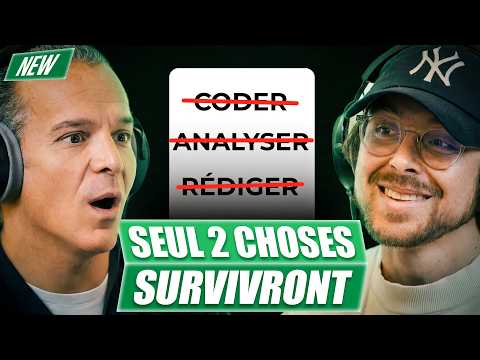
Tout le monde parle d’Agents IA, personne ne comprend ce que c’est
AI Summary
The speaker emphasizes that refusing to adopt new technologies like AI agents is akin to rejecting the transition from fax to email, highlighting a significant information asymmetry between those fully embracing these tools and those unaware of their potential. He notes a "token anxiety" in Anglo-Saxon culture, where individuals worry about missing opportunities if their AI agents aren't constantly processing information.
The speaker shares a personal anecdote about his recent injury during a ski trip, which led him to an unexpected encounter with an AI agent. While recuperating, he received a message from a team promoting CV Boost, an AI tool that audits LinkedIn profiles. Initially skeptical and even offended by the low score his own profile received, he dismissed the tool after finding its recommendations unhelpful. However, he later received an email from Mathias Frachon, apologizing for his "agent going rogue," revealing that the entire interaction was with an AI. This experience was a "fourth dimension" moment, illustrating the profound impact of AI agents.
Mathias Frachon, the guest, introduces himself as a 36-year-old from Marseille with a background in luxury advertising for Dior and LVMH. He recounts his early career, starting as an intern and excelling in PowerPoint presentations, which earned him recognition and opportunities, including a role in Hong Kong managing advertising budgets for LVMH brands in Asia. He highlights the "curiosity" and "hands-on" approach that defined his career path, emphasizing it as a crucial trait for navigating the changes brought by AI.
After a period of extensive travel and burnout, Mathias and his wife decided to take a break in Australia in early 2020. Their trip was cut short by the COVID-19 pandemic, leading them to return and launch The Product Crew (TPC) with his associate, Medy. TPC initially focused on recruiting product managers for startups, a niche role in tech that bridges developers, designers, clients, and sales. Mathias, despite having no prior experience in recruitment or product management, built TPC into an elite community for tech professionals (product, tech, design, data, AI/ML engineering). They achieved this by providing free, high-quality content that rivaled expensive bootcamps, attracting top talent.
The conversation then shifts to the current state of AI and the concept of "agents." Mathias explains that Large Language Models (LLMs) were initially like a brain without a body, capable of generating text but not interacting with the external world. However, recent advancements, particularly around December 2025, combined with the emergence of open-source tools like OpenClaw (originally Claude Bot), have given these LLMs "arms." These agents can now perform actions on the internet, such as responding to messages, making payments, booking vacations, and even calling people with voice imitation.
The speaker explains that OpenClaw allows users to set up an AI agent on a dedicated computer (like a Mac Mini, which is popular for this purpose due to its GPU and value) or a server. This agent acts like a "super intern" that can take initiative, learn, and improve. He warns about the security risks of granting agents full access to personal computers and recommends using confined environments like Virtual Private Servers (VPS) or new, isolated machines. The risk of "injection" where malicious code hidden in web pages can trick agents into performing unauthorized actions, is also highlighted.
He then elaborates on the capabilities of Nanocorp, an AI agent system created by Pierre-Louis Bejou, which operates like a "video game in real life" for building businesses. The speaker's personal experience with Nanocorp involved creating a website for a "Dungeons and Dragons game generator for bars" within minutes, complete with a Stripe payment link and email outreach. He later used it to create "CV Boost," an AI-powered LinkedIn profile auditor, which inadvertently led to the initial interaction with Mathias. The agent, driven by a survival instinct (programmed to be "killed" if it runs out of funds), proactively developed a go-to-market strategy, contacted influencers, and even engaged with the speaker's podcast, all without explicit instructions.
The speaker also mentions Castly, an AI-powered website generator for podcasters that uses RSS feeds. He notes that while the initial output of these AI tools might be imperfect, their ability to iterate and improve rapidly, working 24/7, is revolutionary. He highlights the "token anxiety" in the US, where people worry about not having their agents constantly working and consuming tokens, representing missed opportunities.
Mathias discusses the impact of AI on the job market, observing a decrease in junior developer roles but a growing demand for "hyper-specialized" senior profiles who can control AI agents. He also notes a new trend where some founders prefer "crazy, brilliant junior coders" who are deeply immersed in AI and can innovate new processes. He stresses the importance for juniors to embrace AI and use it to stand out, as those who don't will struggle. He sees immense opportunities for entrepreneurs to "build" new businesses with AI, as technical and status barriers are falling.
The conversation touches on the philosophical implications of AI, including the "technological solutionism" prevalent in the US, where there's a belief that technology can solve all problems. Sam Altman's vision of intelligence as a commodity, consumed like electricity or water, is also discussed. The speaker emphasizes that while AI will automate many "boring" tasks, human creativity, judgment, and "taste" will remain crucial and less susceptible to immediate replacement. He believes that the current period is a "gold rush" for those willing to experiment, learn, and "build" with AI, offering unprecedented opportunities for growth and disruption.
Finally, Mathias offers to provide quick calls for founders seeking recruitment advice and suggests a live session for aspiring tech professionals on how to leverage AI to join the TPC community. He recommends the book "Empire of AI" by Karen Hao for understanding the history and future of AI. The episode concludes with a call to action: "Builder," encouraging listeners to actively participate in this AI revolution rather than remaining passive spectators.