Prediction Markets are better than Crypto Exchanges.
AI Summary
The speaker presents five reasons why prediction markets are currently superior to crypto exchanges for making money. The central argument is that prediction markets offer a more accessible and profitable environment for traders.
The first reason highlights the unique nature and diversity of prediction markets. Unlike crypto exchanges, which primarily focus on a limited number of assets like Bitcoin and Ethereum for options and futures trading, prediction markets offer a vast array of betting opportunities. These include elections, weather, sports (like esports, baseball, and the Masters), global politics, finance (such as oil), and "mention markets." This wide variety creates numerous unique edges for traders, as opposed to the more constrained options on crypto exchanges where the primary goal is often just predicting Bitcoin's price movement.
Secondly, the speaker contends that counterparties on prediction markets are "dumber" or less sophisticated compared to those on major crypto exchanges like Binance. This perceived lack of sophistication makes it easier for traders to find "expected value" and profitable trades. The speaker illustrates this by suggesting that even in seemingly random events, like a baseball game, a discerning trader can identify an edge by exploiting inefficient pricing or delayed data. For instance, a home run might be scored, and for a brief moment, a trader could "snipe" a favorable bid before the market fully adjusts. This inefficiency, even in popular markets like baseball, is attributed to the less efficient nature of prediction markets compared to the highly optimized and smart crypto markets, where consistent long-term profitability is challenging due to the market's intelligence.
The third point emphasizes non-correlated returns available in prediction markets. In crypto trading, especially for medium to long-term traders or those with a specific bias (e.g., shorting or longing Bitcoin), returns can be highly correlated. For example, simultaneously shorting Ethereum, the S&P 500, and Bitcoin would result in highly correlated returns. In contrast, prediction markets allow for entirely uncorrelated bets. Betting on the Chicago Cubs to win one game and the New York Knicks to win another has no correlation; the outcome of one does not affect the other. This independence means that even when general market volatility is low, or a specific strategy requires a particular market movement (like Bitcoin going up or down), prediction markets always offer trending markets and opportunities, often with no correlation between different events. This constant availability of uncorrelated opportunities is deemed more important than commonly perceived.
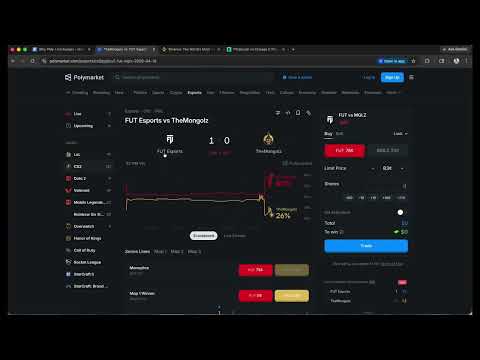
The fourth and "most important" reason is the ability to master a niche within prediction markets. The speaker encourages traders to identify what they are good at and exploit it. While sports are a common choice, traders can specialize further, for example, in specific esports like Counter-Strike, Dota 2, League, Rainbow, or Valorant. These niche markets, even those worth millions, can present significant inefficiencies that allow a knowledgeable trader to make substantial profits, potentially five or six figures in a single game. The speaker contrasts this with crypto, where profitable niches are far fewer than commonly believed, even when considering different trading styles like RSI or options trading. The vast array of options in prediction markets makes it "impossible" not to find an edge in at least one market.
Finally, the speaker highlights the prevalence of risk-free returns through arbitrage in prediction markets, which is much harder to achieve consistently in traditional crypto. While crypto offers some arbitrage opportunities (like funding radar, hedging options with spot, or buying and selling across exchanges), prediction markets are teeming with untapped arbitrage potential. Specifically, sports arbitrage between sportsbooks like DraftKings or Bovada and prediction markets like CalSheet or Polymarket is described as "fantastic" and highly profitable. The speaker suggests that arbitraging between different prediction markets (e.g., CalSheet versus Polymarket) or, even better, between a prediction market and a sportsbook, offers significantly higher returns than crypto arbitrage, even with bots.
In summary, the speaker strongly advocates for prediction markets, viewing them as a "wild west" where opportunities abound due to unique offerings, less sophisticated counterparties, non-correlated returns, the ability to specialize in niches, and abundant arbitrage opportunities. This environment is presented as significantly more conducive to making money for traders compared to the more mature and efficient crypto exchanges, even for an experienced Bitcoin trader. The speaker also mentions the emergence of new prediction markets from major players like Coinbase and Gemini, further expanding the landscape for profitable trading.