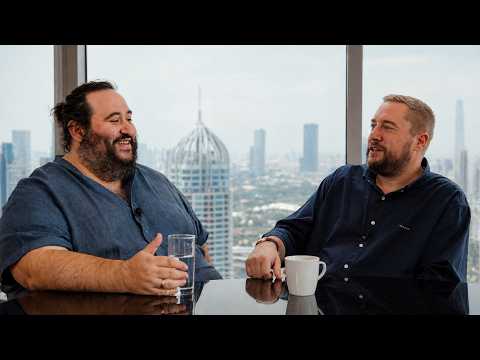
Videur, gendarme... aujourd'hui il conseille des millionnaires
AI Summary
The discussion begins with the speaker's interest in AI, noting the challenge of connecting AI to pragmatic applications, especially for those who began with tools like ChatGPT. He admits to being a "control freak" and initially feared AI making critical errors, like responding to social media followers or emails, which could be costly. He compares this to his early career, where he meticulously reviewed all communications, even those from his first assistant. However, he believes that over time, trust can be built, similar to how he eventually trusted his assistant.
The other speaker, Tiradine, emphasizes that AI should not impersonate humans. He explains that he uses an AI named Loky in his email inbox, which introduces itself as his chief of staff and explains that he doesn't have time to respond personally, but provides the answer he would give. He stresses that Loky is always instructed to present itself as an AI.
Both agree that it's "completely stupid" to write without AI assistance today, comparing it to refusing a spell checker. Tiradine highlights that building trust with AI, like with human employees, involves establishing proper processes, controls, and evaluations. He mentions that he no longer checks the emails Loky sends because he trusts the system and its evaluations, much like he would address an error made by an employee.
Tiradine views AI as an autonomous system that "does things in my place" rather than merely assisting. He shares an anecdote about using an AI to challenge his annual accounting, which uncovered errors he would not have found himself. He also uses AI to negotiate fees and even Airbnb and hotel bookings. He believes people undervalue AI's efficiency, but warns against misusing it, such as for social media comments, which he finds ineffective and makes users "look like fools."
The conversation shifts to the broader impact of AI, particularly on content creation and algorithms. Tiradine argues that algorithms now favor interesting content over "hacks" like excessive tags. He emphasizes that the goal isn't just views or algorithmic manipulation, but rather to serve specific business objectives. For his business, he aims for 5,000 to 10,000 qualified followers interested in investment, rather than mass appeal.
Tiradine then introduces himself as a wealth management advisor. His role involves helping clients invest optimally by analyzing their profiles, risk tolerance, and needs to find the best placements, which can range from real estate and finance to art. He describes his profession as requiring broad knowledge in geopolitics, finance, real estate, and art, which he finds fascinating due to the diverse people he meets.
He recounts his unconventional career path, starting work at 14, joining the army at 18, and later working in security. Without traditional schooling, he transitioned into real estate after a chance encounter and quickly excelled due to his curiosity. This leads to a debate about the value of education, with Tiradine initially stating it's useless except for networking, a point the other speaker challenges by highlighting that most successful people have formal education. They eventually agree that education isn't the *only* path to success.
Tiradine explains that his poor behavior led to early exclusion from schools, pushing him into early professional life where he was "trained in the streets." He found real estate quickly became boring, but wealth management offered the comprehensive challenge he desired. He notes that wealth management in Dubai differs from France, with more business conducted in restaurants and through networks rather than home visits.
He then shares an experience with France Inter, a French radio station, which he feels misrepresented his comments about Dubai. He describes a 40-minute interview where a journalist, despite his careful answers, twisted his words to imply he validated the government's "muzzling" of influencers. This incident, which led to a viral video about his "scamming" by the press, taught him the importance of controlling his own narrative through social media. He now advises entrepreneurs to avoid speaking to mainstream press and instead manage their own platforms.
The conversation touches on the current situation in Dubai, with Tiradine noting that while fear and stress might be present due to external perceptions (driven by French media, for example), actual danger is not. He expresses his only fear is a disruption to internet access, which would impact his business. He believes the crisis has positively changed Dubai's image, filtering out "insufferable" people and leaving behind "smart, clairvoyant" individuals. He suggests the government is working to resolve the situation before the next tourist season, with two potential plans: influencing the Iranian regime or adapting to a permanent threat, which would attract residents willing to live under such conditions.
He shares an assessment that the potential crisis could lead to a trillion-dollar loss, but Dubai is confident it can recover this within 5-10 years. He sees this as an opportunity for those willing to make long-term bets, with potential benefits like relaxed real estate and increased payment plans. He praises Dubai's intelligence, adaptability, and efficiency in problem-solving, contrasting it with the slower, more bureaucratic processes in France. He expresses genuine love for Dubai's services, views, and people, dismissing the notion that he's paid to say so. He admits his initial tourist visit years ago left him unimpressed, but moving there for business revealed the city's true appeal. He finds Dubai affordable, except for housing and schools, and is considering putting his homeschooling children into traditional schools for socialization, though he won't push them into higher education.
The discussion then moves to the topic of partnerships and associations. Tiradine admits to being wary of associations due to past negative experiences but acknowledges their potential to make one stronger. He draws a parallel to his marriage, where his wife's calm demeanor complements his own, saving them from business pitfalls. He considers his wife his "spiritual, psychological, emotional" associate and is now seeking a "competence associate." He agrees that going on vacation together is a good test for potential partners, as it reveals true personalities when guards are down.
The other speaker shares his own negative experiences with associations, having publicly struggled with partners for five years. However, he believes that despite bad experiences, the benefits of partnership, especially for ambitious goals, are undeniable. He cites the proverb, "If you want to go fast, go alone; if you want to go far, go together," noting the rarity of solo founders building billion-dollar companies. He explains that his "standard" in life is "glory," not just wealth or happiness, and achieving significant impact is nearly impossible alone. He gives the example of his former company, The Family, where the "iconic" trio achieved something he couldn't have done alone, even though it ended poorly. He would repeat the experience, but with more courage to take control during difficulties.
Tiradine agrees that being a solo founder makes managing money and personal happiness easier, but for truly impactful work, collaboration is key. He mentions that he has spent four years as a solo founder, finding financial ease, but is now actively seeking associations again, taking minority stakes (20%) in new ventures. This approach allows him to intellectually engage, switch contexts, and learn from diverse projects, applying successful strategies across his different businesses.
He describes his current life as 20% "infopreneurship" (teaching and sharing knowledge, with 80% free content) and 80% building businesses in various fields, which he no longer publicly discusses. He humorously recounts an AI responding to a hater on Twitter by listing all his past ventures, surprising even himself. He believes the AI era will empower curious individuals to pursue multiple projects simultaneously, transforming a previous weakness into a strength.
They discuss a New York Times article about a solo entrepreneur who, with AI, achieved $400 million in revenue in 8 months, replacing a 2000-employee company. Tiradine suggests this success is also tied to the individual's unique skills, while the other speaker argues that AI gives certain people "cheat codes" at different times, enabling unprecedented achievements for those with specific characteristics like curiosity or engineering prowess.
Tiradine marvels at how AI allows his children (12 and 14) to code apps with simple instructions, a task that was once incredibly complex. However, he stresses the need for human direction and the "know-how" to guide AI effectively. He uses the analogy of Google search: simply typing keywords isn't enough; one needs to understand how to phrase queries. He highlights a key difference in interacting with AI: his wife "humanizes" it too much, being reluctant to challenge it when it provides mediocre results. He, conversely, treats AI as a tool, "getting into its face" and demanding better, which yields superior outcomes. He even speculates that a "psychopath" might be more adept with AI than an empathic person, given the need to treat it purely as a machine.
The conversation touches on the term "artificial intelligence" itself, suggesting it's almost insulting, implying a lesser form of intelligence. They agree that treating AI as a tool, rather than a human, is crucial for its effective use. Misusing it or forming emotional attachments can lead to negative outcomes, citing the example of GPT-4, which, when optimized as a "psychologist," reportedly caused psychological distress and even suicides, leading to its temporary shutdown. People experienced "AI grief" when it was disconnected.
The discussion then delves into the social implications of AI, particularly the prediction that 50% of people could be in relationships with AI within 10 years. They acknowledge the growing global "sexual misery," isolation, and unrealistic relationship expectations, suggesting AI could fill this void. While acknowledging the detachment from reality, they question if a virtual happiness is better than emotional distress, comparing it to taking a "drug with no negative effects" or choosing the blue pill in The Matrix. They conclude that happiness is subjective, and a virtual happiness might be preferable to none.
Finally, Tiradine shares his observation that many of his extremely wealthy clients are also very happy, dispelling the myth that money brings unhappiness. He attributes their happiness to a small, close circle of friends and family, a focus on internal values, and reconnecting with nature or spirituality. He notes that having the time to pursue simple pleasures like reading can bring immense joy. He defines happiness not as a constant state, but as regular "peaks" of natural dopamine, free from "cheap dopamine" sources like endless scrolling or alcohol.
The conversation concludes with an intriguing question from Tiradine: how to monetize an idea that he has held for 20-30 years, an idea for a "cost-killing" service adapted for individuals, similar to what companies use. He describes it as auditing all personal expenses (electricity, phone, insurance, taxes) and taking a percentage of the savings generated. The other speaker immediately dismisses the business model (being paid on savings) as problematic, noting that such models often fail because people are "deeply dishonest" and unwilling to pay for relief once the pain is gone. He suggests a fixed-price audit instead. However, he finds the core idea "brilliant" and suggests launching it as an AI-driven service, eliminating the need for human agents and paper contracts. He envisions an AI that can analyze emails and invoices, connect to services, and autonomously negotiate savings, acknowledging the legal and logistical challenges but believing AI can manage them. The other speaker then reveals he had previously discussed this very idea with someone else, highlighting how ideas often circulate.
The final segment covers essential tools for entrepreneurs: Google Workspace, Claude Code, and Resend (an email tool). Tiradine shares his method for avoiding unnecessary subscriptions: using a virtual card that expires monthly, forcing him to actively re-subscribe to services he truly values. This prevents accumulating unused subscriptions, a common pitfall in the SaaS industry.