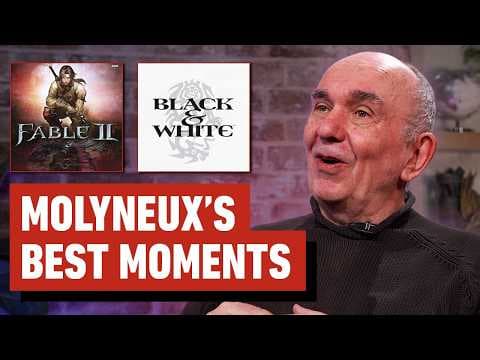
Peter Molyneux Picks His Favourite Moments From Every Molyneux Game
Audio Summary
AI Summary
The speaker reflects on the development and key aspects of several games, starting with "Fable 3," which he regrets didn't fully realize its original vision of a grand opera exploring the journey to the throne and its consequences. He believes the core idea of becoming king and facing the repercussions of one's actions was strong, despite the team's otherwise fantastic job. A significant missed opportunity for "Fable 3" was its movie-making feature, released just before YouTube's popularity, which could have been a different experience if the team had anticipated the platform. He also notes a mistake in making the game too compulsive, preventing players from relaxing and fully engaging with the movie studio aspect. A notable incident during "Fable 3"'s development involved Activision halting CD production due to a tester's screenshot showing a character on a toilet with purple underwear, which lawyers interpreted as showing genitalia, leading to the removal of the underwear from the game.
Moving to "Populous," the speaker describes it as a multiplayer game born from his and Glen Corpus's daily two-machine sessions. His personal goal was to consistently beat Glen, which he achieved by rapidly expanding and building castles. He humorously recounts an incident in Japan where, as the national champion, he was unable to use a cheat he had built into the game due to a camera on his hand, leading to a swift defeat.
"Theme Park" was developed by him and Deis Arbus in nine months at his house. His favorite part was creating dangerously elaborate roller coasters. A simple yet impactful feature was making patrons thirstier by putting too much salt on chips, increasing drink sales—a small detail that became a unique selling point. The idea for "Theme Park" originated from his business trips to America, where he visited theme parks and envisioned designing his own, despite others initially deeming it a crazy idea for a simulation not based on strict accuracy but on fun. He acknowledges that "Theme Park"'s isometric graphics, while charming, made it appear childish compared to "RollerCoaster Tycoon," which looked like a more serious game, though he found "Tycoon" a bit too "fiddly."
"Dungeon Keeper" is his third favorite game he developed, created by a team of seven at his house during an intense crunch period. His favorite moment was realizing they were building something that would be attacked. He fondly remembers Mark Healey's coarse but effective graphics for characters like the "kinky mistress" and "horny." The worst part, in retrospect, was the possession mechanic, which he now views as a mere gimmick that didn't significantly enhance the game, a sentiment he hopes to rectify in "Masters of Albion."
"Black & White" was exceptionally challenging to develop due to its ambition: using AI, a HUD-less interface, and an open world. A memorable moment was finally getting the creature into the game engine after years of development, only to find it repeatedly swiping at its own legs. This was due to the creature's AI prioritizing the most nutritious thing around, which happened to be its own limbs. He notes the difficulty in unifying the creature and the world within the game. The speaker preferred playing as evil in "Black & White" because most players chose the good path, missing out on the extensive effort put into the evil side. He cites an example of a quest where a villager asks for a rock, offering 35 different player responses, mostly evil, such as squashing the person or having the creature eat villagers, with only one good option: delivering the rock. He observes that only about 10% of players embraced the evil path. He also discusses the visual morphing of the hero, noting that evil transformations (red eyes, dark skin, horns) were easier to design than good ones (beyond a halo). His favorite moment was the player's realization that their hero was changing to reflect their alignment.
"Fable 2" is summarized as being "about the dog." His favorite moment was realizing the dog should be a companion, not a weapon. Initially, the dog was aggressive and constantly barked, making it aggravating. A complete rewrite of the dog systems made it a more balanced companion that barked when appropriate but wasn't overly aggressive, illustrating the "less is more" principle in development.
Regarding "Milo," the speaker expresses regret that the technology wasn't fully there at the time, contrasting it with today's large language models. He highlights the use of early Microsoft speech recognition and synthesis AI. His favorite aspect, often unseen by players, was the joy of inspiring the young character. He connected this to the joy of parenting, where every interaction influences a child. He believes they "nailed" magical moments where Milo would take and examine items, making "intellectual leaps" (though he admits they were "cheating" through game design) that gave the player a sense of inspiring the character.
He acknowledges AI's current negative press but advocates for embracing it in the games industry to discover new possibilities, cautioning against the release of "AI slop."
Finally, he addresses "Curiosity," apologizing for "overegging the center of the cube" and wishing he had simply used concept art. He expresses surprise at the level of communication and enjoyment players derived from the game, citing the retelling of the 9/11 tragedy through player taps and 800,000 concurrent players in 2012.
He then discusses the new game, which has been in development for years, asking "what is a god game?" He aims to answer this question more succinctly than he could with "Populous." The core idea is freedom. The opening moments involve the player as a hero finding a throne, sitting on it, zooming into the land, and then having their hand amputated (a "big hand"). This is a direct answer to the "who are you?" question from "Black & White." The game then allows players to freely explore what they can do with this hand—picking up, smashing, destroying, and even tidying things up, which he considers a powerful and satisfying action in a game. He is very proud of this opening sequence.