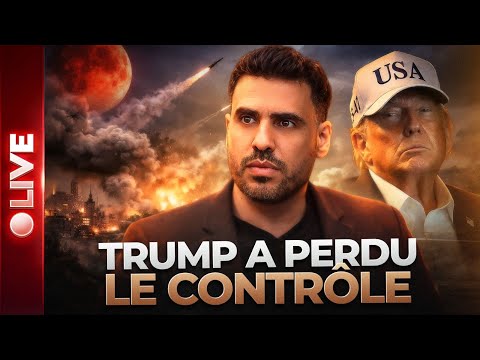
La première phase de la guerre en Iran est un échec total pour Trump
AI Summary
This summary is based strictly on the provided transcript, detailing a strategic and esoteric analysis of the escalating conflict involving Iran, the United States, and Israel.
### The Failure of the "Spectacular War"
The geopolitical scenario Donald Trump initially envisioned—a "spectacular" war characterized by a swift decapitation of the enemy executive followed by negotiations from a position of strength—has failed. While Trump sought a quick resolution similar to past interventions in South America, Benjamin Netanyahu and his advisors are pursuing a total war. This conflict is framed not just as a regional skirmish but as a pivotal event marking the potential end of the American Empire.
The timing of these events is linked to esoteric markers. The transcript notes that the main protagonists—Trump, the late Ayatollah Khamenei, and Netanyahu—were all born during eclipses or blood moons. Regardless of personal belief in astrology, the speaker argues that because these decision-makers believe in such signs, their actions become more predictable.
### The Logistics of Defeat
A central theme of the analysis is that "amateurs talk strategy, while professionals talk logistics." The US military position in the Middle East is currently compromised by systemic logistical failures. Key bases, such as the one in Bahrain, have been neutralized or severely damaged. The US Navy’s resupply lines are overextended; currently, the only viable port for replenishment is Diego Garcia near the Maldives. This creates a fatal delay: a frigate can deplete its interceptor missiles in 12 hours but requires a full week to travel and resupply.
Furthermore, the economic math of the war favors Iran. Iranian drones and missiles are inexpensive (ranging from $20,000 to $2 million), yet they require five to seven US interceptors to stop, with each interceptor costing significantly more than the target. This ratio of 30-to-1 or 70-to-1 in favor of Iranian expenditure makes a prolonged conflict unsustainable for the US Treasury and industrial base.
### The Martyrdom of Khamenei and the Nuclear Shift
The reported death of Ayatollah Khamenei is described as a catastrophic strategic error for the West. Khamenei was a terminal cancer patient who reportedly chose martyrdom, a concept of immense power in Shia Islam that has unified the Iranian population.
Strategically, Khamenei was the primary internal barrier to Iran’s nuclear weaponization, having issued several "fatwas" against weapons of mass destruction. With his removal, the theological and political brakes on the nuclear program have vanished. The speaker suggests Iran may already possess nuclear capabilities, and the destruction of the "nuclear gatekeeper" paves the way for their military application.
### The Iranian "Mosaic" Defense
Iran has prepared for this confrontation for forty years, developing a "mosaic" defense strategy. The country is divided into 31 autonomous military regions that can operate independently if the central command is hit. Utilizing advanced tunneling technology, Iran has hidden mobile launchers deep within mountains, allowing them to strike and disappear. Unlike the US, which relies on vulnerable surface bases and ships, Iran’s infrastructure is decentralized and hardened.
### Global Shifts and the Isolation of the US
The conflict is reshaping global alliances. China is actively supporting Iran with satellite intelligence (Baidou system), providing high-precision military signals that resist Western jamming. China has also imposed an embargo on rare earth metals, essential for the US to replenish its missile stocks.
In Europe, cracks are appearing in the Western alliance. Spain has refused to allow the US to use its bases for the Iranian conflict, leading Trump to threaten a total trade cutoff. Turkey has also signaled it will not participate, prioritizing the stability of its long-standing border with Iran. Meanwhile, Russia is the primary economic beneficiary, as rising oil prices (approaching $85-$100 per barrel) allow the Kremlin to fund its own military operations indefinitely.
### Domestic Turmoil and the "Terror" Strategy
In the US, Trump faces immense pressure. Public support for the war is at 27%, lower than the support for the Vietnam War at its conclusion. There are indications that the Democratic Party may pursue impeachment based on Trump’s failure to consult Congress before escalating. Additionally, the assassination of moderate voices like Charlie Kirk has backfired, radicalizing the American right-wing base under figures like Nick Fuentes.
The speaker concludes that Netanyahu’s primary tool for maintaining power is the "terror of extermination." By framing the conflict as an existential threat to all Jewish people, Netanyahu seeks to unify the diaspora and the Israeli public behind his leadership. However, this strategy relies on maintaining a state of perpetual fear. The only "grain of sand" that could stop this momentum is if a significant portion of Zionists turn their backs on Netanyahu’s path toward total war.
### Final Outlook
The situation is described as an "escalation trap." Iran has successfully drawn the US into a long-term conflict it cannot win logistically. While the US and Israel possess immense firepower, including the "Mad Dog" nuclear option, the geopolitical and asymmetric advantages currently lie with the Iranian-Russian-Chinese axis. The transcript ends with a metaphysical reflection: while the "plotters" believe they are nearing their goal of a New World Order or a "Greater Israel," historical and divine patterns often suggest that such hubris leads to an ultimate, sudden collapse.