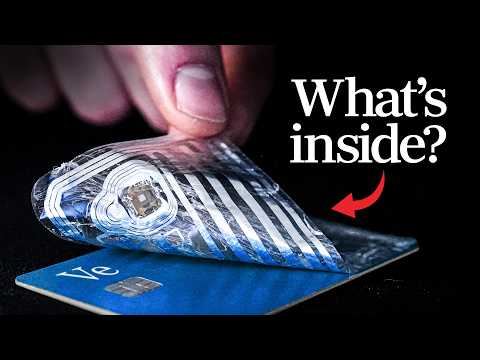
I Dissolved My Credit Card To Understand How It Works
AI Summary
This video explores the hidden technologies within credit cards, tracing their origins back to a CIA counter-surveillance operation and examining their evolution in terms of security and convenience.
The narrative begins with a demonstration of how acetone, commonly found in nail polish remover, can dissolve a credit card, leaving behind the internal antenna and chip. This visual sets the stage for understanding the physical components of these everyday objects.
The historical context dives into a 1945 incident where Soviet school children gifted a hand-carved plaque to the US ambassador, which unbeknownst to him, contained a revolutionary listening device. This bug, dubbed "The Thing," was groundbreaking because it lacked any power source, making it undetectable by conventional sweeps. It was activated remotely by Soviet radio waves, which caused electrons in its antenna to oscillate and re-radiate a signal. The device's resonant frequency was highly tuned, and a diaphragm within the plaque vibrated with sound, altering the capacitance and thus the resonant frequency. This modulation of the radio waves, similar to AM radio, allowed the Soviets to capture conversations. The Americans, unable to detect it, eventually discovered and reverse-engineered the device, recognizing its advanced capabilities. This led the CIA to develop their own enhanced version, Project Easy Chair, which used radio waves as a power source for a small microphone and amplifier hidden in furniture.
The video then shifts to the post-war economic boom and the need for easier payment methods. Early credit cards, like the BankAmericard launched in 1958, simplified purchases but were cumbersome. Transactions involved imprinting card details onto slips, which were then manually processed by banks, leading to delays and security vulnerabilities like fraud.
The innovation of the magnetic stripe, credited to IBM engineer Forrest Parry in the early 1960s, revolutionized credit card transactions. Inspired by audio cassettes, Parry discovered that magnetic tape could store data on cards, and a chance suggestion led to ironing the tape onto the card. This stripe allowed for faster transaction processing and quicker fraud detection. However, magnetic stripes had a critical weakness: they could be easily skimmed and cloned, leading to widespread fraud. Tony Sales, a former fraudster, recounts how easy it was to collect card numbers using "grabbers" and make significant profits.
To combat this, the EMV standard and the introduction of the chip emerged in the early 2000s. The chip, essentially a mini-computer, encrypts transaction data using a secret key shared only with the issuing bank. This dynamic encryption generates a unique code for each transaction, making it virtually impossible to reuse stolen codes. Cloning the chip is also extremely difficult due to its deeply embedded secret key and anti-tampering measures. While chip and PIN significantly reduced counterfeit fraud, it also increased transaction times.
The quest for speed and convenience then led to contactless payment technology, or Near-Field Communication (NFC). This technology, with roots in the RFID technology developed for toll booths, allows for transactions without physical contact. Credit cards use NFC to communicate with readers via a modulated magnetic field, powered by the reader itself. While convenient, early NFC readers could potentially extract basic card information from a short distance. However, the crucial security features like the secret key and the CVV code remained protected, limiting the effectiveness of simple cloning for fraud. The video highlights the risk of "digital pickpocketing" or "ghost tapping," where a reader within close proximity can initiate fraudulent transactions, especially in countries with higher tap limits or no limits, like the US.
To mitigate these risks, the video emphasizes the importance of enabling transaction notifications on mobile banking apps, allowing users to spot suspicious activity immediately. It also suggests mobile wallets as a more secure alternative, as they use tokenization, replacing actual card numbers with unique tokens.
The video concludes with a cliffhanger, teasing an attempt to steal $10,000 from MKBHD's locked iPhone using a payment terminal, hinting at the ongoing evolution and potential vulnerabilities of payment technologies.