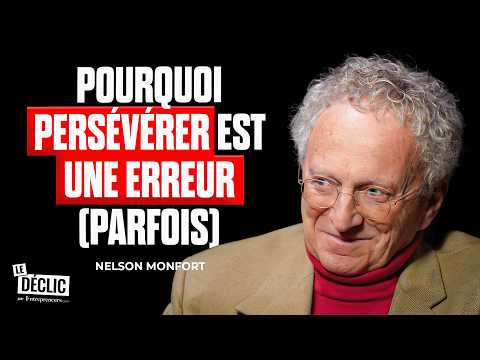
"J'étais à deux doigts d'abandonner” : La vérité sur l'histoire de Nelson Monfort
AI Summary
In this episode of "Le Déclic," host Alex sits down with Nelson Monfort, a celebrated figure in French sports journalism. Monfort, known as the voice and face of sports for over 30 years, has covered more than 15 Olympic Games and 30 Roland Garros tournaments. He's also recognized for inventing the polyglot interview, effortlessly switching between English, Spanish, and Italian to speak with legends like Usain Bolt, Rafael Nadal, and even Bill Clinton. Beyond his broadcasting career, Monfort has become a man of the stage and letters, authoring several books and performing in theater, demonstrating a remarkable ability to reinvent himself after a long television career.
Monfort begins by recalling his upbringing with an American military father and a French mother. English was his first language, and dinner conversations at home were always steered by his father towards engaging topics like geography, history, and American politics, which deeply fascinated him. This early exposure to diverse subjects fostered a desire for a life filled with encounters and outdoor experiences, rather than being confined to an office. Despite holding advanced degrees in law and political science from Sciences Po, Monfort found that most traditional job offers didn't suit him. This led him to pursue a path less traveled, knocking on many doors that initially remained closed.
His journey into journalism began at the very bottom, doing interviews for fourth or fifth division football teams in the Oise region during freezing January mornings for regional editions of *Le Parisien*. Seeing his simple "NM" signature in print brought immense satisfaction, fueling his determination. He admits he was close to giving up at times, recalling self-funded trips to cities like Lyon and Grenoble for meetings that never materialized. However, a "click" occurred through encounters with key people, which gradually opened doors. This included his entry into prestigious written press like *Le Figaro* and *Le Quotidien de Paris*, followed by radio, where he hosted a tennis and golf show. It was there that he was noticed by Jacques Chancel, then director of programs at FR3 (now France 3), who became a mentor and opened the doors to television. Monfort emphasizes that individual will needs reciprocity, and Chancel's support was crucial.
Monfort's television debut was at a tennis exhibition in Cap d'Agde, featuring top players like Chris Evert and Steffi Graf. It was here that he first showcased his ability to conduct interviews in English and Spanish, a novelty that quickly gained traction. He clarifies that while this multilingual approach launched his career, he soon sought to be recognized as a journalist, not just an interpreter, moving into commentary and show presentations, a process that took considerable time and effort.
Reflecting on the evolution of media, Monfort notes the stark contrast between his early career, devoid of internet, mobile phones, or TNT, and today's fast-paced digital landscape. He sees this technological advancement as a mixed blessing, coining the term "fléau sociaux" (social scourges) for social media. He expresses concern about the decline in reading, genuine communication, and face-to-face interaction, lamenting a growing "inculture" and the constant need for validation online. He personally avoids looking up his name on Google, believing it's a testament to his disinterest in online chatter.
Monfort has a strong opinion on the increasing distance between athletes and the media. He recalls a time when he could share a drink or even dinner with players like John McEnroe. Today, a "cordon of security" has emerged around sports figures, artists, and politicians, driven by a global shift towards increased violence and distrust. He recounts an incident at Roland Garros where he was physically restrained from approaching Rafael Nadal, only for Nadal himself to intervene and insist on the interview. This experience deeply saddened him, as it represents a loss of authenticity and proximity between the public and their heroes.
Drawing parallels between high-level athletes and entrepreneurs, Monfort highlights shared qualities: preparation, motivation, punctuality, strong presentation skills, and above all, hard work. He emphasizes that the most spontaneous outcomes are often the most thoroughly prepared. He believes that if work becomes a pleasure, one can truly succeed in life. To maintain his position at the top for decades, Monfort credits respect – for his colleagues, the "little hands" behind the scenes, and especially the public. He ensures he always presents himself impeccably, viewing it as a sign of self-respect and respect for others. He cites Jacques Chancel as a role model for treating everyone, from powerful figures to the most humble, with the same dignity and respect.
He recalls the unexpected rise of his puppet in "Les Guignols de l'info" in the mid-90s, which significantly boosted his popularity. He viewed this caricature positively, attributing it to his American origins and a strong sense of self-deprecation. He regrets the show's cancellation, seeing it as a loss of French impertinence and humor.
Monfort emphasizes the importance of daring and taking risks, sharing an anecdote about interviewing Bill Clinton at Roland Garros by waiting outside a restroom, an audacious move that secured a unique interview. He encourages young journalists and entrepreneurs to "dare," to politely and courteously pursue their goals, even if it means facing rejection. He recounts a difficult experience at Charles de Gaulle Airport after France won the World Cup in 2018, where no player, except Olivier Giroud, agreed to an interview. Monfort, live on air, explained the situation, maintaining that trying and failing is not an "échec" (failure); "l'échec, c'est de ne pas tenter" (failure is not trying).
In his later career, Monfort has transitioned to theater and writing. He finds immense joy in live performance, connecting directly with audiences, and believes that "you have to love people" to succeed, a quality he feels is often lacking in politics today. His writing, rooted in his early career in print journalism, allows him to capture memories and encounters in a lasting form, a counterpoint to the fleeting nature of modern media. He is currently writing a memoir, which he personally pens, filled with rich anecdotes from his life.
When asked about remaining relevant across generations, Monfort expresses pride in being seen as "transgenerational," appealing to both young and old. He attributes this to his consistent attitude of respect and authenticity, being the same person on and off television. He highlights his successful 20-year duo with Philippe Candeloro in figure skating commentary, a partnership built on honesty and mutual support, which transcended the sport itself to entertain and educate a broad audience.
Monfort believes that connecting with an audience, whether as a commentator or an entrepreneur, requires substance beyond mere eloquence. He advocates for prioritizing solid content over superficial charm, and embracing vulnerability. He concludes with a powerful message about human nature: "L'homme naît bon" (man is born good), and that genuine sincerity, even with hesitation, can be deeply endearing. He also emphasizes the importance of preparation, citing his meticulous research on athletes, and the sensitivity to human emotions, recalling a moment when he chose not to interview a distraught Laure Manaudou.
Finally, Monfort offers advice to entrepreneurs who fear fully embracing their unique qualities: "Assumez vos différences, à force, ils s'y habitueront" (Own your differences; eventually, they will get used to them). He hopes to be remembered as a good man who remained true to the child he once was, fulfilling his dreams with honesty. His ultimate "déclic" came from a humiliating experience at a golf tournament where he was told to step out of a photo with celebrities. This moment ignited a fierce determination to ensure that next time, he would be in the picture, a resolve that shaped his career.