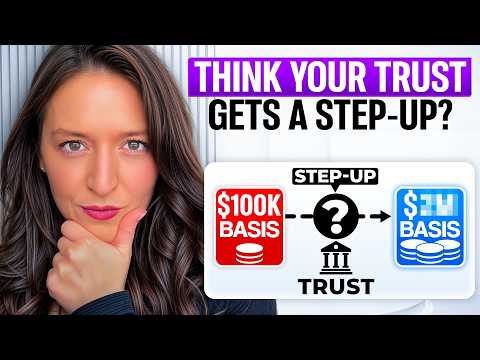
Your Trust Could Wipe Out One of Your Biggest Tax Breaks
AI Summary
This discussion focuses on how placing an asset into a trust impacts its eligibility for a step-up in basis upon the owner's death, a crucial factor in determining capital gains taxes for heirs. The core message is that simply stating an asset is "in a trust" provides insufficient information to determine its cost basis, as the type and structure of the trust are paramount.
The first scenario involves a revocable trust. If a mother places a $1 million brokerage account with a $200,000 basis into a revocable trust, she retains full control, including the power to amend or revoke it. For income tax purposes, it's generally treated as if she still owns it directly. Crucially, because she retains the power to revoke it, the asset is typically considered part of her taxable estate when she dies. Consequently, when she passes away and the account is still worth $1 million, it generally receives a step-up in basis to $1 million, effectively erasing the $800,000 in embedded gains. This means putting appreciated assets into a revocable trust typically does not remove their eligibility for a step-up in basis.
The situation becomes more complex with an irrevocable trust. If the same mother puts the $1 million stock with a $200,000 basis into an irrevocable trust, the answer to whether it gets a step-up in basis is "it depends." The term "irrevocable" only signifies that she cannot undo the trust; it doesn't dictate the asset's basis treatment at her death. An irrevocable trust can be structured as a grantor trust, a simple trust, or a complex trust, each with different implications. Furthermore, a trust can have one status for income tax purposes (determining who pays annual taxes on trust income) and a completely different status for estate tax purposes (determining if the property is included in someone's estate at death).
The IRS, in Revenue Ruling 2023-2, clarified a common point of confusion. Consider a mother who creates an irrevocable trust and gifts stock worth $200,000 (with a $100,000 basis) into it. She retains powers that make her the owner for income tax purposes, meaning she personally pays the annual taxes on the trust's income. However, she does not retain the power to reclaim the stock, so it's not part of her personal estate. Years later, the stock is worth $1 million, and she dies. The IRS ruled that merely being the owner for income tax purposes (a grantor trust) is not sufficient to qualify for a step-up in basis. Because the asset was never treated as "passing from" the mother under estate tax rules, it retains its original $100,000 basis. This highlights that "grantor trust" status does not automatically guarantee a step-up.
Comparing the three scenarios:
1. **Mom owns directly:** Original basis $100,000, value at death $1 million. Basis resets to $1 million.
2. **Mom owns through a typical revocable living trust:** Original basis $100,000, value at death $1 million. Basis resets to $1 million.
3. **Mom gifted into an irrevocable grantor trust (not part of her taxable estate):** Original basis $100,000, value at death $1 million. Basis stays at $100,000.
This demonstrates a $900,000 difference in basis for the same investment and value at death, purely based on how the trust is structured.
It's important to note that while estate inclusion is a major path to a step-up in basis, it's not the only one. Section 1014 of the tax code asks whether property is "acquired from or passed from" the deceased. There are situations where an asset never touches someone's taxable estate but still qualifies for a step-up.
The discussion then addresses implications for married couples, connecting to the concept of bypass trusts. Historically, bypass trusts were used to ensure the first spouse's estate tax exemption wasn't wasted. For example, if a husband dies and leaves $2 million to a bypass trust for his wife, this $2 million receives a basis adjustment at his death. If the trust grows to $5 million over 20 years and is structured to keep assets out of the wife's taxable estate, the $3 million of growth would *not* be eligible for a step-up in basis upon her death. Her children would inherit the asset with a $2 million basis, incurring capital gains on the $3 million appreciation. In contrast, if the wife had inherited the $2 million outright, it would grow to $5 million, and her children would inherit it with a $5 million basis, avoiding capital gains on the appreciation. This illustrates a $3 million swing in basis based on trust structure.
While bypass trusts served a vital purpose historically (preserving exemptions, protecting assets for children from prior marriages, creditor protection, and control over asset distribution), the landscape has changed significantly due to "portability" and the increased estate tax exemption. Since 2011, a surviving spouse can generally utilize the unused portion of the deceased spouse's estate tax exemption directly, reducing the need for bypass trusts solely for exemption preservation. The estate tax exemption has grown substantially, currently at $15 million per person (indexed for growth), compared to under $1 million in the 1990s and early 2000s. Therefore, estate plans drafted before 2011 or even 2018, when avoiding estate taxes was the primary concern, should be reviewed with an attorney to assess if the strategy is still beneficial or if it's now costing more in capital gains than it's saving in estate taxes.
Two common myths are debunked:
1. **If a trust distributes stock, you get a fresh basis:** Generally no. Beneficiaries typically inherit the trust's original basis, not a reset to current market value.
2. **If a trust sells an appreciated asset, the gain disappears:** No. The gain is still taxed, either at the trust level or passed through to beneficiaries, with the trust determining who pays.
Advanced planning can sometimes intentionally pull appreciated assets back into someone's taxable estate to earn a future step-up, especially if there's an unused estate tax exemption. Granting certain powers over an asset can enable a future step-up without triggering estate taxes. This counter-intuitive strategy requires legal counsel and challenges the common assumption that the goal is always to keep assets out of the estate. Sometimes, the opposite is the best move.
When someone mentions their assets are "in a trust," the critical questions to ask (rhetorically for oneself, unless it's family) include:
* Is it revocable or irrevocable?
* Who is treated as the owner for income tax purposes?
* Was the original transfer a completed gift?
* Is the asset included in someone's taxable estate at death?
* Does it otherwise qualify as "passing from" the deceased?
* What is the current basis compared to today's value?
* If married, will the spouse potentially get a second step-up?
Ultimately, a trust is a structure, and the tax outcome depends entirely on how that structure was built and the decisions made years prior.