Comment décupler sa force de travail avec l'IA : outils, agents, cas concrets - GDIY Live 12
AI Summary
The event began with a welcome from Conto, emphasizing the value of in-person interactions. The host announced Conto's upcoming product, which will allow users to interact directly with their accounts to add beneficiaries or prepare transfers, a feature already utilized by some for advanced operations not possible with traditional banks.
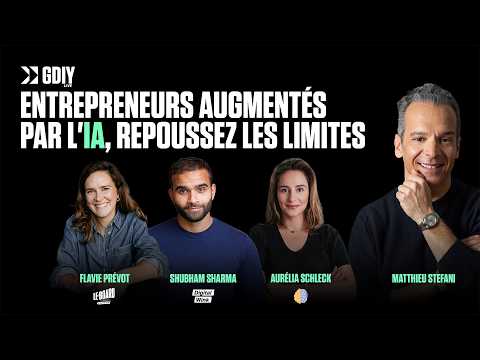
The discussion then shifted to AI, noting how much the field has evolved in just one year. A previous AI event focused on prospective ideas, but this evening's discussion would be much more concrete. The speakers were introduced: Flavie Prévaud, Aurélia, and Shoubam Charma.
Flavie Prévaud, a former corporate executive, transitioned to being a solopreneur five years ago. She now works with freelancers and AI agents, running "Le Board," a podcast for freelancers and solopreneurs in France. Aurélia, who founded her first AI company ten years ago when AI was not yet mainstream, now aims to help at least 10,000 people transition to using AI, focusing on action rather than just consumption. Shoubam Charma, with a background as a developer and engineer, is passionate about how new technologies like no-code and AI are transforming work methods.
A quick poll revealed that most attendees use AI daily, many have paid subscriptions, and some are paying over €20 per month for AI tools. Less familiar tools like Claude and Lovable were also mentioned.
Shoubam demonstrated Lovable by creating a CRM dashboard in just 21 seconds with a simple prompt. He contrasted this with his past as an engineer, where coding was highly valued and well-compensated. Five or six years ago, developers were "stars" in the market, commanding high salaries and enjoying significant power due to their specialized skills. A project like the CRM dashboard created in 21 seconds would have cost at least €50,000 and taken months, involving multiple iterations and service providers. Today, the cost of development for such a tool is effectively zero, or around €20 per month for a tool like Claude.
This shift has created fear among developers, as AI tools like Claude Code can write code significantly faster and of higher quality than human engineers. Shoubam cited Dario, the head of Anthropic, who stated that AI writes better code than their engineers. He also mentioned Jack Dorsey, founder of Twitter and Square, who recently laid off 4,000 employees because the company plans to work differently, leveraging AI. This indicates a broader change where previously secure roles are being disrupted.
Shoubam emphasized that this transformation affects everyone, not just developers. He warned against waiting for tools to be perfect before engaging with them, as the impact of AI is immediate and significant. He shared his personal workflow, which has been revolutionized by AI. He receives daily recaps from OpenClow, which drafts emails, categorizes them, and prepares meeting summaries. He uses Granola to transcribe and analyze all his meetings. AI agents handle sponsorship negotiations, talk arrangements, and CRM updates. He no longer writes emails, quotes, invoices, support responses, or meeting minutes, as AI generates these automatically.
He acknowledged that his deep immersion in AI is a full-time endeavor, but stressed that everyone's way of working is changing. He finds the experience both "stylish and frightening," but ultimately more stylish because it empowers entrepreneurs to serve clients, solve problems, and be creative more effectively. He mentioned tools like Pensil.dev, an AI-powered Figma for interface design, and Hickfield for AI-generated video content that is indistinguishable from human-made content. He also highlighted AI-powered phone agents that can understand human intonation.
Shoubam uses AI to manage his blog, performing competitive intelligence, SEO keyword research, article writing, and diagram generation. He stated that he now does the work of five people with just a computer, internet connection, and an AI model. He urged people to get hands-on with AI now, rather than waiting for it to be fully mature.
Flavie echoed this sentiment, noting that solopreneurs she coaches are shifting from delivering quickly to clients to spending more time configuring AI agents and tools. This upfront investment saves significant time later. She transformed her "admin day" into an "AI day" to update prompts and create agents. She recommends dedicating at least one day a week to building this "AI capital," which she calls her "Solo Squad." She has built 51 AI agents that work autonomously, even when she is offline.
The discussion clarified the difference between automation (where the path is known) and AI agents (which make decisions). While agent platforms are still evolving, they are becoming more usable. Shoubam shared that he spent 6-7 hours setting up OpenClow, which, despite being "a bit broken," allowed him to understand its capabilities. He communicates with his AI agent, Vadim, via Telegram, and Vadim can even self-upgrade to understand voice messages by searching the internet for solutions.
Aurélia cautioned about the risks of autonomous agents, such as accidentally deleting data, and the "bullshit" surrounding the multitude of AI tools. She advised focusing on concrete use cases rather than testing every tool. Entrepreneurs should identify what takes up most of their time and then implement AI automations or agents to optimize those specific tasks, such as lead generation or meeting preparation.
Flavie described her use cases:
1. **Content Creation:** She uses podcast transcripts as "master content" and then cascades it through AI agents for newsletters, LinkedIn posts, etc. This ensures singularity and leverages her intellectual property. Her AI automates podcast-to-blog article conversion, doubling her website traffic in a year.
2. **Freelancer Support:** She created AI agents for her freelance team (e.g., virtual assistant, podcast manager) to multiply content output. Instead of one article and one Instagram post, they now produce daily carousels, shorts, and more in about an hour.
3. **Product Management:** Her AI agent, "Philippe Membership," analyzes Stripe revenue for her subscription product, identifying subscribers whose subscriptions are ending, allowing her to proactively engage them. She also built a small internal SaaS to create lead magnets in 30 seconds, capturing emails from her content and converting views into clients.
Flavie highlighted the "window of opportunity" for small businesses and solopreneurs to outmaneuver large corporations, which are burdened by slow decision-making cycles. AI allows for rapid decision-to-action cycles, with agents working overnight to create websites or implement solutions at minimal cost. This represents a "fourth dimension" of opportunity.
Aurélia agreed, emphasizing that while everyone consumes AI content, few take action. She believes one can build a SaaS, launch it, and run marketing campaigns in less than a weekend with no-code tools. The main challenge is conceptualizing the idea, not the execution.
Flavie also shared her "boring but essential" tip: building comprehensive documentation. She spent an afternoon detailing her persona, products, objectives, client feedback, and before-and-after scenarios in Notion. This rich context is crucial for AI to produce useful results. By feeding this detailed information to AI, she no longer needs to repeat instructions, simply directing the AI to "fetch my persona," "fetch my product," etc., to generate content or conference outlines.
Shoubam provided an example of automating a tedious task for his associate, Christopher: distributing sponsor payments to podcasters. An AI system now automatically validates invoices and prompts podcasters to upload their invoices, then automatically processes payments. This system, developed in 15-20 days, saves Christopher almost a day of work per week.
The panel agreed that N8N and similar no-code automation tools are becoming less necessary as AI agents become more autonomous and capable of making decisions. The goal is to offload repetitive, low-value tasks to AI, freeing up human intelligence for strategic, creative work. They cautioned against automating useless tasks or getting sidetracked by "shiny objects."
Aurélia stressed the importance of human differentiation. If all tasks are automated, human connection and visibility become paramount. People buy from people, so building a personal brand and network is crucial for lead generation in an AI-driven world.
Regarding tools, Flavie recommended **Dust.tt** for team-based agent customization and **Whisper Flow** for voice dictation, which she uses to speak her prompts to AI. Aurélia also praised **Whisper Flow** and **Claude** as versatile tools. Shoubam mentioned **Granola** for meeting transcription and analysis, noting its superior user experience compared to other meeting AI tools. He highlighted its ability to answer questions about past discussions and even interpret underlying intentions.
The panel also discussed services like **Nanocorp** and **Paulcia**, which can develop business ideas into fully functional websites overnight. Flavie recounted an experiment where an AI created a website for podcasters in 20 minutes, then autonomously evolved its offerings and even prospected clients globally. This led to the concept of "token anxiety," the feeling of not having enough AI agents working for you.
They emphasized that the quality of AI output depends on the "knowledge base" or "context" provided. Flavie maintains a detailed file about herself and her offerings, while Shoubam also includes "skills" files on topics like copywriting and lead magnet creation. This context allows AI to generate relevant and high-quality results. They recommended using plain text files (MD files) for this context, as LLMs process them more efficiently than Notion pages.
The panel concluded by encouraging attendees to view AI as an investment rather than an expense, citing the immense ROI from automating tasks that would otherwise require expensive human experts. They also noted that current AI token prices are "discounted" as companies compete for users, making it an opportune time to invest in AI tools. Flavie shared that the time saved by AI has allowed her to shift from solo content creation to a live, spontaneous YouTube talk show, fostering more human connection and distinctiveness in an increasingly AI-generated content landscape. This "double effect" of AI automating back-office tasks to free up time for more embodied, in-person, and creative endeavors makes entrepreneurs "unstoppable."
Finally, they recommended using YouTube as a free resource to learn new skills, taking transcripts of popular videos, and feeding them to AI to create custom agents, effectively providing free "mini freelancers." They advised starting by asking AI to help build a knowledge base by prompting it to ask all necessary questions to construct the best possible context.