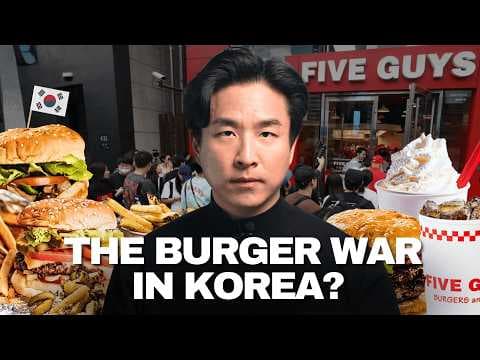
Why South Korea is Obsessed with American Burgers | AB Explained
AI Summary
In South Korea, American burger franchises like Five Guys and Shake Shack have transformed from mere fast food into status symbols, with people queuing for hours and sharing their experiences on social media. This phenomenon is not new; American burgers have a long and storied history in Korea, evolving from a symbol of Western modernity during the Korean War to a luxury item, and then to an everyday fast-food staple, before their current resurgence as premium experiences.
The first official U.S. burger franchise to enter Korea was Burger King in 1984, but the story of the American burger in Korea dates back to the 1950s Korean War. American soldiers introduced hamburgers, which were a stark contrast to traditional Korean communal dining. Local vendors near U.S. military bases, like Itaewon and Songtan, began creating their own versions, often using black-market ingredients and stretching meat with flour and onions due to scarcity. This led to the creation of the "Songtan burger" in the early 1980s—a messy, filling hybrid with pork patties, sweet Korean bread, shredded cabbage, fried egg, ketchup, and mayonnaise.
In 1979, the Lotte conglomerate, led by Shin Kyuk-ho, introduced the fast-food concept to Korea with Lotteria, after observing McDonald's success in Japan. Lotteria localized its offerings, most notably with the sweet Bulgogi Burger, which became a standard for fast-food burgers in Korea. This success proved the profitability of the American fast-food model and paved the way for other Korean conglomerates to import U.S. brands. The Doosan Group brought Burger King in 1984, which initially struggled due to high prices and a flavor profile that was too "American" for the Korean palate, which had grown accustomed to Lotteria's sweeter options.
The true cultural explosion came with McDonald's entry in 1988, strategically timed before the Seoul Summer Olympics. McDonald's opened a massive flagship store in Apgujeong, a wealthy and trendy district, positioning itself as a luxury experience and status symbol for affluent young Koreans. The brand thrived throughout the 1990s as the Korean economy boomed. However, the 1997 Asian Financial Crisis forced American brands to shift from luxury to volume and price competition, making burgers a normalized, cheap, and functional everyday meal.
The current resurgence of premium American burgers began in the early 2010s, driven by Korean-American chefs and entrepreneurs who recognized a demand for authentic, savory Western food. Independent "Sujae burger" (handcrafted or gourmet burger) shops emerged, particularly in Itaewon, offering high-quality ingredients and a culinary experience. This proved that Koreans were willing to pay premium prices for authentic American food.
Korean chaebols, or massive family-owned conglomerates, capitalized on this trend. The SPC Group, known for brands like Paris Baguette, spearheaded the import of Shake Shack. Through a Master Franchise agreement, SPC gained control over Shake Shack's pricing, marketing, and expansion in Korea, while the U.S. headquarters incurred no operational risk. SPC's strategy was a masterclass in corporate engineering: a single, highly publicized flagship store in Gangnam, restricted supply to create "open-run" hype, and premium pricing to position it as a "fine-casual" luxury. This led to the Gangnam location becoming one of Shake Shack's highest-grossing stores globally.
SPC's success inspired other chaebols. The Hanwha Group, primarily a defense and energy conglomerate, replicated SPC's playbook with Five Guys in 2023. They opened a massive flagship store in Gangnam, restricted supply, and generated immense "open-run" hype, with people camping overnight and waiting for hours. Hanwha emphasized American authenticity, meticulously sourcing ingredients and importing iconic elements like free peanuts. Unlike SPC, Hanwha treated Five Guys like a tech startup, aiming for a profitable exit. After scaling to seven profitable locations and generating significant sales, Hanwha sold the Korean operations to a private equity firm, H&Q Equity Partners, tripling its investment in less than three years. This revealed that these high-end American burger franchises had become financial assets, built with hype and scaled for eventual sale to private equity.
However, this strategy of maximizing profit is starting to face challenges. Industry experts view Korea as a global testbed due to its hyper-connected, trend-sensitive, and social media-driven consumer culture. While brands can achieve instant viral fame, the same ecosystem is brutally efficient at killing hype. Consumers eventually realize that paying nearly $20 for a burger from Five Guys is not worth it after the initial Instagram post. Gordon Ramsay Burger, which launched with even more aggressive pricing, including a $100 "1966 burger," faced criticism for its perceived insulting prices. The conglomerate running Gordon Ramsay Burger had to pivot, launching a cheaper spin-off, Gordon Ramsay Street Burger, to target the mass market, acknowledging the "luxury fast-food" illusion had cracked.
Even non-burger brands like Tim Hortons, imported by Korean franchise operators, attempted to rebrand as "premium cafes" with double the Canadian prices. However, Korean consumers saw through this, and the hype quickly died. Despite consumer backlash and a severe cost-of-living squeeze in South Korea, conglomerates continue to import famous Western brands. Their goal is often not to build a sustainable long-term restaurant legacy, but to manufacture hype, inflate brand valuation, and flip the operations to private equity firms for massive profit.
This corporate arms race has two main victims: independent restaurant owners, including the original Korean-American entrepreneurs, who cannot compete with the chaebols' capital and marketing budgets, and are priced out of prime real estate. Secondly, Korean consumers are caught in the middle, realizing that the dream of having these famous Western brands is not what it seems, especially when they cannot afford them. The food and beverage market in Korea is becoming increasingly polarized, with ultra-cheap meals on one end and overpriced foreign franchises on the other, while the traditional mid-tier restaurant market is being squeezed out. The trend continues, with In-N-Out Burger holding flash pop-ups and SPC Group bringing Chipotle to South Korea in 2026, indicating that the corporate wheel will keep turning.