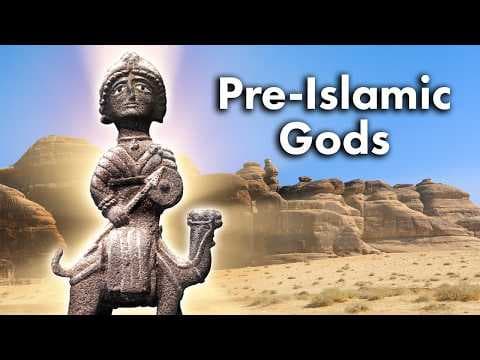
The Gods of Pre-Islamic Arabia
Audio Summary
AI Summary
Around the year 800, in the Abbasid heartland of Iraq, an Arab scholar named Hisham ibn al-Kalbi documented pre-Islamic Arabian paganism in his "Book of Idols." This work cataloged gods and sanctuaries, offering a perspective filtered through an Islamic lens, viewing the pre-Islamic period as the "Age of Ignorance." For centuries, this was the primary, albeit biased, source of information about pre-Islamic Arabian religion. However, a more direct, though initially unreadable, source existed: tens of thousands of Old Arabic inscriptions carved into rocks across what is now southern Syria, Jordan, and northern Saudi Arabia. Written in the Safaitic script, deciphered in the late 1800s, these inscriptions date from around the 3rd century BCE to a few centuries before the Prophet Muhammad.
These inscriptions provide unfiltered, first-person religious expressions from ordinary people. They contain names of gods, prayers, curses, and sacrifices, offering glimpses into the beliefs and practices of those who lived in pre-Islamic Arabia. A herder, for instance, carved a simple plea to the goddess Allat to find a lost sheep. These individuals were primarily nomads, traversing harsh landscapes with their flocks and caravans, leaving behind a rich tapestry of personal religious utterances, often accompanied by numerous drawings of camels.
The religious world depicted in these Safaitic inscriptions is broadly polytheistic, mirroring the ancient Mediterranean and Near East. People recognized and worshipped numerous deities. One inscription from Jordan invokes a multitude of gods: "O Alat, Dushara, Baal-Samin, Gadhar, Gadnabat, Gadwahbel, and every god in the heavens." Some gods were local, worshipped by a single tribe, while others, like Allat, were honored by neighboring peoples. Deities like Baal, the Canaanite storm god, appear to have ancient roots. These gods were perceived as living forces governing natural phenomena such as the sun, rain, abundance, and fortune, and could be appealed to through sacrifice and invocation, even against enemies.
While too numerous to detail exhaustively, the inscriptions highlight several prominent deities. Allat, whose name simply means "the goddess," was the most frequently invoked deity in the Safaitic corpus, appearing over 1400 times. She was called upon for everyday concerns, from finding lost sheep and facilitating reunions with loved ones to ensuring safe journeys. Unlike the abstract, distant gods often depicted in elite literature, Allat appears as an accessible deity, a trusted listener for individual needs. Some inscriptions suggest she was associated with fertility, being called "queen of abundance," leading to comparisons with goddesses like Aphrodite and Ishtar. Her divine lineage is also hinted at, with one inscription calling her the "daughter of Rodal," a male deity who also appears frequently. Other inscriptions further elevate her status, referring to her as the "mother of the gods," suggesting a divine family structure.
Allat is frequently paired with Dushara, the national god of the Nabateans, whose name signifies "master of the Shara" mountains. They appear together so often they seem to have functioned as a divine pair, invoked as joint guarantors of requests, such as seeking vengeance for a murdered brother. Allat's prominence is further underscored by her mention in the Quran, where she is singled out as one of three goddesses to be rejected, highlighting her widespread worship across Arabia.
Beyond Allat, the inscriptions name dozens of other gods, each with varying frequencies of invocation. Dr. Ahmad al-Jalad reconstructs the pre-Islamic Arabian religious worldview as a balance between two primary forces: the gods and fate. The gods were sentient beings who influenced natural phenomena and human life—the sun, rain, abundance, fortune, justice, and vengeance. Fate, on the other hand, was a malevolent, uncaring force that preyed on humanity without warning, against which no prayer was effective. The struggle for survival in the desert lay between these two poles, with the gods acting as a buffer against disaster. This worldview was deeply practical, focusing on tangible needs rather than abstract theology.
Gods associated with natural forces played a crucial role. Shams, the sun god, is invoked once alongside Allat in an oath of self-amputation, signifying vengeance. While his exact theological representation is unclear, the logic of appealing to a sun god in the harsh, sun-drenched desert is evident. Baal-Samin, the storm and rain god, often shortened to Baal, shares his name with the Canaanite deity and was revered as "master of the rains." The inscriptions illustrate the critical impact of his favor, as a herder records suffering through a "year of misery" because Baal-Samin "withheld" the rains, forcing his livestock to eat dry fodder. When one god failed to provide, people turned to others, as seen when a herder, frustrated by Baal-Samin's inaction, calls upon Allat for security.
The Gads represented another category of deities, associated with fortune. Various Gads are mentioned, such as Gad-Nabat and Gad-Awid, but scholars argue these are localized manifestations of a single West Semitic god of fortune. Fortune was a vital element in the precarious desert environment, and individuals would make sacrifices to influence it, as exemplified by a herder sacrificing an animal to Gad-Awid for bounty and security during a period of extreme cold.
The approach to these gods involved specific rituals designed to elicit their response. Prayers were highly formulaic, typically starting with a vocative particle (akin to "O"), followed by the god's name, an imperative verb, and the request. Carvers often included their genealogy, acting as a signature that identified them and their lineage. This structured approach suggests a learned and replicated method of prayer, ensuring the gods recognized the appeal.
Pilgrimage, known as "haq," was another significant ritual, predating the Islamic Hajj. While not a single annual pilgrimage to Mecca, these journeys were to sacred sites dedicated to specific deities, scattered across settlements. Evidence suggests timing was important, with pilgrimages linked to seasonal festivals and astronomical cycles, such as the rising of the constellation Virgo. Ritual purification before pilgrimage was also practiced. One inscription mentions a pilgrimage to Saya, a sanctuary dedicated to Baal-Samin, failing, possibly due to war or the temple being decommissioned. While distinct from the Islamic Hajj in its local and varied nature, the core concept of a religious journey to a sacred place as an obligation was well-established.
Animal sacrifice, referred to by the word "dhabaha" (the root of modern Arabic "dhabiha" for ritual slaughter), was considered the most potent way to motivate a god. Such sacrifices represented a significant economic cost for nomads, underscoring the belief that divine protection was worth the loss. The act of sacrifice was often recorded permanently, on boulders or rocks, serving as a public testament of the costly action and a permanent witness to the divine bargain.
Magic, particularly the belief in the "evil eye," was also a significant concern. When herders suspected their livestock's failure was due to envious glances, they invoked deities like Allat and Dushara for protection and abundance. The evil eye was understood as a social phenomenon, where envy could literally harm what was envied, such as health, livestock, or prosperity. Curses were also employed, often at the end of inscriptions, to deter defacement and magically protect the carved words. These curses, like the plea for protection against a "whisperer's mischief" addressed to Rodau, reveal a shared understanding of malevolent, invisible forces, echoing themes found in later religious texts.
However, even with these rituals, the gods were not always successful, and fate remained an insurmountable force. The term "maniyya" (fate) appears frequently in funerary inscriptions, often in phrases like "fate lay in wait" or "struck down by fate." Fate was not a negotiable deity but an active, often violent, force that governed random events like war, natural disasters, and death. Unlike the gods, fate was never directly addressed, petitioned, or appeased. The inscriptions portray it as a hunter or raider, striking without warning, against which human intervention through the gods was the only hope, though never guaranteed.
In conclusion, the Safaitic inscriptions offer a vital counterpoint to earlier, Islamically biased accounts of pre-Islamic Arabian religion. They reveal a deeply practical, lived religious world where individuals navigated the precariousness of life in the desert by engaging with deities who governed natural forces and human fortune. This involved a spectrum of rituals, from standardized prayers and seasonal pilgrimages to costly sacrifices and magical protections. Yet, this engagement was always shadowed by the ever-present, inescapable force of fate, a stark reminder of the limits of divine intervention and the ultimate fragility of human existence.