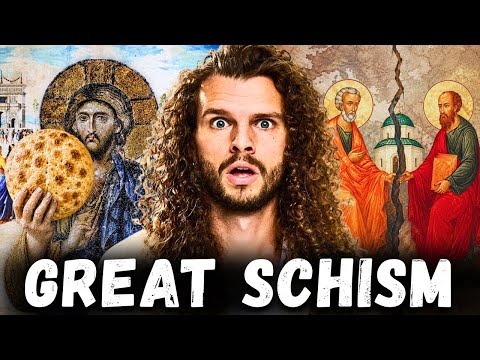
The Crusade That BROKE Christianity
Audio Summary
AI Summary
The Great Schism, which divided the unified Christian church into Roman Catholic and Eastern Orthodox branches, was not a sudden event but a slow, gradual drift over centuries. It was a story of two halves of the same faith ceasing to speak the same language, answer to the same leader, and follow the same rules, marked by violence, brutality, and betrayal.
To understand the schism, one must go back to 400 AD when the Roman Empire, though nominally unified, already comprised two distinct worlds: the Latin-speaking West governed from Rome and the Greek-speaking East governed from Constantinople. When the Western Roman Empire collapsed in the 5th century, Rome was left in disarray with broken roads, barbarian kingdoms, and no emperor. The Bishop of Rome, the Pope, became the primary institution capable of governing, negotiating with invaders, feeding cities, and maintaining order. Consequently, the Western Church learned to function with one strong, centralized head, viewing alternatives as chaos.
In contrast, the Eastern Roman Empire, later known as the Byzantine Empire, remained wealthy, sophisticated, and stable. The Patriarch of Constantinople, the head of the Eastern Church, lived in close proximity to a powerful, living emperor. Thus, the Eastern Church and the emperor worked side-by-side, with the emperor protecting the church and the church anointing the empire. In the East, no single bishop was meant to be the overarching ruler.
This divergence in experience led to vastly different instincts. The Western Church learned to be self-reliant, even standing above kings, as the Pope and the Church were often the only stabilizing force. The Eastern Church, however, grew up with a close relationship to imperial power, and did not believe in a single bishop holding supreme authority. These two "siblings," separated young, developed different perspectives: one fiercely self-reliant, the other wealthy and connected, viewing the first as crude and self-important.
Language also became a barrier. The West prayed in Latin, while the East prayed in Greek. By the 1000s, church leaders on each side could not communicate or understand each other's documents without translators. They began to feel less like one church, despite having agreed on fundamental doctrines—the same God, Christ, scripture, and creed—for centuries. The division wasn't over hard theological questions, but a failure to listen to each other.
This was the backdrop for the eventual schism. Two distinct cultural groups, operating under one faith, no longer shared a common language or a unified idea of who was in charge. All that was needed was a spark, which came in the 11th century.
Two main points of contention fueled the conflict. The first, and arguably the most significant, concerned the authority of the Bishop of Rome. Everyone in the ancient church agreed that Rome was special, being the city of Peter and Paul. For centuries, the Bishop of Rome was honored as "first amongst the bishops of the world"—first in dignity, first in honor. The East had no issue with this. The conflict arose over the meaning of "first."
This distinction is captured by the terms "primacy" versus "supremacy." In Rome, it was believed that Christ himself had entrusted Peter, and by extension Peter's successors (the Popes), with unique authority over the entire church, not just honor but actual jurisdiction—the final word on all matters of faith. This was a doctrinal supremacy. The East, however, understood the church to be governed collegially, through all bishops gathered in council. Rome held the highest honor, the "first chair at the table," but that chair was still *at the table*, not a throne above it. For the East, Rome could be honored without being obeyed.
This difference was irresolvable: one side believed the Pope could overrule a council of bishops, while the other believed a council was the highest authority, above any single man, including the Bishop of Rome. This wasn't a new argument in 1054; disagreements on this issue had occurred almost two centuries earlier. In the 860s, a scholar named Photius became Patriarch of Constantinople, but Pope Nicholas I of Rome refused to recognize him, claiming Rome had a veto over who led the church in the East. This led to mutual condemnations and disputes over newly converted Bulgarian lands. Photius also accused the West of corrupting the sacred creed by adding words to it, a charge that would resonate for a millennium. This earlier schism, however, healed, proving that such disputes were not automatically fatal and could be resolved. In 1054, the parties arguably chose not to resolve it.
The second major point of contention was the "added words" to the creed, specifically the Latin word "filioque," meaning "and the son." Centuries earlier, in the 300s, the entire church had adopted the Nicene Creed, a shared statement of belief, agreeing never to alter it unilaterally. The original creed stated that the Holy Spirit "proceeds from the Father." The West later added "and the Son," making it read that the Holy Spirit "proceeds from the Father and the Son."
The "filioque" originated not in Rome, but in Toledo, Spain, in 589. The Visigoths, who ruled Spain, had been Arians, a heresy denying Christ's full divinity. When the Spanish king converted to mainstream Christianity, the Spanish bishops added "and the Son" to the creed to explicitly affirm Christ's divinity and protect against Arianism, arguing that if the Spirit proceeds from the Father, and Christ is God, then it must also proceed from the Son. This local fix for a local problem spread, championed by Charlemagne's court in the Frankish kingdom. For a long time, Rome itself resisted adopting it, with one Pope even displaying the original creed on silver tablets in St. Peter's. However, seeing it as a legitimate clarification to defend Christ's divinity, Rome finally adopted the altered version into its liturgy in 1014.
From the Western perspective, this was not sabotage but a necessary clarification. From the East's perspective, the *procedure* was the scandal. The creed was shared property, settled by councils where East and West decided together. No one, not Spain, not the Franks, not even Rome, had the authority to unilaterally edit it. Changing the creed unilaterally was not just a theological error; it was Rome's claim to supremacy made manifest. To the East, the "filioque" and papal power were two facets of the same issue: Rome acting as the "big dog," undermining them without consultation.
The underlying disputes were about the Pope's authority and the creed's wording. Yet, the immediate catalyst for the schism was a dispute over baking bread for communion. In the 1040s, Normans conquered Byzantine territory in southern Italy, forcing Greek churches there to abandon Eastern customs, including their use of leavened bread, and adopt Roman practices. This reached Patriarch Michael Cerularius of Constantinople, a proud, rigid, territorial, and politically fearless man. In retaliation, he closed Latin churches in Constantinople around 1052-1053.
The Western Church used unleavened bread (flat wafers) for communion, believing the Last Supper was a Passover meal, and Passover bread is unleavened. They sought to emulate Jesus' actions precisely. The Eastern Church, however, used leavened bread, which was seen as representing the New Covenant, the resurrection, and a living, risen Lord. To the Eastern mind, unleavened bread belonged to the Old Covenant, the law before Christ. They even argued that the Greek word used in the Gospels for the Last Supper referred to ordinary leavened bread, not traditional Passover matzah. For the East, using flat wafers was not just odd but had profound theological implications.
While arguing about bread might seem trivial today, communion was their holiest sacrament. Each side believed the other was fundamentally wrong in performing the most sacred moment of their religion. The East called Westerners "Azamites" (unleavened ones), while the West saw the East as putting yeast into something holy, deviating from Christ's command.
The situation escalated with an exchange of increasingly angry letters. What turned this "cold war on paper" hot was the collision of three difficult personalities at the worst possible moment—one of whom was already dead.
The first was Patriarch Michael Cerularius of Constantinople, a proud, rigid, territorial, and fearless leader who believed the Bishop of Rome was merely one important patriarch with primacy of honor, not a monarch over all Christianity. He had no intention of bowing or compromising.
The second was Pope Leo IX, a reform-minded bishop from France, committed to rooting out corruption and upholding the church's dignity. He was equally committed to the conviction that Christ had given Peter's successor (the Pope) supreme authority over the entire Christian world, including the East. This created an immovable object in Constantinople and an irresistible claim from Rome.
The third was Cardinal Humbert of Silva Candida, Leo's chief advisor and the worst possible choice for a peace mission. Humbert was fiercely anti-Byzantine, combative, and short-fused. He arrived in Constantinople ready to fight, not to negotiate. He began with blistering attacks on Cerularius and asserted Rome's supreme authority, citing the "Donation of Constantine," a document supposedly granting sweeping power to the papacy. Crucially, this document was a forgery, though no one in 1054 knew this. Both sides were firm in their convictions, standing on ground that was not entirely what they believed.
Adding to the dramatic irony, Pope Leo IX died in April 1054, while his envoys were en route. A papal delegation's authority typically evaporates upon the Pope's death. Thus, Humbert and his delegation were technically acting on behalf of a deceased Pope, negotiating for a ghost. Yet, they pressed on.
Cerularius, confronted by Humbert's arrogance and demands, refused to engage. For months, Humbert was ignored, his fury building. On Saturday, July 16, 1054, Humbert acted. He marched into the Hagia Sophia, Constantinople's magnificent cathedral, during the divine liturgy, past the congregation, straight to the high altar. There, he laid down a bull of excommunication, formally cutting off Cerularius and his supporters from the church, condemning them for their "folly." He then turned, walked out, and at the threshold, shook the dust from his feet, a gesture Jesus instructed his disciples to perform against any town that rejected them, declaring in Latin, "Let God see and judge." A deacon reportedly ran after him, begging him to take back the decree, but Humbert refused.
Cerularius responded within days, excommunicating Humbert and his companions from the Eastern Church. The doors had slammed in both directions, marking what many remember as the moment Christianity split.
However, the reality was more nuanced. Neither excommunication was broad. Humbert's bull condemned Cerularius personally and a handful of his direct supporters. Cerularius's reply condemned Humbert and his two fellow church leaders. No one excommunicated Eastern Christianity as a whole, nor the Church of Rome. Roman leaders even praised the Byzantine emperor and the city's ordinary people. Furthermore, Humbert's bull might have been invalid, issued by a delegation whose authorizing Pope was dead, and based on a forged document.
The events of July 1054 were initially barely recorded by chroniclers. Popes and Byzantine emperors continued negotiations. Forty years later, during the First Crusade, East and West still cooperated closely, indicating no recognized formal schism.
The rupture truly solidified and hardened over the next century and a half, made official by a violent catastrophe in 1204. Western crusaders, sworn to march for the Holy Land, instead turned on Constantinople. They stormed and looted the city, desecrating churches and carrying off relics as trophies. This act of betrayal by those who were supposed to be kin deeply wounded the East. After this, the earlier disputes over leavened bread and the "filioque" seemed minor. The East realized they were no longer distant relatives of the Western Church but viewed the West as complete foreigners, feeling burned and betrayed. This is where the split became final, its effects still visible today.
The Eastern Church calls itself "Orthodox" (right belief, correct worship), while the Western Church calls itself "Catholic" (universal, a faith for everyone). Neither side believed it was leaving; each was convinced it was the true church, holding the line while the other strayed. No one intended a definitive break. The dramatic scene in the Hagia Sophia is largely a retroactive construction by later generations seeking a clean beginning to a division that had none. The division began far earlier, and the