Red & Black Knights (extraordinary result) - Numberphile
AI Summary
The video explores two distinct knight-moving puzzles on an infinite chessboard. The first scenario involves a single knight that always moves to the lowest unvisited square. Starting at zero, the knight follows a path, marking visited squares. Initially, it seems the knight will continue indefinitely, but eventually, it gets trapped, having visited all possible adjacent squares. This results in a finite sequence of squares.
The second, more complex scenario introduces multiple "courteous" knights of two colors, red and black. The rule for placing knights is that a new knight is placed on the first unattacked square encountered along a spiral path. In the first variation of this, only one type of knight is placed. A knight is placed at zero, then at one, and so on, skipping squares attacked by already placed knights. This creates interesting, periodic patterns, like clusters of five knights separated by singles, and vertical lines with alternating clusters of two and four. After a thousand steps, the pattern is visually striking and mathematically precise, showing a periodic structure.
The video then introduces two-colored knights, red and black, who take turns placing their pieces. The key rule is that a black knight can be placed on a square not attacked by a red knight, and a red knight can be placed on a square not attacked by a black knight. They are "friends" with knights of their own color, meaning they can be placed on squares attacked by their own color. Black places first, then red, alternating.
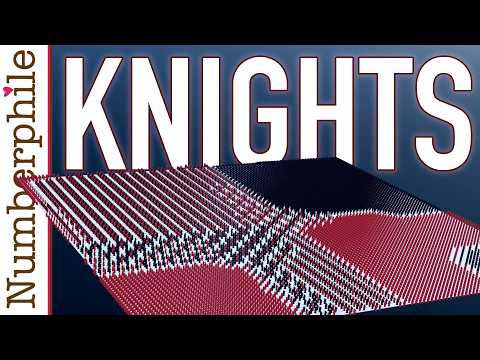
Initially, after a thousand squares, the board shows a mixed pattern with some quadrants predominantly red and others black, or a mix. However, as the number of squares increases dramatically to 100,000, and then to a million, a surprising evolution occurs. What started as small red corners expand into wide strips of solid red, and similarly for black. By 64 million squares, black knights completely dominate two quadrants, and red knights dominate another two, separated by "indecisive" strips. These solid color regions grow larger and larger, suggesting a permanent, stable state where the board is divided into distinct red and black territories.
The unexpected formation of these vast, solid-colored regions from seemingly random initial placements is highlighted as a mysterious and astonishing outcome. The question of whether three colors would also settle into such distinct territories is posed, suggesting further avenues of exploration for this fascinating knight-placement problem.