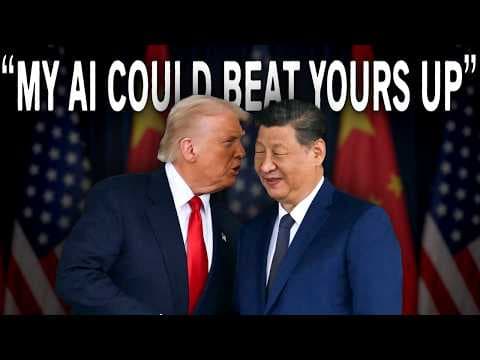
bUt wE cAn"T lEt cHinA WiN tHe AI aRmS rAcE!!
Audio Summary
AI Summary
Major AI companies, including OpenAI and Nvidia, have significantly ramped up their lobbying efforts in the US, collectively spending over $100 million in the past year to influence policy. Their unified message to policymakers centers on the perceived threat of China dominating artificial general intelligence (AGI). They argue that over-regulation, under-regulation, insufficient government support, or even restricting chip sales to China would all lead to China winning the AI race. This strategy, while seemingly simplistic, appears to be highly effective in Washington.
Despite Nvidia's claims of indispensability, they've admitted their market share in China is now negligible due to local competitors developing their own advanced alternatives. These Chinese alternatives, reportedly matching or exceeding American models, are achieving this with less advanced hardware and fewer resources, a fact acknowledged by Nvidia itself.
Concurrently, it's becoming evident that current AI models, while potentially falling short of their hyped applications, are proving exceptionally effective for mass surveillance, warfare, cyber operations, and propaganda. The central argument presented by AI companies is that if China gaining an upper hand in AI is an existential threat, then understanding the hypocrisies in the US approach is crucial.
One such hypocrisy is the selective application of the "China threat" narrative. Companies that warn of a Chinese AI takeover are simultaneously lobbying to sell their most advanced chips to China. For instance, Nvidia, after an initial ban, was allowed to resume selling its high-end H200 chips to China. While these sales are technically capped and routed through the US for inspection, the volume could still significantly boost China's AI compute capabilities. This occurs in the same year that AI's dominance by China was framed as a generational threat. Furthermore, Nvidia is now lobbying to sell even more advanced chips, arguing the H200 isn't competitive enough to secure the Chinese market, contradicting their previous claims of CUDA making their hardware irreplaceable.
This contradiction extends to how companies present their AI technologies. They simultaneously portray their products as harmless to regulators, thereby avoiding liability frameworks, and as the most powerful creations in human history with existential risks to investors and grant committees. This dual messaging serves different purposes: minimizing liability in front of regulators and maximizing potential funding by emphasizing the stakes to investors and government bodies.
The lobbying efforts extend beyond direct political contributions. OpenAI's founders and early investors have channeled millions into "Build American AI," a group that funds influencers promoting the narrative that AI must remain in America and that China must not win. This campaign appears to be aimed at paving the way for potential government bailouts for OpenAI.
The "arms race" framing is also used to push for deregulation. Most deregulatory efforts have focused on environmental protections and energy prioritization to speed up data center construction. However, the compute generated by these data centers is largely for consumer applications like targeted advertising, customer service bots, and entertainment, rather than defense or national security. The argument is made that if AI were a true national security priority, policy would focus on fast-tracking genuinely strategic AI projects and treating the rest as consumer products. Instead, the entire industry is being treated like a Manhattan Project, leading to the rollback of regulations concerning liability for inappropriate AI-generated content, mental health protections for children, and responsibility for AI-facilitated crimes. These are precisely the areas that would not hinder the development of defense-grade AI.
The AI industry is not voluntarily seeking regulation akin to weapons manufacturers or nuclear energy operators, which would involve strict licensing, tracking, and end-use restrictions. Such oversight would limit their ability to scale, attract foreign capital, and maintain their inflated valuations. The "arms race" narrative thus serves as a convenient justification for deregulation without accountability.
Kevin O'Leary's ventures, such as his proposed data centers in Utah and Alberta, exemplify this strategy. His primary goal appears to be leveraging the "competing with China" narrative to secure government approvals, tax exemptions, and cheap energy contracts. These packages can then be potentially flipped to investors. If projects don't materialize, O'Leary maintains a non-committal stance, with taxpayers bearing the loss. This mirrors the broader industry approach of securing government concessions under the guise of national security without delivering on the underlying projects.
Ironically, China is actively regulating its AI sector, implementing measures for ethics, risk monitoring, safety assessments, mandatory algorithm registration, and labeling of AI-generated content. The US, in contrast, has minimal federal regulation in these areas and is actively lobbying against state-level laws that could fill the gap. China's investment in AI is also considerably lower than in the US. While China's regulations are not perfect and can be politically motivated, they demonstrate a proactive approach to state control and development of AI, whereas the US relies on the hope that private interests will align with geopolitical ones.