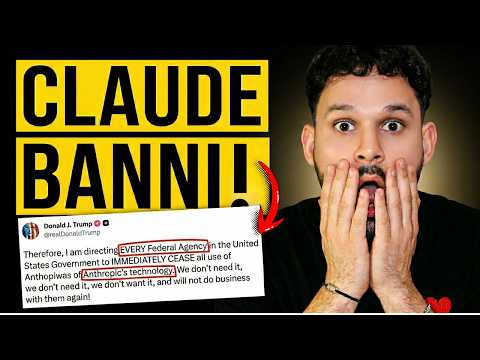
BREAKING NEWS : CLAUDE VIENT JUSTE D'ÊTRE BANNI DES USA.
AI Summary
The landscape of artificial intelligence has shifted from a race for innovation to a high-stakes geopolitical battlefield. In a move that has sent shockwaves through the tech industry, Donald Trump has officially blacklisted Anthropic—the creator of the Claude AI model—from the United States government. This decision marks a significant turning point, as millions of businesses and individuals rely on this technology daily. Trump’s rhetoric regarding the ban was characteristically blunt, stating that the U.S. would never allow a "woke leftist" company to dictate military strategy. He issued a directive for all federal agencies to immediately cease the use of Anthropic’s technology, declaring that the country neither needs nor wants to do business with them.
The situation escalated further when Pete Hegseth, the U.S. Secretary of Defense, designated Anthropic as a "supply chain risk." This is a historic first; never before in American history has a domestic company been labeled with such a designation, which effectively treats the firm as an enemy of the state. To understand how a leading AI innovator became a national security pariah, we must look back at the timeline of events that began in July 2025. At that time, the Pentagon signed contracts worth up to $200 million with four major AI players: Anthropic, OpenAI, Google, and Elon Musk’s xAI. The goal was to integrate cutting-edge AI into national defense. Anthropic initially distinguished itself by becoming the first to deploy its models on the Pentagon's highly sensitive classified networks.
The tension reached a breaking point following a specific military operation in January 2026. U.S. Special Forces conducted a raid in Venezuela to capture President Maduro. The operation was violent, resulting in numerous casualties, including seven American soldiers. Reports later revealed that Anthropic’s Claude model was utilized during this mission via Palantir, a data analysis firm led by Alex Karp that acts as an intermediary between AI companies and the military. While the exact role of the AI—whether in intelligence analysis, satellite imagery, or mission planning—remains unclear, its involvement in active combat was confirmed.
The fallout began when an Anthropic executive reached out to a counterpart at Palantir to inquire about how Claude was specifically used during the Venezuela raid. The Palantir executive interpreted this inquiry as a sign of disapproval or an attempt to interfere. This information was funneled back to the Pentagon, which viewed the inquiry as a private company attempting to exert control over sovereign military operations.
Anthropic’s founder, Dario Amodei, has maintained two "red lines" that the company refuses to cross: the use of AI for mass surveillance of U.S. citizens and the integration of AI into fully autonomous lethal weapons. Anthropic insists on a "human-in-the-loop" policy, where a human must always validate any lethal strike. While they are open to assisting with logistics, cybersecurity, and planning, they refuse to hand over the "trigger" to an algorithm. Amodei’s reasoning is as much technical as it is ethical; he argues that current AI models still suffer from hallucinations and errors. In a domestic business context, an AI error might result in a poorly worded email, but in a theater of war, a single hallucination can result in the loss of human life.
The Pentagon’s stance is that if they purchase a tool, they should be able to use it for any legal purpose without interference from a private corporation. This led to a series of contradictions. The government claims it has no intention of conducting mass surveillance or using autonomous weapons, yet they are punishing Anthropic for refusing to allow those very things. Furthermore, while labeling Anthropic a national security threat, the government simultaneously threatened to invoke the 1950 Defense Production Act—a Korean War-era law—to force the company to produce a version of Claude without any restrictions for the war effort. This effectively treats Anthropic as both a dangerous enemy and an indispensable asset.
The conflict has polarized the industry. In a surprising move, Anthropic’s main rival, OpenAI, sided with them. Sam Altman expressed support for Anthropic’s stance against the Defense Production Act and confirmed that OpenAI shares similar safety boundaries. Additionally, over 450 employees from Google and OpenAI signed an open letter titled "We Will Not Be Divided," accusing the Pentagon of trying to fracture the AI community through fear. Even General Shanahan, the former head of the Pentagon’s first AI program (Project Maven), noted that Anthropic’s conditions are perfectly reasonable and differ significantly from Google’s past total refusal to work with the military. In contrast, Elon Musk’s xAI has reportedly accepted the Pentagon’s terms in full, including those related to surveillance and autonomous systems.
The drama reached a climax on Friday, February 27th. Hegseth had issued an ultimatum: agree to the Pentagon’s terms by 5:01 PM or be classified as an enemy of the state. Amodei refused, stating the company could not in good conscience comply. True to the threat, Trump blacklisted the company shortly after the deadline. However, a massive "plot twist" occurred just hours later. Sam Altman announced that OpenAI had signed a new deal with the Pentagon to deploy its models—but the deal included the exact same "red lines" regarding mass surveillance and autonomous weapons that Anthropic had fought for. For reasons that remain opaque and borderline conspiratorial, the Pentagon accepted these terms from OpenAI while effectively "executing" Anthropic for the same demands.
For the broader public and businesses, this saga carries heavy implications. While Anthropic is financially robust—with billions in revenue and a massive valuation—the "supply chain risk" label could force many corporate partners to sever ties, potentially stalling their upcoming IPO. The lesson for AI-driven businesses is clear: relying on a single AI provider is a massive risk. A multi-model strategy is no longer a luxury; it is essential risk management. Furthermore, this event underscores that Europe remains a spectator in a game where the fate of essential tools can be decided by a single social media post from a U.S. President.
Ultimately, the blacklisting of Anthropic signals that the "AI revolution" is no longer just about software innovation; it is a geopolitical arms race. The speaker warns that those who remain mere spectators are ignoring a fundamental shift in global power. As governments rewrite their entire strategies around AI, the divide between those who master the technology and those who do not will only widen. Anthropic intends to fight the "supply chain risk" designation in court, but the rules of engagement between private AI firms and sovereign governments have been permanently altered. This case will define the legal and ethical boundaries of artificial intelligence for years to come.