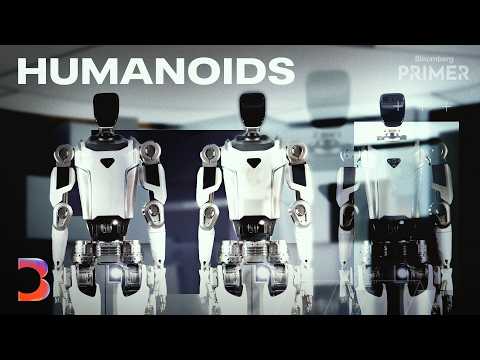
Humanoid Robots and the Gap Between Hype and Reality | Bloomberg Primer
AI Summary
Humanoid robots are experiencing a surge in development and investment, moving beyond research labs into real-world applications with the potential to revolutionize labor. This advancement is driven by breakthroughs in Artificial Intelligence (AI), particularly the concept of "physical AI," which integrates specialized AI with robotic bodies equipped with sensors, batteries, and actuators. The goal is to create robots capable of learning and adapting to unpredictable environments, unlike traditional programmed robots. This paradigm shift could lead to a multi-trillion dollar market by 2050, with applications expected in homes, hospitals, and especially factories.
Companies like 1X are at the forefront, developing robots such as Neo. Neo's behavior is entirely AI-driven, processing sensory data through large neural networks to generate motor commands for tasks ranging from balancing and walking to manipulation. The success of such robots hinges on the availability of vast amounts of data. AI has transformed robotics by eliminating the need for task-specific coding; instead, everything is data-driven, enabling robots to perform a wider variety of tasks and improve over time.
The current frenzy in humanoid robotics is fueled by significant investments, with billions of dollars poured into the sector in 2025 alone. Prominent figures in the tech industry, including Jensen Huang of Nvidia and Elon Musk of Tesla, are vocal proponents, predicting transformative impacts. Nvidia, a major supplier of AI GPUs for training large models, is also developing hardware and software solutions for these robots. OpenAI, Google, and Tesla are also investing heavily in bringing AI out of screens and into the physical world. Elon Musk, for instance, has projected that Tesla's Optimus robot could generate $30 trillion in annual revenue.
However, there's a recognized gap between the current capabilities and the hype surrounding humanoid robots. While demonstrations showcase impressive feats, many robots still require human assistance or remote operation for complex tasks. A significant challenge is the "robot data gap"—the lack of recorded physical experience that robots can learn from. To bridge this gap, companies are employing various data-gathering strategies:
1. **Simulation:** Creating hyper-realistic virtual environments where thousands of robots can learn simultaneously. However, simulations may lack real-world detail.
2. **Harvesting Real-World Video:** Utilizing existing footage of humans performing tasks. The challenge here is extracting full 3D structure from 2D video.
3. **Teleoperation:** Using VR to remotely control robots, recording their movements and sensory input. This is a slow but effective method for data collection and is being used by companies like 1X, although it has been criticized for its use in demonstrations.
The concept of a "Flywheel" is also being explored, where robots learn on the job, collect data, and use it to train improved AI models, creating a continuous cycle of improvement.
China is emerging as a dominant force in the humanoid robotics market. Driven by government initiatives and substantial investment (pledging 1 trillion yuan in 2025 to promote emerging technologies), China has seen a proliferation of humanoid robot companies. Companies like AgiBot, UBTech, and Unitree are leading in shipments, benefiting from a highly integrated supply chain and scaled manufacturing capabilities, similar to their success in the electric vehicle (EV) market.
Despite the rapid advancements and investment, humanoid robots face significant engineering hurdles. They are often slow, have limited battery life, and struggle with the dexterity required for tasks like picking up and handling objects. In manufacturing and warehouses, where industrial robots are already established, humanoids are being piloted for specific applications, such as working in cold environments where human workers would be uncomfortable. However, they still damage products, drop items, and misplace them, necessitating human oversight for corrective actions and audits.
The deployment of humanoids in more complex, semi-structured environments like hospitals presents even greater challenges due to the high stakes and inherent uncertainties. Economists are also studying the potential impact on employment and the quality of work, emphasizing the need for worker involvement in the deployment process.
While the ultimate success of humanoid robots in becoming indispensable companions or remaining a novelty is yet to be determined, the field is experiencing a significant resurgence. Experts remain optimistic about the future but stress the importance of realistic timelines for widespread adoption, acknowledging that much research and development are still needed.