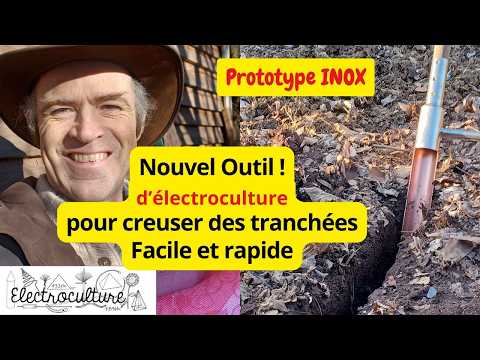
Nouvel outil pour creuser des tranchées dans le sol pour poser l'antenne magnétique d'électroculture
AI Summary
This video introduces a specialized stainless steel tool designed for digging straight trenches in the soil. While the tool is versatile enough to bury irrigation pipes or electrical cables, its primary purpose in this context is to facilitate electroculture. The device is built for durability and is designed to be used with a standard 38 mm straight shovel handle, which can be found in most hardware or garden stores. For very soft soil, it can even be operated by hand.
The tool operates through a simple lever action. The user places their foot on a horizontal bar to push the blade into the ground and then tilts the handle to lift the soil. The speaker demonstrates its effectiveness in heavy clay soil, noting that while it works in various conditions, the process is significantly easier when the ground is moist. The tool allows for adjustable depths ranging from 10 cm to a maximum of 40 cm.
A significant portion of the video is dedicated to the practical application of electroculture. The speaker explains that trenches must be precisely oriented along a North-South axis using a compass to align with the Earth's magnetic field. This alignment is critical for the installation of magnetic antennas. The speaker demonstrates that the magnets within these antennas must be placed in the same direction as the terrestrial magnetic field to function correctly.
Regarding the materials used, the speaker clarifies a common misconception: galvanized iron wire (1 to 2 mm in diameter) is preferred over copper for this specific technique. These wires can be laid in the trenches for hundreds of meters or even kilometers, making the system suitable for large-scale agricultural fields.
The depth of the wire is another crucial factor. For optimal results, the wire should be buried between 10 and 50 cm deep. The speaker warns that placing the wire deeper than 50 cm reduces its effectiveness, and at a depth of one meter, the benefits disappear entirely. For farmers, this method is particularly well-suited to no-till systems where the wires can remain undisturbed. When installed correctly—typically in parallel rows spaced 50 cm to 1.5 meters apart—this method can reportedly increase crop yields by 30% to 100%.
The speaker concludes by directing viewers to his website for the tool and magnetic antennas. He also mentions his book and a decade’s worth of online resources, totaling over 500 pages of information on the subject of electroculture.