The Year of Windows Humiliation
Audio Summary
AI Summary
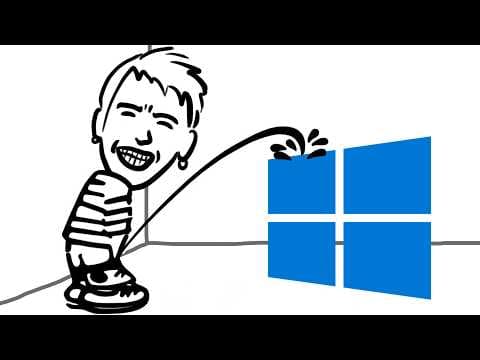
For decades, the idea of the "year of the Linux desktop" or Apple significantly challenging Microsoft's desktop market share has been a running joke. Despite continuous improvements in competing operating systems and Microsoft's own missteps, Windows has maintained its dominance. However, this dominance is now showing cracks that are widening, potentially leading to a critical mass for widespread adoption of alternatives. This isn't necessarily the year of the Linux desktop, but rather a "year of Windows humiliation," a fact Microsoft seems to acknowledge through a recent open letter promising improvements after years of "crapification."
Historically, Microsoft has lost market share in other platform wars, such as web servers (now less than 10%) and pocket PCs (from over 60% in 2007 to zero). Currently, a significant shift is occurring, particularly among gamers, a loud and influential demographic. While Windows has traditionally been the go-to for gamers due to broad title support, lower prices, and modding tools, this is changing. Kernel-level anti-cheat and copy protection systems have often kept gamers tied to Windows, but this loyalty is eroding.
Tom's Hardware observed that Linux market share, which had languished around 1% for years, saw a significant turning point in 2022, with projections of surpassing 2% in 2024 and 3% in 2025. This momentum is largely attributed to Valve's efforts. After the failed launch of the original Steam OS in 2015, Valve spent nearly a decade funding the development of Proton, a compatibility layer that translates Windows Direct3D API calls to Vulcan, a cross-platform graphics API. This technology became prominent with the launch of the Steam Deck, a Linux-based handheld gaming PC running Steam OS 3.0. The Steam Deck made Linux gaming accessible to a broad audience, allowing users to simply pick up the device and play Windows games. The open-source gaming community, now with corporate backing, has further developed this, making Steam OS and Steam Deck features accessible on a wider range of hardware through gamer-friendly Linux distributions like Basite and Catchio OS.
Concurrently, Microsoft has been criticized for turning Windows into a platform filled with ads for OneDrive, Xbox Game Pass, and Edge Browser, which users find intrusive. While Valve has sold an estimated 4 million Steam Decks, the groundwork laid has led to an explosion of Linux usage among gamers, with the latest Steam survey putting Linux at about 5% market share for the first time. Although there may be some sampling irregularities contributing to this sudden jump, the overall trend of increasing Linux adoption is clear. Furthermore, Framework recently announced that its Ubuntu version of the new Framework 13 Pro laptop is outselling the Windows version.
In response to this erosion, Microsoft is taking drastic measures. The most notable is the new Xbox full-screen experience or Xbox mode, developed to provide a more seamless gaming experience on handheld PCs like the ROG Xbox Ally X. This mode reduces system resource usage, particularly memory, and simplifies navigation with a controller. The question arises: why now? Microsoft has owned the Xbox brand for nearly 25 years and could have implemented such improvements sooner but chose not to until forced into action. This demonstrates the positive impact of competition.
Another user group seeing shifts is pre-built systems. While some tier-one PC builders offer Linux systems, they are often buried deep in options and poorly priced compared to discounted Windows machines. This is due to Microsoft's powerful marketing programs that incentivize partners to prominently feature Windows products.
The "sleeping giant" of Apple's Mac product line has also awakened. Despite the iPhone dominating Apple's balance sheet, Mac's market share has been steadily growing and is poised for a major breakout. Apple Silicon has given the company control over performance, supply chain, and margins. The M4 Mac Mini, offering a general-purpose desktop at a competitive price, and the MacBook Neo, a $600 laptop (or $500 for students) using a last-gen phone chip, have been key. Apple is now aggressively pursuing volume, contrasting with the rest of the industry reeling from pricing shocks. This aggressive strategy is changing the competitive landscape, a challenge that Snapdragon Windows ARM laptops may not be enough to counter.
Microsoft's traditional customers are increasingly ready for change. Beyond gaming enthusiasts, Mac and Linux are attracting AI, software development, freedom, privacy, and value enthusiasts. Many users openly admit to using Windows only out of necessity. Microsoft is making efforts beyond the Xbox initiatives, such as removing unnecessary Copilot AI features from tools like Snipping Tool, fixing search, and allowing taskbar repositioning. However, these changes raise the question of why they took so long. While "better late than never," the enormous inertia Microsoft possesses doesn't guarantee its continued dominance. The analogy of the Titanic, which didn't sink instantly but eventually did, suggests that Microsoft's challenges are significant, and only time will tell if they can navigate them.