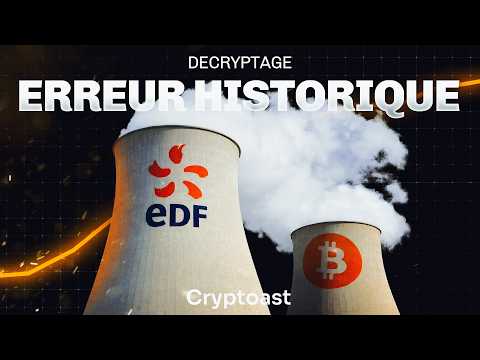
Comment EDF a perdu 5 milliards d’euros à cause de Bitcoin ?
AI Summary
Électricité de France (EDF), a major electricity producer in France and Europe, faces significant financial challenges, with a debt of 51 billion euros. This situation is exacerbated by the fact that electricity prices in France are tied to the European market, leading to a substantial increase in consumer bills, far exceeding production costs. Geopolitical tensions can directly impact French electricity bills, even when local production is abundant and cheap.
The transcript argues that EDF missed a crucial opportunity in 2007, and again in 2017, to leverage its excess electricity production for profit. The core problem identified is the inability to effectively store large quantities of electricity. While batteries exist, they are not a viable large-scale solution due to high installation and environmental costs. The fundamental challenge is that electricity must be consumed almost instantly upon production, and any surplus is typically lost.
France, with its significant nuclear power generation, experiences a structural surplus issue. Nuclear reactors operate continuously, producing electricity even when demand is low, such as at night. Historically, EDF has modulated nuclear reactor output to manage these surpluses. However, recent reports indicate that modulating reactors damages them, leading to increased maintenance costs and, consequently, higher electricity prices in the long run. The European Union alone generates over 700 TWh of surplus electricity annually, a figure significantly higher than France's total annual consumption. France produces about 525 TWh, consumes 442 TWh, and exports 75 TWh, resulting in an annual surplus of approximately 8 TWh.
The transcript proposes Bitcoin mining as a solution to monetize these electricity surpluses. Bitcoin mining involves using computers to perform complex calculations to validate transactions and earn Bitcoin rewards. A key characteristic of Bitcoin mining is its flexibility; miners can shut down their operations instantly without harming the hardware or the network. This allows mining farms to be strategically located near power plants, consuming surplus electricity when it's abundant and ceasing operations when there's a high demand for electricity from consumers.
In 2017, French miners, including Sébastien Gouspiou, approached EDF with a proposal to utilize their surpluses for Bitcoin mining. This proposal was rejected. According to estimates, if EDF had accepted this offer, it could have potentially recovered around 5 billion euros, a significant portion of its debt. The transcript attributes this refusal not to cost or technical feasibility – as mining infrastructure was already operational globally – but to an "ideological reflex" against Bitcoin.
Evidence supporting this ideological resistance is presented through a LinkedIn conversation involving an EDF Director of Innovation. When presented with the idea of using flexible consumers like Bitcoin miners for surplus renewable energy, the initial response was to seek something "more beneficial for the climate." However, a Bitcoin expert countered by citing studies on the positive impact of Bitcoin mining on electrical networks and its role in avoiding greenhouse gas emissions, citing Texas as an example where miners stabilize the grid during peak demand. Despite this, the discussion at EDF reportedly stalled. Furthermore, a potential sale of EDF's Exillon branch included an exclusivity clause that could have prohibited EDF from Bitcoin mining for two years, though this clause was eventually removed.
Beyond utilizing surpluses, the transcript suggests that increasing electricity demand through Bitcoin mining could also help avoid the need to modulate nuclear reactors, thus reducing maintenance costs. The concept of reusing the heat generated by mining computers for domestic heating is also highlighted. This dual function – generating Bitcoin and heat – transforms electricity twice. The Austrian company 21 Energy offers consumer products like radiators that are also Bitcoin miners, such as the OEN 2. This device, priced between €1770 and €2240, offers significant Bitcoin mining power and also functions as an efficient heater.
The cost analysis for a 1000W unit at 20 cents per kilowatt-hour suggests a monthly cost of around €144 to heat a 50-60 m² room. For smaller spaces, lower power settings are sufficient, leading to lower costs and Bitcoin earnings. The profitability is presented as variable, depending on electricity prices and the price of Bitcoin. Estimates suggest a payback period of 3-4 years for the initial investment at maximum power.
The discussion around Bitcoin mining for monetizing surplus electricity is gaining traction politically. A bill to launch a pilot project for mining was tabled by the National Rally party, though rejected. Former President François Hollande has also been seen interacting with Bitcoin proponents, indicating a growing political awareness of the issue.
The transcript contrasts France's ideological resistance with other countries. Texas has integrated Bitcoin miners into its grid to manage peak consumption. A small Himalayan country uses Bitcoin mining to monetize surplus water power that cannot be transported. Even Japan's historical energy operator, TPC, is experimenting with Bitcoin mining.
In conclusion, the transcript emphasizes that Bitcoin mining is not a panacea for EDF's debt but a tool for smarter electricity consumption in contexts of surplus, demand flexibility, and heat reuse. France's energy mix is well-suited for this, but the lack of willingness to engage without ideological bias has hindered innovation. The article encourages individuals to consider holding Bitcoin in self-custody and to explore personal Bitcoin mining solutions for energy transformation, recommending the 21 Energy website and a discount code.