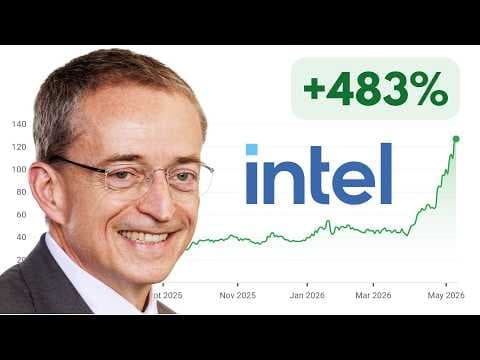
Intel is back. Thank the old CEO.
Audio Summary
AI Summary
Recent reports from the Wall Street Journal and Bloomberg indicate Apple has a preliminary agreement with Intel to manufacture some of Apple's self-designed chips, a significant development given Apple's status as a major chip client. This follows announcements that Elon Musk's companies, SpaceX and Tesla, would also use Intel's next-generation 14 process. Nvidia invested $5 billion into Intel, and the U.S. government acquired a 10% stake last year, becoming Intel's largest shareholder. These events mark a remarkable turnaround for Intel, whose stock price has surged by almost 500% in the last year.
This turnaround, in my opinion, validates the vision of former CEO Pat Gelsinger, who was arguably unfairly fired. A year ago, I described Gelsinger's leadership as navigating Intel through a "valley of death"—a period of immense and costly investment with high risk but potential for significant returns. Gelsinger's bold bet was to transform Intel into a world-class chip manufacturer, investing unprecedented sums. Historically, Intel performed both chip design and manufacturing in-house, unlike competitors like AMD and Nvidia who outsourced manufacturing to specialized fabs like TSMC. However, Intel's manufacturing capabilities had fallen behind TSMC's. Gelsinger, an engineering-focused CEO, chose the challenging path of catching up to TSMC, aiming to deliver five manufacturing generations in four years—an unprecedented feat.
This strategy involved an aggressive spending spree, pushing Intel deep into the "valley of death." Gelsinger utilized all available cash, ruthlessly divested non-core assets, sold and leased back fabs, laid off thousands, and secured government co-financing for manufacturing expansion. Despite these efforts, he was fired just as the company reached its lowest point, with investors and the board losing confidence.
His successor, Lip Bhutan, initially considered scaling back Gelsinger's ambitious manufacturing plans, which was understandable given the circumstances but would have been catastrophic for Intel's long-term manufacturing aspirations and American efforts to regain chip manufacturing dominance. However, former President Trump intervened, threatening Bhutan and ultimately forcing a deal where the U.S. government acquired a 10% stake in Intel and gained oversight to prevent fab sales. This effectively compelled Intel to adhere to Gelsinger's original plans.
Fortunately, this timing was perfect. Intel began exiting its "valley of death" as the industry experienced a massive tailwind from the AI boom. The 18A node, the final stage of Gelsinger's sprint, launched shortly after his departure and proved competitive, putting Intel back on track as a capable manufacturer. The next node, 14A, is also promising, with Elon Musk's companies adopting it. These successes, including products like Panther Lake and Clear Water Forest, are largely the result of Gelsinger's engineering efforts.
The AI boom has driven unprecedented spending on data centers by hyperscalers like Microsoft and Amazon, who are now dedicating nearly all free cash flow to this expansion. This surge in demand has benefited all chip companies. Intel's Clear Water Forest is a competitive data center chip, and the increasing need for general-purpose CPUs for agentic AI has given Intel a larger share of the pie. Furthermore, traditional fabs like TSMC and Samsung cannot keep up with demand, making Intel's manufacturing capacity highly attractive.
Gelsinger explicitly rebuilt Intel Foundry to attract third-party customers, and now, with 18A and 14A maturing, the stars are aligning. Lip Bhutan, a shrewd dealmaker, has leveraged his industry connections to secure clients. Crucially, he aligned Intel's interests with Trump's by selling the government a 10% stake. Trump, consistently advocating for U.S. manufacturing and deal-making, has become a powerful ally, explicitly stating his intent to help Intel secure customers. While Intel's fabs may still be slightly more expensive or less advanced than TSMC's or Samsung's for high-end chips, the gap has narrowed significantly. An advanced U.S. fab, owned by an American company, co-owned by the U.S. government, with available capacity, and aligned with the President, is a highly attractive option, especially since