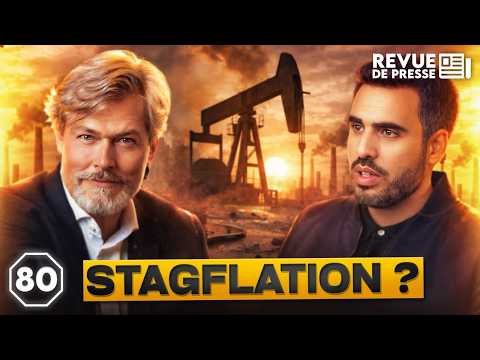
Quelles conséquences pour un barril à 150 dollars ?
AI Summary
This summary provides a comprehensive overview of the 80th "Octagon" discussion between Idriss Aberkane and Gunter Pauli, focusing on the global economic shift toward stagflation, geopolitical energy crises, and innovative paths for recovery based on the provided transcript.
### The Threat of Global Stagflation
The discussion opens with the emergence of stagflation—a destructive combination of economic stagnation and high inflation. Drawing from his experience living in Japan during its "lost generation" in the 1990s, Gunter Pauli warns that Europe is currently inflicting this condition upon itself. By cutting off affordable Russian energy, Europe has become dependent on expensive American shale gas, which Pauli describes as an ecological disaster that serves as a "gold mine" for the United States.
This shift has led to a total loss of competitiveness for European industries, particularly in the chemical and automotive sectors. Pauli criticizes the European Union’s "zig-zag" policy regarding electric and internal combustion engines, noting that by banning the latter, they ignored ecological vegetable-based fuels that could have saved the industry. He highlights that once investment stops for several years, a sector cannot easily recover.
### Lessons from Japan: Sony vs. Panasonic
Pauli uses the Japanese experience to illustrate how businesses survive stagflation. Sony managed to maintain its market value by pivoting to high-value-added services, specifically by acquiring Hollywood studios to control content. In contrast, companies like Panasonic and Matsushita attempted to survive by moving production to China to lower costs, a strategy that failed to solve the underlying problem.
In Europe, the military-industrial complex is currently seen by some as an economic hedge. However, Pauli argues that military production is fundamentally destructive and lacks a "multiplier effect." Unlike investments in high-value services that promote other sectors, spending on ammunition and tanks is a "one-shot" expense that does not contribute to long-term societal well-being.
### Demographics and the Real Estate Crisis
The conversation draws parallels between Italy and Japan regarding demographic decline. Italy is seeing a rise in "mamon"—adults in their 40s living with their parents. This is driven by a collapse in birth rates and a distorted real estate market. While property prices are crashing in rural areas, they remain prohibitively high in tourist-heavy city centers.
Pauli explains that Japan's unique real estate market was shaped by post-war inheritance taxes of 80%, forcing families to demolish and rebuild every 30 years to manage tax liabilities. In the West, the crisis is different: large investment firms like Black Rock and Blackstone are consolidating the rental market. Pauli points out that forty years ago, a worker needed roughly 850 hours of labor to pay annual rent; today, Gen Z requires 2,600 hours. This "neo-feudalism" forces the younger generation to stay home, further stagnating the economy.
### The Piedmont Model: A Path to Recovery
Despite the bleak outlook, Pauli offers the Italian region of Piedmont as a blueprint for success. Through the "Slow Food" movement and agritourism, the region has dramatically increased the value of its agricultural output. Instead of selling milk as a cheap commodity for 22 cents a liter, farmers provide high-quality local services, effectively earning 5 Euros per liter. This focus on "high-value-added" local activity has made agritourism the fastest-growing sector in the region, outperforming traditional industry and electronics. This model demonstrates that the only way to beat stagflation is to create unique, high-value experiences that cannot be commodified by global markets.
### Energy Geopolitics and the "Atlantic Rim"
The transcript highlights a 700% explosion in shipping costs for Liquefied Natural Gas (LNG) due to tensions in the Strait of Hormuz. Pauli argues that energy prices are manipulated rather than market-driven, benefiting the US and Israel while hurting Europe and Japan.
As a solution, Pauli proposes focusing on the "Atlantic Rim," specifically mentioning Cape Verde. He suggests that peaceful zones in the Atlantic have the potential to produce massive amounts of hydrogen using wave energy. While Europe has "mystified" hydrogen with talk but little action, Pauli argues that the current high energy prices make these innovative projects economically viable. This transition would allow countries to bypass unstable geopolitical routes in the Middle East.
### Religion, War, and Political Maneuvers
A significant portion of the discussion addresses the religious rhetoric surrounding potential conflict with Iran. Reports suggest that some US military commanders are framing the war in apocalyptic terms, referencing the "Armageddon." Similarly, Israeli leadership has invoked biblical references like "Amalek." Pauli expresses deep concern over this lack of nuance, fearing that after Iran, Turkey may be the next target. He suggests that the US and Israel might seek to replace leaders like Erdogan with more compliant figures.
Regarding US domestic policy, the Supreme Court’s decision to potentially refund $180 billion in Trump-era tariffs is viewed by Pauli as a test of executive power. He doubts the money will ever be paid, suggesting Trump will find a way to bypass the judicial requirement, further asserting his authority.
### Japan’s Digital Pivot
Finally, the Bank of Japan’s move toward "tokenizing" the yen is discussed. Pauli clarifies that this is not a top-down innovation but a response to Japanese youth who are already using blockchain-based systems. The state is simply trying to catch up and bring "mattress cash"—the massive amounts of physical currency held by Japanese citizens—into the digital economy. This move aims to internationalize a cultural shift that has already taken place among the younger generation.