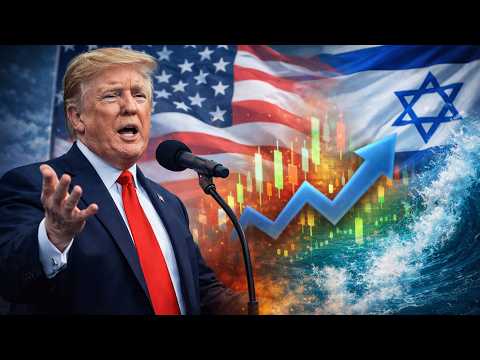
TRUMP ANNONCE LA FIN DU CONFLIT : Le soulagement des marchés ?
AI Summary
Welcome to this final debrief. Significant market movements are underway, with oil prices hovering around $100. While Donald Trump's announcement of a potential end to the conflict in Iran within 2-3 weeks has brought some market relief, causing American markets to rise by almost 3%, it's crucial to remain cautious. These developments are not yet finalized, and the situation can change rapidly.
Several key indicators and events demand attention. Oil prices remaining above $90 suggest continued pressure and potential inflation beyond just gasoline. Even if an agreement is reached and the Strait of Hormuz reopens, conditions for passage and insurance premiums for tankers remain uncertain. The market is currently over-anticipating both positive and negative outcomes.
Important economic data is expected in the coming days. Today, the ADP employment figures for the US will be released, serving as a prelude to Friday's NFP (Non-Farm Payroll) report. These job creation numbers are critical as they influence the Federal Reserve's interest rate decisions. The Fed was unable to adjust rates last time due to a lack of March data. The last ADP figures showed job destruction in February, leading to concerns about stagflation—rising prices alongside a weakening economy. A prolonged blockage of the Strait of Hormuz could significantly impact global growth by 3 percentage points.
Market closures will also affect liquidity and volatility. American markets will be closed on Friday for Good Friday, and French markets will be closed on Friday and Monday for Easter. Reduced liquidity typically leads to increased volatility, so caution is advised, especially given the amplified movements from recent announcements.
Beyond oil, interest rates are another critical indicator. The 4.40-4.50% range for interest rates is considered a "point of no return," where concerns truly begin to mount. The rising cost of borrowing, particularly in the US, becomes very strained as rates approach 4.5%. This explains the tension observed in risky assets, not immediately after oil prices surged, but once interest rates started to climb in anticipation. It is now almost certain that the Fed will not lower rates before the end of the year, possibly even before the end of 2027, depending on future inflation figures. This re-evaluates many market assumptions.
The US dollar has been rising steadily but not dramatically, unlike oil prices or US interest rates. This stability has influenced positions like the Euro/Dollar pair, where selling positions around 1.1467 have been profitable. However, with the Euro/Dollar moving above 1.1530, the inclination to sell has diminished, as technical indicators suggest a shift in pressure.
Regarding US markets, the SP500 is currently navigating the MM50 weekly zone. It's important not to panic if the market dips slightly below this level, as past instances have shown subsequent rebounds. Donald Trump is expected to speak about Iran tonight at 3 AM French time, which could trigger significant overnight movements in futures contracts and potentially confirm or deny the current global market rebound.
Looking at major US indices, the Nasdaq, Dow Jones, and Russell 2000 (small caps) are all reacting to their MM50 weekly levels and previous highs from 2021 and 2024. This highlights the importance of key technical levels. The SP500 futures, having moved above 6450, no longer present a selling opportunity for now. On the cash market, an extreme open with a gap up and subsequent buying indicates a strong upward impulse. It's crucial not to trade against this flow unless at least 50% of the impulse candle is retraced. Sustained integration above 24000 for the Nasdaq and 47000 for the Dow Jones would signal a confirmed low and potential for further upside.
In Europe, the DAX is also at a key zone. After an initial bullish excess, the index may return to the middle of its range, potentially leading to a period of consolidation similar to what was seen in May and June.
A positive re-evaluation of the market is underway, potentially driven by a slight easing of oil prices, interest rates, and the dollar. The dollar is playing less of a safe-haven role, suggesting that if the Strait of Hormuz reopens, the Fed might have more flexibility than previously thought.
The speaker emphasizes the importance of a disciplined, progressive approach to market exposure, focusing on key zones. Rather than reacting emotionally to daily fluctuations, it's essential to have a predefined plan. Emotional trading often leads to poor outcomes. For instance, the speaker highlights a recent small loss on an SP500 position, but explains it was part of a larger, successful strategy based on flow continuation and risk management. This contrasts with impulsive buying at perceived lows or selling at perceived highs, which often results in losses.
The speaker expresses a preference for buying gold over US indices at present. Gold, after hitting its MM50 zone between 3800-4000, showed a "spike" (a large wick indicating capitulation) followed by stabilization. Subsequent analysis of shorter timeframes revealed higher lows, indicating renewed buying pressure. This allowed for a disciplined entry, with a first target reached at 4700 and a second at 4815, where the MM20 daily is located. The recent rise in gold is attributed to a slight easing of the US dollar and a general calm in the market, though gold's role as a safe haven during panic is questioned, as investors may sell it for cash to cover other exposures.
In the crypto market, Bitcoin and Ethereum remain range-bound around $70,000 and 3000-4000 respectively. The speaker does not see a reason for panic and notes that even excluding Bitcoin, Ethereum, and stablecoins, the total altcoin market is stabilizing. No major decisions regarding short-term or long-term crypto exposure are advised at this time, as many altcoins continue to underperform against Bitcoin and Ethereum.
In summary, the current market environment is characterized by high volatility and uncertainty. It is crucial to manage exposure moderately and progressively, sticking to well-defined plans based on key technical levels. Avoid emotional reactions to market noise. The speaker provides an example of a successful long-term strategy in the defense sector, where maintaining a long-term bullish perspective despite short-term dips has yielded positive results. The market is not "illegible"; rather, it often requires a disciplined approach that may not align with impulsive, short-term reactions. The speaker concludes by reiterating the importance of adjusting one's strategy progressively rather than making radical, overnight decisions, especially with potential 3% swings in either direction within a single day.